


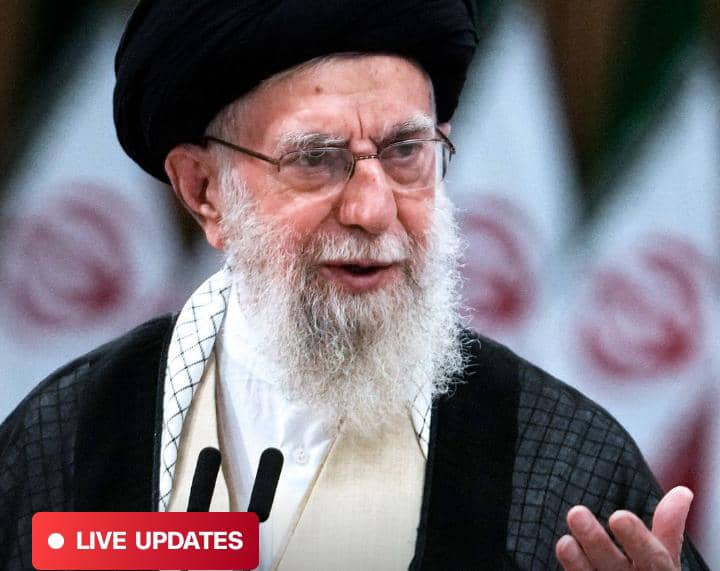
(DDM) – East has been thrown into chaos following the reported killing of Iran’s Supreme Leader, Ayatollah Ali Khamenei, in massive coordinated strikes carried out by the United States and Israel.
The unprecedented attack, confirmed by Iranian state media, marks one of the most consequential escalations in decades between Washington, Tel Aviv and Tehran.
United States President Donald Trump openly declared that the military operation would continue with heavy bombing throughout the week, signaling a dramatic shift from targeted strikes to what he described as a broader effort aimed at regime change in Iran.
Iranian authorities confirmed that Ayatollah Ali Khamenei was killed during the bombardment, ending the decades-long rule of the cleric who had been the country’s most powerful political and religious figure since 1989.

The strikes, described by US officials as a decisive campaign against Iranian military and political infrastructure, reportedly targeted command centers, missile facilities and strategic installations across major cities.
However, Iranian state media also reported that one of the strikes hit an elementary school, killing more than 100 girls, a claim that has intensified global outrage and calls for independent verification.
President Trump framed the offensive as necessary to dismantle what he called a destabilizing regime in Tehran, arguing that Iran’s leadership had long funded proxy militias and threatened American and Israeli interests across the region.
For years, tensions between Washington and Tehran had simmered over Iran’s nuclear ambitions, ballistic missile program and its support for armed groups in Lebanon, Iraq, Syria and Yemen.
The latest escalation, however, goes far beyond previous flashpoints, including the 2020 US drone strike that killed Iranian General Qassem Soleimani.
Analysts say the killing of Iran’s sitting supreme leader represents a historic turning point that could permanently reshape the balance of power in the Middle East.
In response, Iran launched what officials described as an “unprecedented wave” of retaliatory attacks across the region.
Missiles and drones were fired toward US military bases, Israeli territory and strategic energy infrastructure throughout the Middle East.
Air hubs were damaged, densely populated areas were shaken by explosions and oil shipments were disrupted, raising fears of a global energy crisis.
The Strait of Hormuz, a critical chokepoint for global oil supply, is now under heightened threat as shipping companies reassess security risks.
Inside Iran, scenes of both mourning and celebration were reported in Tehran.
While many citizens gathered in grief over Khamenei’s death, others were seen celebrating in the streets, reflecting deep internal divisions within the country.
Across the United States, reactions were equally polarized.
Some Americans praised the administration’s hardline stance, calling it a bold move against a long-standing adversary.
Others took to the streets in protest, warning that the attack could trigger a prolonged regional war with devastating human and economic costs.
International leaders have urged restraint, fearing that the cycle of attack and retaliation could spiral into a broader global conflict involving major powers.
The coming days are expected to be critical as Washington signals continued bombardment while Tehran vows sustained retaliation.
With leadership uncertainty now gripping Iran and military operations expanding, the world watches anxiously as a volatile standoff threatens to redraw the geopolitical map of the Middle East.




