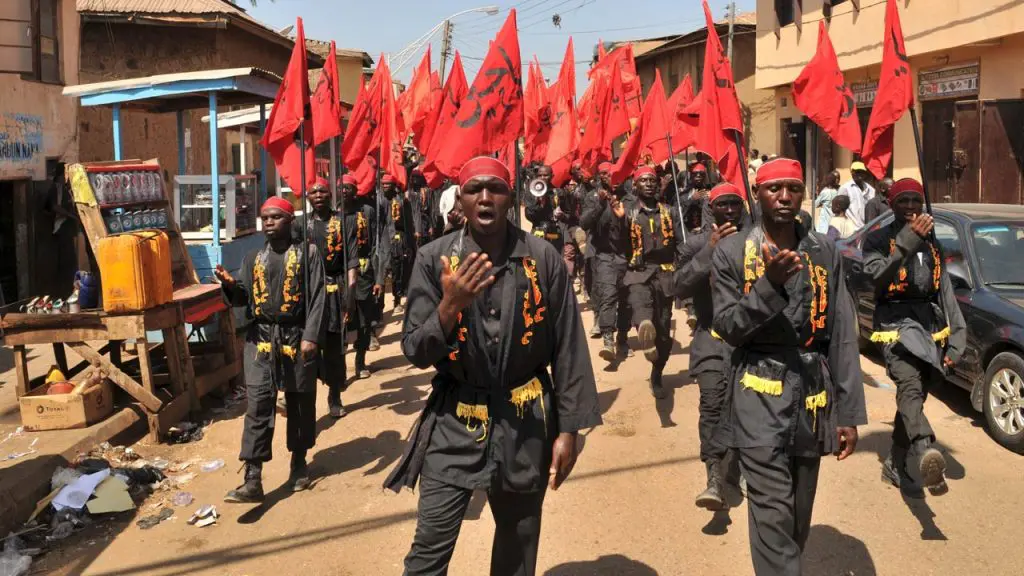
Thousands of members of the Islamic Movement in Nigeria (IMN) staged coordinated protests across several northern cities on Sunday, condemning the reported killing of Iran’s Supreme Leader, Ayatollah Ali Khamenei, in a joint United States–Israeli military strike.
The demonstrations took place in Muslim-majority areas, with large crowds marching through city streets carrying Iranian flags and portraits of Khamenei, Iran’s revolutionary founder Ayatollah Ruhollah Khomeini, and IMN leader Ibrahim Zakzaky.
Protesters voiced strong opposition to the attack, describing it as an unjustified act of aggression and accusing Western powers of destabilising the Middle East.
Marches Across Northern Cities
In Kano northern Nigeria’s largest city and a major centre of IMN activity demonstrators walked nearly five kilometres from a mosque in the Fagge district to the movement’s headquarters in Goron Dutse.
Participants chanted religious slogans and waved Palestinian flags while condemning both the United States and Israel for what they described as “unprovoked” military action that reportedly killed Khamenei along with members of his inner circle and family.

Crowds repeatedly shouted “Allahu Akbar” (“God is Great”) and called for an end to Western involvement in Middle Eastern affairs.
“The attacks show the insincerity and unreliability of the United States and Israel, which launched the strikes in the middle of negotiations,” protest leader Umar Yakubu told demonstrators during the march.
Calls for Peaceful Demonstrations
Despite the strong rhetoric, organisers urged protesters to remain peaceful and avoid confrontation with security agencies.
Yakubu called on supporters to follow the guidance of IMN leader Ibrahim Zakzaky, who currently resides in Abuja, stressing that demonstrations should remain orderly.
Security presence was heightened in several cities as authorities monitored the protests, though no immediate reports of violence were recorded.
Background of the Islamic Movement in Nigeria
The IMN, a Shiite Islamic organisation inspired by Iran’s 1979 Islamic Revolution, has long advocated for an Iranian-style Islamic system in Nigeria.
The group has experienced repeated tensions with Nigerian authorities over the years.
One of the most significant confrontations occurred in December 2015, when Nigerian soldiers raided Zakzaky’s residence in Zaria after IMN members blocked a military convoy during a religious procession.
Official figures indicated that approximately 350 members of the movement were killed in the operation, an incident that continues to shape relations between the group and the government.
The protests in Nigeria reflect the global reaction to escalating tensions in the Middle East following the reported killing of Khamenei, an event that has triggered demonstrations and political reactions in several countries.