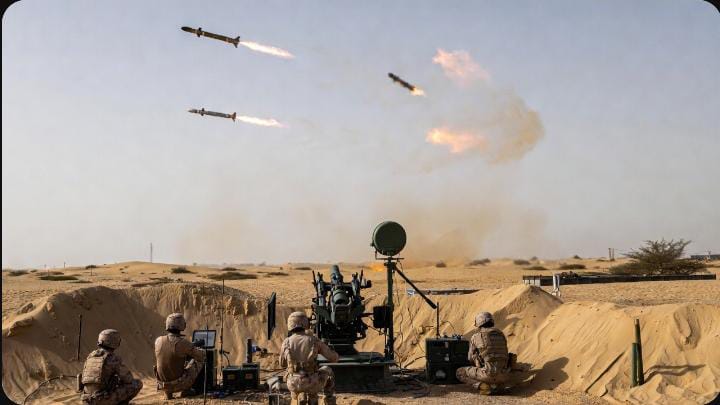
(DDM) – Saudi Arabia’s Ministry of Defense announced Wednesday that it successfully intercepted and destroyed two cruise missiles near the central city of Al Kharj, underscoring rising regional tensions amid the widening Middle East conflict.
The ministry confirmed the interception in an official statement attributed to its spokesperson but did not immediately disclose whether the incident caused casualties or structural damage.
Diaspora Digital Media (DDM) gathered that the missiles were neutralized before reaching their intended targets, although authorities have yet to clarify the origin of the projectiles or identify those responsible for the launch.
Al Kharj lies approximately 55 miles, or 85 kilometers, southeast of the capital, Riyadh, placing the incident within proximity of key strategic and military infrastructure.
The area hosts the Prince Sultan Air Base, a major Saudi military installation that has historically accommodated United States military aircraft during joint operations and regional security missions.

Security analysts say the location’s strategic importance heightens concerns about the broader implications of the attempted strike.
Prince Sultan Air Base has served as a critical hub for air defense coordination and coalition activities, particularly during periods of heightened instability in the Gulf region.
The interception signals the continued activation of Saudi Arabia’s air defense systems, which the kingdom has strengthened over recent years following repeated missile and drone attacks attributed to regional adversaries.
Saudi Arabia has previously faced missile and drone strikes targeting oil facilities, airports, and military bases, particularly during escalations involving Yemen’s Houthi movement and broader regional rivalries.
The latest incident comes at a time when tensions across the Middle East remain elevated, with multiple actors engaged in direct and proxy confrontations.
Cruise missiles pose a unique threat because of their low-altitude flight paths and precision-guided capabilities, making rapid detection and interception critical for minimizing damage.
Military experts note that the successful interception demonstrates the operational readiness of Saudi air defense systems, which often integrate advanced radar detection and missile shield technologies.
However, the absence of immediate information about casualties or infrastructure damage leaves unanswered questions about the scale and intent of the attempted strike.
Regional observers warn that attacks near major airbases could signal an expansion of conflict zones or attempts to test defensive responses.
The Saudi government has not yet indicated whether it will pursue retaliatory measures or lodge formal complaints through diplomatic channels.
As tensions continue to ripple across the Gulf, the interception near Al Kharj highlights the fragile security environment surrounding critical military and energy infrastructure in Saudi Arabia.
Authorities are expected to provide further updates as investigations into the attempted strike continue.