


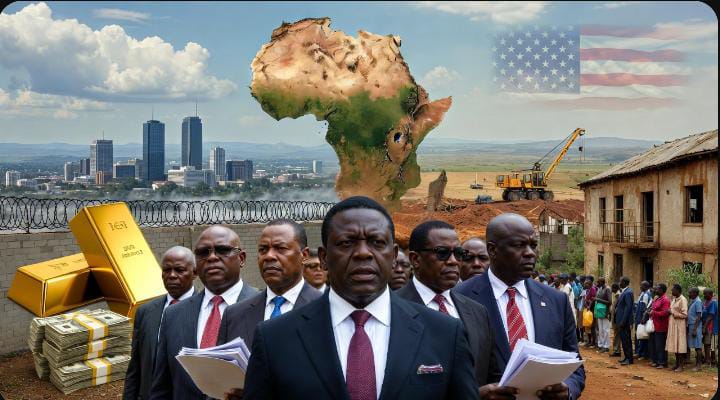
(DDM) – The United States government has announced fresh sanctions targeting key political and business figures in Zimbabwe, intensifying pressure on the southern African nation amid renewed concerns over governance, corruption, and democratic backsliding.
The latest measures, according to U.S. officials, are aimed at individuals and entities accused of undermining democratic processes, facilitating corruption, and enabling human rights violations.
Washington insists the sanctions are not directed at ordinary Zimbabweans but rather at specific actors believed to be responsible for weakening institutions and limiting political freedoms.
The decision has once again placed Zimbabwe under international spotlight, reviving a decades-long standoff between Harare and Western governments.
Zimbabwe has faced sanctions from the United States and the European Union since the early 2000s.
The restrictions were first introduced during the era of late former President Robert Mugabe, following disputed elections, land reform controversies, and allegations of state-sponsored violence against opposition members.
At the time, Western governments accused Mugabe’s administration of suppressing dissent and manipulating electoral processes.
Zimbabwe’s government has consistently rejected those claims, arguing that sanctions were imposed as punishment for its land redistribution program, which seized white-owned commercial farms and redistributed them to Black Zimbabweans.
After Mugabe was removed from power in 2017 through a military intervention, his successor, Emmerson Mnangagwa, pledged to re-engage the international community and reform the economy.
Mnangagwa promised political reforms, economic stabilization, and a renewed commitment to democratic principles.
However, critics argue that progress has been slow and, in some areas, reversed.
International observers raised concerns following Zimbabwe’s recent elections, citing reports of voter intimidation, arrests of opposition figures, and restrictions on civil society groups.
The U.S. government says the newly announced sanctions are part of a recalibrated strategy designed to hold individuals accountable rather than isolate the country as a whole.
Under the measures, targeted individuals could face asset freezes, travel bans, and restrictions on financial transactions involving U.S. entities.
American officials argue that corruption remains a central challenge in Zimbabwe’s struggling economy.
Zimbabwe continues to grapple with high inflation, currency instability, and unemployment, despite vast mineral wealth that includes gold, platinum, and lithium reserves.
Economic analysts say political uncertainty has discouraged foreign investment and worsened financial hardships for ordinary citizens.
The Zimbabwean government has frequently blamed sanctions for its economic difficulties.
Officials in Harare argue that sanctions limit access to international credit markets and complicate trade relationships.
The United States counters that its sanctions are narrowly tailored and do not restrict humanitarian aid, trade in food, or medical supplies.
Human rights organizations say accountability is essential but warn that sanctions alone cannot resolve Zimbabwe’s systemic political issues.
They argue that meaningful reforms must come from within the country’s leadership structures.
Regional bodies such as the Southern African Development Community have previously called for the lifting of sanctions, describing them as counterproductive.
Meanwhile, opposition groups inside Zimbabwe say international pressure remains necessary to safeguard democratic institutions.
The renewed sanctions signal that relations between Harare and Washington remain fragile.
Diplomatic ties between the two countries have fluctuated for more than two decades, marked by periods of cautious engagement and sharp criticism.
For many Zimbabweans, the debate over sanctions has become deeply political.
Supporters of the ruling party view them as foreign interference.
Opposition supporters often see them as leverage against entrenched power structures.
As Zimbabwe seeks economic recovery and international re-engagement, the path forward remains uncertain.
What is clear is that the sanctions issue continues to shape Zimbabwe’s political narrative and its relationship with the West.
The coming months will test whether renewed pressure leads to reform, further isolation, or another cycle of diplomatic stalemate.




