



More than two decades after one of the most debated moments in African football history, fresh reports suggest that the Nigeria Football Federation is considering a bold and unprecedented legal step to challenge the outcome of the 2000 Africa Cup of Nations final, a match that still lingers in the memory of many Nigerian football fans as a painful and controversial defeat. The development comes at a time when recent decisions by the Confederation of African Football have reignited discussions about fairness, consistency, and accountability in continental football governance.
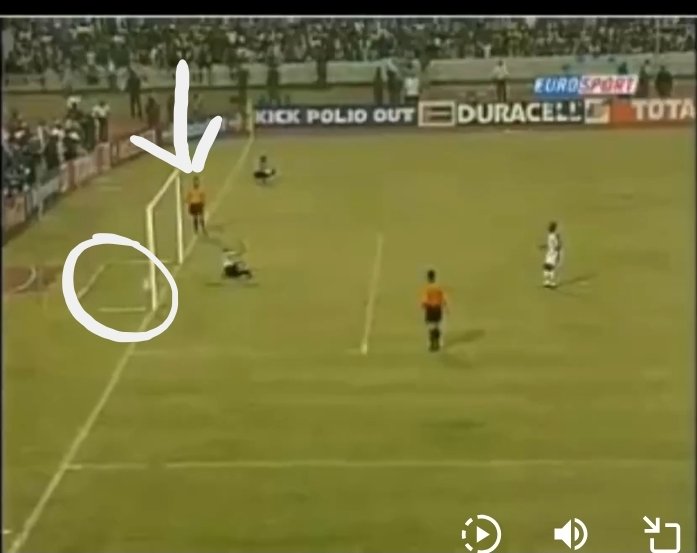
The 2000 AFCON final, co-hosted by Nigeria and Ghana, saw the Super Eagles face arch-rivals Cameroon in a tense and dramatic encounter that ended in a penalty shootout after a 2-2 draw in regulation time. However, the defining moment of that shootout remains one of the most disputed officiating calls in African football history. Nigerian forward Victor Ikpeba appeared to have successfully converted his penalty, only for the referee to rule that the ball had not crossed the line. The decision stood despite visible protests from Nigerian players and fans, ultimately contributing to Cameroon’s victory and the awarding of the trophy.
Watch the Video of the penalty kick below:
At the time, the decision sparked outrage across Nigeria, with many arguing that the call was not only incorrect but also decisive in determining the outcome of the final. Despite the controversy, no formal review or reversal of the result was undertaken, and the matter gradually faded into history, albeit with lingering resentment among supporters. Now, more than 25 years later, the issue appears to be resurfacing in a new and unexpected context.

DDM News gathered that the renewed interest in the 2000 final is being driven in part by recent developments involving CAF’s handling of another major tournament controversy. Reports indicate that CAF recently took the extraordinary step of overturning a result involving Senegal and Morocco, a decision that has sparked widespread debate across the footballing world. While details of that case continue to be scrutinised, the precedent it sets has opened the door for calls to revisit past decisions that may have been influenced by officiating errors or procedural irregularities.
For many observers, the comparison is unavoidable. If CAF is willing to reconsider and even reverse outcomes in more recent competitions, questions naturally arise as to why similar scrutiny cannot be applied to older cases, particularly one as high-profile as the 2000 AFCON final. Within this context, the reported move by the NFF is being viewed not just as an attempt to seek redress for a historical grievance, but also as a broader challenge to the consistency and transparency of CAF’s decision-making processes.
DDM News understands that legal experts are divided on the feasibility of such a move. On one hand, the significant passage of time presents obvious challenges, including issues related to jurisdiction, evidence, and the principle of finality in sporting results. On the other hand, the evolving landscape of sports governance, coupled with advances in technology and growing emphasis on fairness, has led some to argue that no injustice should be considered beyond review if credible grounds exist.
Beyond the legal complexities, the issue carries deep emotional and symbolic weight for Nigerian football. The 2000 final was more than just a match; it was a moment of national significance, played on home soil and watched by millions. The perceived injustice of that night has remained a point of reference in discussions about officiating standards and the treatment of African teams within continental competitions. Revisiting the case, therefore, is not merely about altering a result, but about addressing a longstanding sense of grievance and restoring confidence in the integrity of the sport.
At the same time, the potential implications of such a move extend far beyond Nigeria. If CAF were to entertain or respond to a petition of this nature, it could open a Pandora’s box of historical disputes, with other nations potentially seeking to challenge past decisions. This raises important questions about where to draw the line between correcting injustices and preserving the historical record of sporting competitions.
CAF, for its part, has yet to issue any official response to the reports, leaving room for speculation about how it might react if a formal petition is submitted. The organisation is already under pressure to demonstrate consistency in its handling of disputes, particularly in light of recent controversies. Any decision it makes in relation to the 2000 final could have significant implications for its credibility and authority moving forward.
As the story continues to unfold, it serves as a reminder of the enduring impact of controversial decisions in sports and the challenges of balancing justice with practicality. Whether or not the NFF ultimately proceeds with legal action, the mere possibility has already reignited a conversation that many believed had been settled long ago.
For Nigerian fans, the hope is that the issue will at least prompt a broader reflection on fairness and accountability in African football. For CAF, it represents yet another test of its ability to navigate complex and sensitive issues in a way that upholds the integrity of the game. And for the wider football community, it underscores the reality that, in sport as in life, the past is never entirely behind us, especially when questions of justice remain unresolved.




