




Tensions across the Middle East have surged to a dangerous new high following an explosive exchange of threats between the United States and Iran, raising fears of a catastrophic escalation that could cripple the Gulf region’s energy and water lifelines. In a dramatic turn of events, Donald J. Trump issued a stark ultimatum to Tehran, demanding that Iran fully reopen the strategically vital Strait of Hormuz within 48 hours or face devastating military consequences targeting its power infrastructure. The warning, delivered in a strongly worded public statement, has since triggered a chilling response from Iranian authorities, who have now threatened to strike critical infrastructure belonging to the United States and its regional allies, including facilities essential for survival in the Gulf—desalination plants.
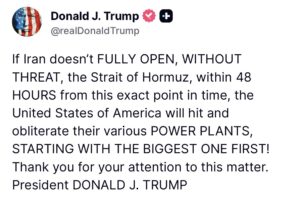
According to emerging reports monitored by DDM News, Iran’s military command has made it clear that any attack on its energy facilities would be met with a sweeping retaliation that goes beyond conventional targets. The warning specifically highlighted energy installations, IT systems, and most alarmingly, desalination plants—facilities that provide the majority of drinking water across Gulf nations. This development has sent shockwaves through the region, as analysts warn that targeting desalination infrastructure could trigger an unprecedented humanitarian crisis in countries heavily dependent on processed seawater for daily survival.
DDM News gathered that the significance of desalination in the Gulf cannot be overstated. Nations such as Saudi Arabia, the United Arab Emirates, and others rely almost entirely on these plants for potable water due to their arid climates and limited natural freshwater sources. One widely cited analysis indicates that a successful strike on major desalination hubs, such as the massive facility in Jubail, could render water supplies unavailable to millions within days. In Saudi Arabia alone, such a disruption could force the evacuation of major urban centers, including Riyadh, home to over eight million residents, within a week. The implications of this are staggering, transforming what would typically be a military confrontation into a full-scale humanitarian disaster.
The unfolding crisis centers heavily on the Strait of Hormuz, a narrow but critically important waterway through which a significant portion of the world’s oil supply is transported. Any disruption to this route has immediate global consequences, including spikes in oil prices, supply chain disruptions, and economic instability far beyond the Middle East. Iran has historically used threats to close or restrict passage through the strait as a geopolitical lever, particularly during periods of heightened tensions with Western powers.

The ultimatum from Donald J. Trump marks one of the most aggressive postures in recent times, with the explicit mention of targeting Iranian power plants signaling a readiness for direct confrontation. Analysts suggest that such strikes would not only cripple Iran’s domestic infrastructure but also risk provoking a broader regional war involving multiple actors. In response, Iran’s decision to place desalination facilities on its list of potential targets represents a calculated escalation designed to exploit the vulnerabilities of Gulf states and their reliance on imported security guarantees.
DDM News understands that the inclusion of IT infrastructure in Iran’s warning further complicates the scenario, as cyber warfare could accompany physical attacks, amplifying disruption across financial systems, communications networks, and essential services. This multi-dimensional threat underscores the evolving nature of modern conflict, where battles are no longer confined to traditional battlefields but extend into critical civilian infrastructure that underpins everyday life.
The international community is now watching closely as diplomatic channels scramble to prevent a descent into open conflict. European and Asian stakeholders, heavily reliant on energy supplies passing through the Strait of Hormuz, are particularly alarmed by the potential fallout. Any sustained disruption could trigger a global energy crisis, with ripple effects on inflation, transportation, and industrial production worldwide.
Within the Gulf region itself, governments are reportedly reviewing emergency preparedness plans, including contingency measures for water supply, energy distribution, and civilian protection. Security around critical infrastructure has been heightened, with military and intelligence agencies placed on high alert. However, experts caution that defending sprawling desalination networks and energy facilities from coordinated attacks may prove extremely challenging, especially in a scenario involving both missile strikes and cyber operations.
DDM News notes that this latest escalation comes at a time when the Middle East is already grappling with complex geopolitical tensions, making the situation even more volatile. The possibility of miscalculation or rapid escalation remains high, particularly given the tight timeline outlined in the U.S. ultimatum. Should the 48-hour window expire without a diplomatic breakthrough, the region could find itself on the brink of a conflict with far-reaching and devastating consequences.
As the clock ticks, the stakes could not be higher. The battle lines being drawn are no longer just about territorial control or political influence—they now touch on the fundamental resources that sustain life itself. Water, energy, and infrastructure have become central to this unfolding crisis, raising the specter of a conflict that could reshape the Middle East and disrupt global stability on an unprecedented scale. For now, the world watches anxiously, hoping that diplomacy can prevail before threats turn into irreversible action.

