
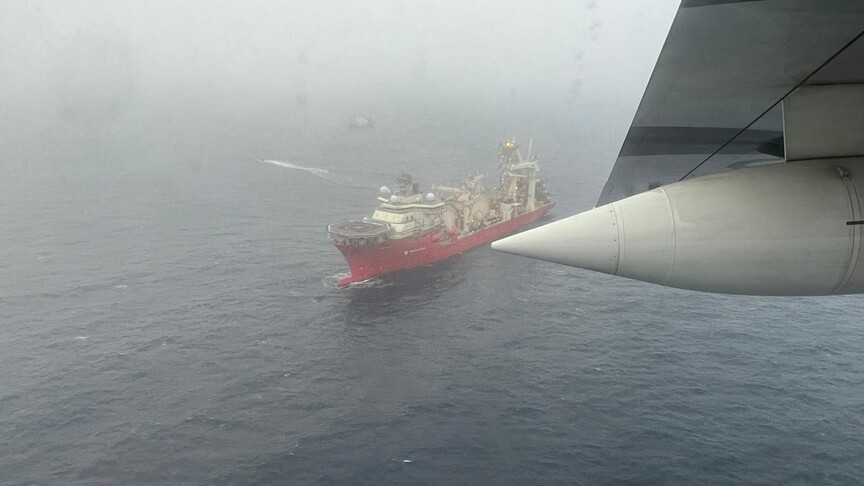
Tensions in the Middle East escalated sharply on Sunday after reports emerged that Iranian forces launched drone strikes against multiple American vessels in what Tehran described as retaliation for the seizure of one of its cargo ships by United States forces in the Gulf of Oman. The dramatic confrontation has raised fresh concerns over the fragile ceasefire arrangement in the region and the possibility of a wider military escalation involving both nations.
According to Iranian local media, the incident began when US naval forces intercepted and boarded an Iranian-flagged container ship identified as TOUSKA, allegedly after the vessel attempted to move through what American authorities described as a restricted naval zone. The United States claimed the ship had attempted to breach a naval blockade being enforced in the Gulf of Oman, prompting immediate military action by the USS Spruance under the supervision of the United States Central Command, also known as CENTCOM.
President Donald Trump was the first to publicly announce the interception on Sunday, describing the operation as a necessary security action aimed at maintaining control of strategic waters in the Gulf region. Shortly afterward, CENTCOM released its own confirmation, stating that the USS Spruance had intercepted the vessel after it allegedly failed to comply with naval directives and posed a threat to ongoing maritime operations in the area.
However, Iran strongly rejected the US account, insisting that the seizure of the TOUSKA was an act of aggression and a clear violation of an existing two-week ceasefire arrangement brokered by Pakistan. That ceasefire, which was announced on April 7, had largely held and was seen by regional observers as a rare opportunity for de-escalation between rival powers operating in the Gulf.

Iranian officials said the vessel was carrying legitimate commercial cargo and had every right to pass through international waters. According to the semi-official Tasnim News Agency, American forces not only intercepted the ship but also opened fire on it, disabled its navigation systems, and forcibly boarded the vessel. Iranian authorities described the action as a deliberate provocation and immediately warned that retaliation would follow.
Within hours of the seizure, reports began to emerge that Iranian drones had been launched toward multiple American vessels operating in the Gulf of Oman. Tasnim reported that the strikes were carried out as a direct response to what Tehran viewed as an unlawful military action against its ship. The agency did not specify whether the targeted American vessels were military ships or commercial maritime assets, but the attack marked a significant escalation in an already tense standoff.
Another Iranian outlet, Fars News Agency, also semi-official and often used to communicate positions close to the country’s military establishment, reported that the Khatam al-Anbiya Central Headquarters had confirmed the retaliation. According to the report, the military command viewed the US action as a breach of trust under the ceasefire arrangement and believed immediate action was necessary to defend Iranian sovereignty and deter future aggression.
Iranian military spokesman Ebrahim Zolfaghari further intensified the accusations by stating that US forces had opened fire on the vessel before boarding it. He insisted that the Iranian ship was not engaged in any hostile action and was on a legitimate route after departing from Port Klang in Malaysia on April 12. Ship tracking data reportedly supports the timeline of the vessel’s journey, placing it in the Gulf of Oman before the confrontation occurred.
The Gulf of Oman remains one of the world’s most strategically sensitive waterways, linking the Arabian Sea to the Strait of Hormuz, through which a significant portion of global oil shipments passes. Any military confrontation in the region often sends shockwaves through global energy markets and diplomatic circles, especially when it involves Iran and the United States.
International observers are now watching closely to see whether this latest confrontation will unravel the ceasefire and trigger a broader military response. Analysts warn that the use of drones against American vessels could provoke a major counterstrike from Washington, particularly if any military casualties or serious damage are confirmed.
While Washington has so far focused on defending the seizure of the TOUSKA as a legitimate enforcement action, Tehran views the move as a violation of both maritime law and diplomatic commitments made under the Pakistan-mediated truce. This conflicting interpretation has placed the ceasefire under severe strain and could undermine ongoing efforts by regional actors to prevent direct conflict.
Security experts say the timing of the confrontation is particularly sensitive, given the already volatile regional climate involving naval patrols, proxy conflicts, and competing military alliances. The involvement of Pakistan as a mediator in the ceasefire had initially provided some diplomatic breathing space, but the seizure of the cargo vessel appears to have reopened deep mistrust between the parties.
The possibility that both military and commercial ships may now become targets has also raised alarm among international shipping operators. Maritime insurers and shipping companies are expected to review security measures for vessels transiting through the Gulf of Oman and nearby waters, where even isolated incidents can trigger widespread disruptions in trade routes and insurance costs.
DDM News gathered that diplomatic channels are now being quietly activated by several countries seeking to prevent the situation from spiraling further. Regional governments, particularly those dependent on uninterrupted maritime trade, are concerned that a prolonged naval confrontation could affect oil exports, commercial shipping, and broader economic stability.
At the same time, the incident is likely to fuel political debate in both Tehran and Washington, where hardline voices may push for stronger retaliatory measures. For Iran, the public seizure of one of its vessels represents a direct challenge to national sovereignty. For the United States, any attack on its naval presence in the Gulf may be treated as an unacceptable threat requiring firm response.
As the world waits for clearer details on the scale of the drone strikes and the status of the seized vessel, one thing remains certain: the fragile calm in the Gulf has once again been shattered. DDM News continues to monitor the unfolding developments as fears grow that what began as a ship interception may rapidly evolve into a much larger geopolitical confrontation with global consequences.