



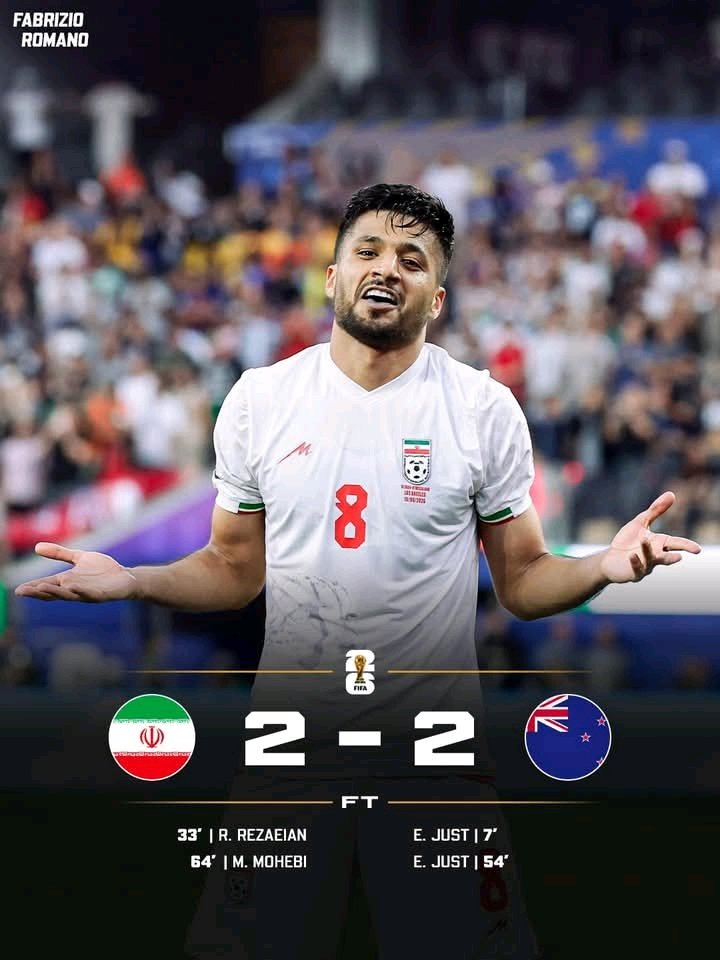
Iran opened their 2026 FIFA World Cup campaign with a hard-fought 2–2 draw against New Zealand in a pulsating Group G encounter that delivered drama, momentum shifts, and moments of clinical finishing from both sides. Played in front of an energetic crowd, the match showcased Iran’s resilience as they twice came from behind to salvage a valuable point in their tournament opener.
New Zealand entered the contest with high energy and an aggressive pressing style, immediately testing Iran’s defensive structure. Their intent was clear from the outset as they looked to disrupt Iran’s rhythm in midfield and force turnovers in dangerous areas. The early pressure paid off in the 18th minute when forward Elijah Just capitalized on sustained attacking play, finishing calmly from close range after a well constructed move inside the penalty area to give New Zealand a 1–0 lead.
Iran, however, refused to be rattled by the early setback. Gradually growing into the match, they began to assert control through patient buildup play and increased possession in midfield. The combination of Sardar Azmoun and Mehdi Taremi began to trouble the New Zealand defensive line, creating pockets of space and forcing the opposition goalkeeper into action.

Their persistence was rewarded in the 38th minute when Iran found their equalizer. Following a dangerous set piece that caused chaos inside the box, the ball fell kindly to Ramin Rezaeian, who reacted quickest to slot home from close range. The goal, coming in the 38th minute, restored parity at 1–1 and shifted momentum firmly in Iran’s favor heading into halftime.
The second half resumed with renewed intensity from both sides, but it was New Zealand who struck again to regain control of the match. In the 54th minute, Elijah Just once again proved decisive, completing his brace with a composed finish after breaking into space behind the Iranian defense. His second goal restored New Zealand’s lead at 2–1 and placed Iran under significant pressure to respond for a second time.
Iran responded with urgency and tactical adjustments, pushing higher up the pitch and increasing the tempo of their passing. The introduction of fresh attacking options added more width and creativity, forcing New Zealand to retreat deeper into their defensive shape. Wave after wave of Iranian attacks began to build, with several attempts narrowly missing the target or being denied by disciplined defending.
The breakthrough came in the 72nd minute when Iran finally found their second equalizer. After sustained pressure inside the New Zealand penalty area, a loose ball broke kindly for Mohammad Mohebbi, who reacted instinctively to fire home from close range. The 2–2 goal sparked celebrations on the Iranian bench and set up a tense final phase of the match.
As the game moved into the final 15 minutes, both teams pushed aggressively for a winner. New Zealand threatened on the counterattack, using pace in wide areas to stretch Iran’s defense, while Iran continued to dominate possession and search for openings through intricate passing sequences. Despite several half chances on both ends, neither side was able to find the decisive breakthrough.
Iran’s midfield control in the closing stages helped them stabilize the game, but New Zealand’s defensive discipline ensured that the scoreline remained unchanged. Goalkeepers on both sides were called into action late on, making crucial saves to preserve the draw as fatigue began to set in.
The final whistle confirmed a 2–2 result that reflected the balance of the contest. New Zealand will feel disappointed not to have held onto their lead twice, especially after the impressive attacking performances of Elijah Just, who scored in the 18th and 54th minutes. However, defensive lapses at key moments ultimately cost them maximum points.
For Iran, the result will be viewed as a demonstration of character and determination. Twice coming from behind in a World Cup opener highlights their mental strength and ability to respond under pressure. Goals from Ramin Rezaeian in the 38th minute and Mohammad Mohebbi in the 72nd minute ensured that Iran left the pitch with a crucial point despite a challenging match.
Head coach Amir Ghalenoei will take encouragement from his team’s fighting spirit, but will also likely demand improvements in defensive concentration, particularly in transitions where New Zealand found success. Iran’s attacking structure showed promise, but finishing efficiency and game management remain key areas for refinement as the tournament progresses.
New Zealand, meanwhile, can take positives from their attacking sharpness and ability to exploit defensive gaps, but they will need greater control in midfield and stronger game management if they are to progress from a highly competitive Group G.
With both teams earning a point from their opening fixture, Group G remains wide open. Every match from this point forward carries increased importance as teams battle for qualification into the knockout stages.
Iran now shift focus to their upcoming fixtures, where consistency and defensive discipline will be crucial. New Zealand, on the other hand, must regroup quickly and turn promising performances into victories if they are to keep their World Cup hopes alive.
The match ultimately delivered everything expected from a World Cup encounter, intensity, drama, and resilience, setting the tone for what promises to be a tightly contested group stage.




