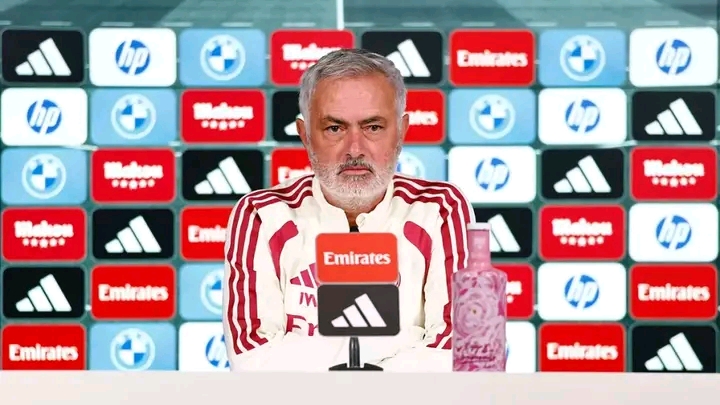
José Mourinho has renewed the debate over the impact of international breaks on elite football, arguing that the demands of international duty are making life increasingly difficult for Europe’s biggest clubs.
The Portuguese tactician made the observation after Real Madrid battled to a 2-1 victory over Celta Vigo at the Santiago Bernabéu on Saturday, November 21, admitting that his side struggled to find their usual rhythm because several players returned from international assignments with little time to recover.
Although Madrid eventually secured all three points, Mourinho suggested that the difficulties experienced by his team were not unusual, pointing to the disappointing results recorded by other European heavyweights during the weekend.
“It’s never easy after the break. Look at the other teams that had many players with the national teams… you will notice that Arsenal didn’t win, City didn’t win, Chelsea didn’t win. Bayern didn’t win,” he said.
His comments came after a weekend in which several major clubs failed to deliver the results expected of them.
Arsenal were held to a 2-2 draw by Newcastle United, while Manchester City surrendered points in a 1-1 draw against Fulham at the Etihad Stadium. Chelsea endured an even more damaging afternoon, suffering a 4-1 defeat to Leeds United at Stamford Bridge.
Bayern Munich also failed to win their corresponding Bundesliga fixture, drawing 1-1 against Cologne.
For Mourinho, these results illustrated the difficulties managers face when attempting to restore their teams to full competitive intensity immediately after an international window.
The Madrid manager explained that his players returned at different times, with some arriving on Tuesday, others on Wednesday and some as late as Thursday. The situation was further complicated by long-distance journeys, disrupted sleeping patterns and limited opportunities to train together.
Some players had reportedly spent as long as 12 hours travelling before returning to the club’s training base, leaving them with little time to prepare for the Celta Vigo encounter.
Mourinho also highlighted the advantage enjoyed by Celta, who had fewer players involved in international football and therefore had more time to work together as a team before travelling to the Spanish capital.
That difference, he suggested, contributed to the complicated nature of the contest.
Real Madrid were forced to dig deep before eventually finding a way to secure victory, with Mourinho acknowledging that his players were physically drained during the closing stages.
He praised their determination, particularly after the team had to manage the final moments with an unbalanced midfield that included Arda Güler and Jude Bellingham operating in unfamiliar roles.
For the Portuguese manager, the three points were therefore more important than the quality of the performance.
His concerns also reflect a wider issue in modern football, where the increasingly crowded calendar has placed additional pressure on players and coaching staff.
International breaks often require footballers to travel across continents, sometimes covering thousands of kilometres within a few days. Players can return from national assignments carrying fatigue, minor injuries or disrupted recovery routines, while their clubs are expected to prepare for important domestic and European fixtures almost immediately.
The situation becomes particularly challenging for clubs with large numbers of international players, as managers may have only one or two collective training sessions before matchday.
There is also the risk of injuries, with players exposed to demanding schedules at both club and international levels. Clubs invest heavily in their squads and medical departments, but they have limited control over how players are used during international competitions.
Mourinho’s remarks therefore raise an important question about whether the current football calendar gives elite players enough time to recover and perform at their best.
The issue is particularly relevant as clubs compete across domestic leagues, cup competitions and European tournaments, with the Champions League schedule leaving little room for recovery when fixtures resume.
Real Madrid themselves face another demanding assignment against PSV Eindhoven in the Champions League on November 24, giving Mourinho limited time to prepare his players for another important contest.
While the Madrid manager was relieved to secure victory against Celta Vigo, his comments suggest that the challenge extends beyond one difficult weekend.
For Europe’s leading clubs, international football remains an important part of the sport, but the transition back to club competition is becoming increasingly complicated.
And as the demands on elite players continue to grow, managers such as Mourinho are likely to keep questioning whether the football calendar is placing too much pressure on the very players expected to deliver the biggest performances.