



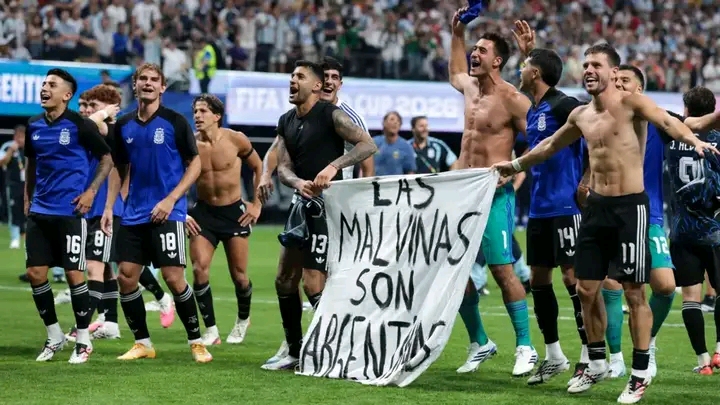
Argentina’s celebrations after securing a dramatic place in the 2026 FIFA World Cup final have been overshadowed by a growing controversy that could result in disciplinary action from world football’s governing body.
The South American giants are reportedly facing a FIFA investigation after members of the squad displayed a banner referring to the Falkland Islands, known in Argentina as Las Malvinas, during their post match celebrations following their thrilling semi final victory over England.
The incident has attracted global attention, shifting the spotlight from Argentina’s impressive football performance to a political issue that has long divided Argentina and the United Kingdom. FIFA is now expected to examine whether the players breached its regulations prohibiting political messages during official competitions.

Argentina secured their place in the World Cup final after fighting back to defeat England 2-1 in one of the tournament’s most entertaining matches. After the final whistle, players and members of the coaching staff celebrated with supporters before posing with a banner carrying the words “Las Malvinas Son Argentinas,” a slogan reaffirming Argentina’s claim over the Falkland Islands.
Photographs of the celebration quickly spread across social media, prompting strong reactions from football fans, politicians and international observers. While many Argentine supporters described the gesture as a patriotic expression of national identity, critics argued that the World Cup should remain free from political demonstrations.
The Falkland Islands have remained under British administration since 1833, although Argentina has consistently maintained that the territory belongs to the South American nation. The dispute escalated into armed conflict in 1982 when Argentina invaded the islands, leading to the Falklands War. The conflict lasted 74 days before British forces regained control, leaving more than 900 people dead, including military personnel from both countries.
Although diplomatic relations between the two countries have improved since the conflict, disagreements over sovereignty continue to surface, making the issue highly sensitive on both sides.
FIFA has long maintained a strict policy against political, religious and ideological messages during its competitions. The governing body believes football should unite people across different cultures and nations rather than become a platform for political disputes.
Under FIFA’s disciplinary code, players, officials and national associations can face sanctions if they display messages considered political during official tournaments. Possible punishments range from formal warnings and financial fines to suspensions in more serious cases.
With Argentina preparing for Sunday’s World Cup final against Spain, any disciplinary decision could become a significant distraction for head coach Lionel Scaloni and his squad. While there has been no official confirmation of possible sanctions, FIFA is expected to review reports, photographs and video evidence before determining whether disciplinary proceedings are necessary.
The controversy comes at a time when FIFA has intensified its efforts to prevent political demonstrations during football events. In recent years the organisation has taken action against teams, players and supporters for displaying political symbols or messages inside stadiums during international competitions.
British officials have reportedly expressed concern over the banner, insisting that sporting events should not be used to promote territorial disputes. Several political figures in the United Kingdom called on FIFA to apply its regulations consistently regardless of the nation involved.
Meanwhile, many Argentine football fans defended the players, arguing that support for the Malvinas claim represents a deeply rooted national sentiment rather than an attempt to provoke political tension. Across Argentina, the issue remains an important part of national history and identity, with annual commemorations honouring those who lost their lives during the 1982 conflict.
Despite the off field controversy, Argentina’s remarkable journey to another World Cup final has earned widespread praise. After overcoming difficult knockout fixtures, the Albiceleste have once again demonstrated resilience, tactical discipline and attacking quality.
Their semi final victory over England showcased those qualities. England opened the scoring before Argentina produced an impressive second half comeback, scoring twice to secure a memorable victory and eliminate the Three Lions from the tournament. The win extended Argentina’s unbeaten run in the competition and kept alive hopes of retaining the World Cup trophy.
Standing between Argentina and another historic title is Spain, who reached the final after defeating France 2-0 in the other semi final. The final promises to bring together two of the tournament’s strongest teams in what many analysts believe could become one of the greatest World Cup finals in recent history.
However, the build up to the decisive match may now be dominated by FIFA’s investigation rather than football itself. Any disciplinary action announced before the final would inevitably create uncertainty within the Argentine camp and dominate headlines around the world.
For FIFA, the case represents another major test of its commitment to keeping politics separate from football. Whatever decision the organisation ultimately reaches is likely to generate strong reactions from supporters, governments and football stakeholders across the globe.
As millions of fans eagerly await the World Cup final, attention will remain fixed not only on Argentina’s pursuit of another global crown but also on FIFA’s response to an incident that has once again highlighted the complex intersection of sport, history and international politics.




