Mario Balotelli remains one of football’s most fascinating examples of extraordinary natural ability mixed with an unpredictable career that never quite reached the heights many expected.
Once regarded as one of the most exciting young forwards in European football, the Italian striker enjoyed memorable spells at Inter Milan and Manchester City, won major trophies and produced unforgettable moments on the biggest stages. However, disciplinary problems, controversial behaviour and inconsistency repeatedly threatened to overshadow his achievements.
Now 36, Balotelli’s remarkable journey has taken him through 13 clubs across six countries, with his latest chapter unfolding at Al-Ittifaq in the United Arab Emirates, where he plays alongside his biological brother, Enock Barwuah.
Balotelli’s rise began in Italy, where his talent became evident at a young age. After emerging from lower-league football with Lumezzane, he attracted attention from Inter Milan, where he developed under the guidance of Roberto Mancini.
The relationship between the two proved particularly important in shaping the early stages of his career. Mancini regarded the youngster as a player with exceptional potential and gave him opportunities to establish himself in Inter’s first team.
Balotelli quickly repaid that confidence. At just 17, he helped Inter win the 2007/08 Serie A title and also played a significant role in the club’s Coppa Italia campaign. His two goals against Juventus in the quarter-finals further demonstrated his ability to deliver in important matches.
However, his progress became more complicated following Jose Mourinho’s arrival at Inter. The Portuguese manager quickly discovered that managing Balotelli’s personality could be just as challenging as developing his footballing ability.
Their relationship was characterised by repeated disagreements, disciplinary issues and questions about the striker’s attitude. Mourinho once described his performance against Roma as almost deserving a zero rating, expressing disappointment with the teenager’s application.
One particularly memorable incident occurred during Inter’s Champions League encounter against Rubin Kazan. Balotelli received a yellow card before half-time, prompting Mourinho to spend almost the entire interval warning him against getting involved in further confrontations.
Despite those instructions, the striker was sent off shortly after the restart.
Nevertheless, Balotelli’s time at Inter was far from unsuccessful. He collected three Serie A titles and a Champions League winners’ medal, although his growing reputation for unpredictable behaviour was beginning to compete with his footballing achievements.
The Manchester City years and the famous ‘Why Always Me?’ celebration
In August 2010, Balotelli reunited with Mancini at Manchester City, who were beginning their transformation into one of English football’s major forces.
The Italian manager believed he could bring discipline to the striker’s game while benefiting from his exceptional attacking qualities. However, Balotelli’s time in England quickly became a mixture of brilliant football and extraordinary controversies.
His off-field activities attracted considerable attention, including a car accident involving his Audi R8, an incident in which he threw a dart at a youth-team player and the infamous firework incident at his Cheshire home.
On the pitch, however, he demonstrated why City had invested in him.
Balotelli helped the club win the 2011 FA Cup, ending their 35-year wait for a major trophy. He also became a fan favourite following several memorable performances, including his famous shoulder goal against Norwich City.
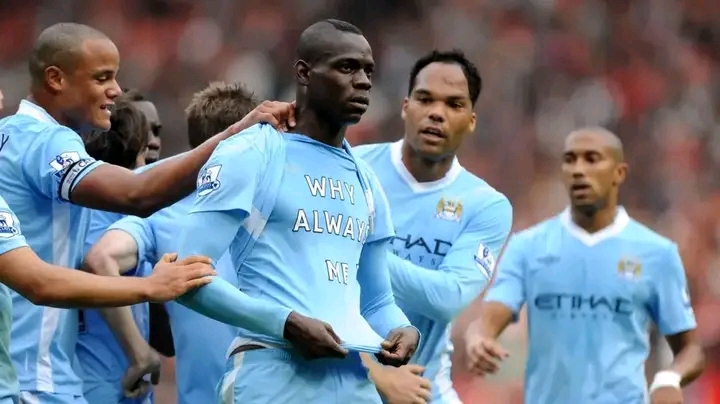
Perhaps his most recognisable moment arrived on October 23, 2011, during Manchester City’s 6-1 demolition of Manchester United at Old Trafford.
After opening the scoring, Balotelli lifted his shirt to reveal the message ‘Why Always Me?’ written on his undershirt.
The celebration became one of the most iconic images of the Premier League era, perfectly capturing his personality and his ability to attract attention both on and off the pitch.
Yet his Manchester City career also featured moments of frustration. His disciplinary problems continued, and he was sent off against Arsenal in April 2012, raising questions about his future at the club and potentially threatening City’s title ambitions.
Ironically, Balotelli would later play a decisive role in the club’s historic Premier League triumph.
During City’s dramatic final-day encounter against Queens Park Rangers in May 2012, he provided the assist for Sergio Aguero’s unforgettable 93rd-minute winner in a 3-2 victory.
It was his only Premier League assist of that season, but arguably the most important contribution of his entire City career.
Balotelli finished his Manchester City spell with 30 goals in 80 appearances across all competitions.
The breakdown with Mancini and the decline in consistency
By January 2013, Balotelli’s relationship with Mancini had deteriorated significantly following an argument during a training session.
The disagreement effectively ended their partnership at City, with the striker returning to Italy to join AC Milan.
Mancini later expressed disappointment about the direction of his former player’s career, describing him as a fantastic footballer whose behaviour was threatening to undermine his talent.
Despite the criticism, those who played alongside Balotelli remembered him as more than the controversial personality portrayed in the media.
Former Manchester City defender Micah Richards described him as a brilliant teammate and a cult hero, insisting that his unpredictable behaviour did not make him a bad person.
Former City defender Nedum Onuoha also reflected on Balotelli’s enormous self-belief, recalling how the Italian genuinely considered himself comparable to Lionel Messi and Cristiano Ronaldo.
Although that level of confidence never translated into a career matching those two superstars, Onuoha acknowledged that Balotelli still achieved more than most professional footballers could ever dream of.
Euro 2012 remains one of his greatest achievements
One of the strongest reminders of Balotelli’s extraordinary ability came during the 2012 European Championship in Poland and Ukraine.
Representing Italy, he produced some of the tournament’s most memorable performances, particularly in the semi-final against Germany.
Balotelli scored twice in a 2-1 victory, with his second goal becoming famous for his powerful finish and iconic shirtless celebration.
Italy eventually lost 4-0 to Spain in the final, but Balotelli finished the competition as one of the tournament’s standout forwards and joint top scorers.
It was arguably the clearest demonstration of what he could have achieved with greater consistency throughout his career.
A journey through European football and beyond
Following his departure from Manchester City, Balotelli’s career became increasingly unsettled.
His subsequent spells included AC Milan, Liverpool, Nice, Marseille, Brescia, Monza, Adana Demirspor, FC Sion and Genoa, among other clubs.
He enjoyed encouraging periods in France, particularly at Nice, where he rediscovered some of his goalscoring form. However, he struggled to maintain that consistency over longer periods.
His international career also became less prominent, despite a brief return to the Italian national team under Mancini in 2018.
Now playing in the United Arab Emirates with Al-Ittifaq, alongside his brother Enock Barwuah, Balotelli continues to write the final chapters of a footballing journey that has taken him across continents.
His story remains a complicated one. He won major domestic honours, lifted the Champions League, helped Manchester City secure their first Premier League title and represented Italy at major international tournaments.
Yet the lingering question surrounding his career is whether his extraordinary talent could have delivered even greater achievements.
For a player who once believed he belonged alongside Messi and Ronaldo, the distance between his potential and his eventual accomplishments remains one of football’s most intriguing stories.