


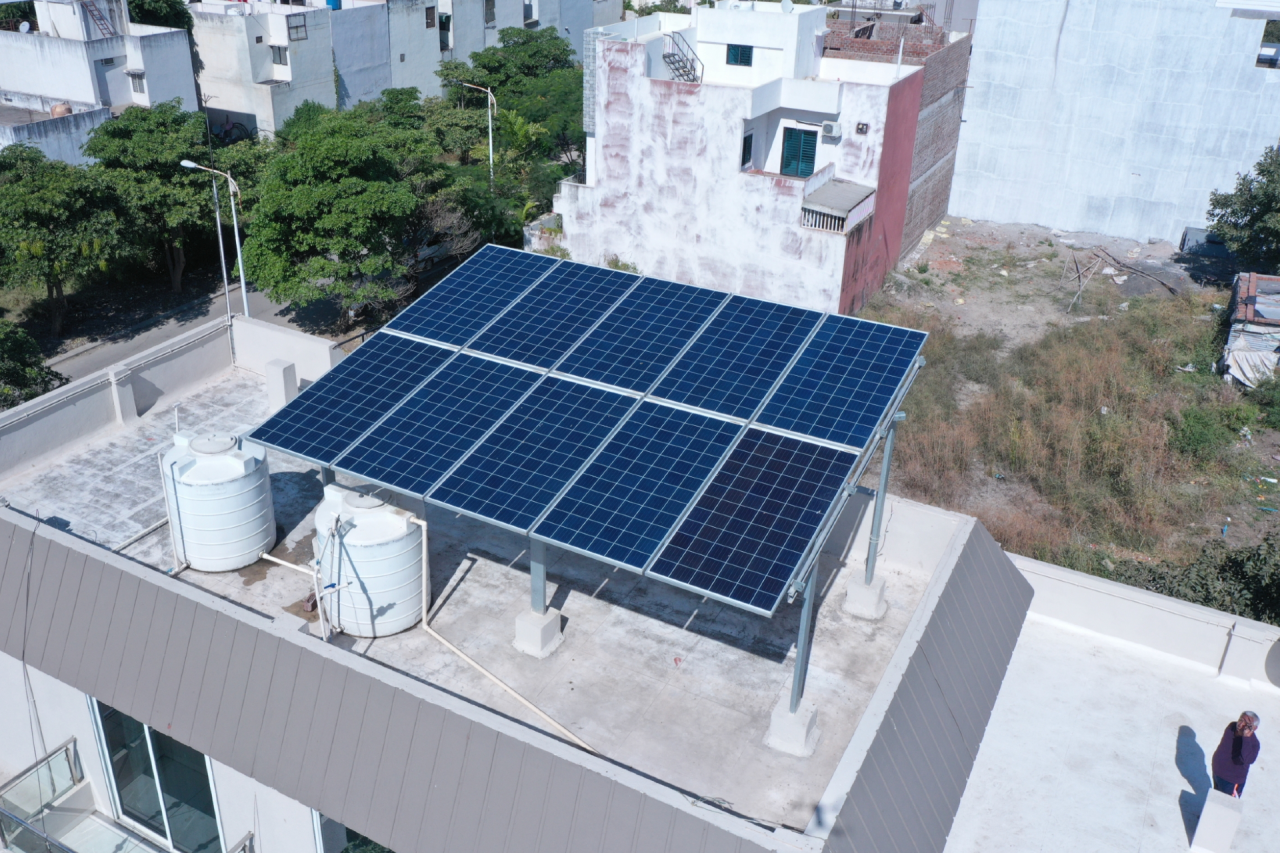
The federal government has launched the Renewable Asset Management Company (RAMCO) to manage and sustain publicly funded renewable energy assets.
RAMCO was launched on Wednesday by Abubakar Aliyu, managing director of the Rural Electrification Agency (REA).
Highlighting the importance of RAMCO at the launch, Aliyu said only three of seven solar hybrid power projects deployed by the agency under the first phase of its Energising Education Programme were found to be in good or usable condition.
He said the assessment showed that some of the projects had deteriorated, not because of engineering failures, but because there was no adequate system for maintaining the assets after commissioning.

“Of the seven, only three were in good or usable condition,” Aliyu said.
“Not because of engineering failure, but because we had not adequately institutionalised what happens after the commissioning of the project.”
Aliyu said since 2017, the REA has deployed 82 megawatts (MW) of solar hybrid generation across 22 federal universities and three teaching hospitals through the Energising Education Programme.
He said another 150MW is either under construction or in the pipeline through the Distributed Access through Renewable Energy Scale-Up (DARES) programme, the National Public Sector Solarisation Initiative and a project being conducted by TETFund under the ministry of education.
Aliyu said the assessment of the existing projects exposed gaps in maintenance, revenue collection and asset management.
“There was no sustainable maintenance regime, no dependable revenue mechanism, and critically, no institution whose primary responsibility was to preserve those assets throughout their economic lives,” he said.
Aliyu said the gaps informed the establishment of RAMCO, which he described as the agency’s “institutional answer” to the problem.
He said RAMCO will reduce reliance on repeated government appropriations for the maintenance and renewal of publicly funded renewable energy projects.
“RAMCO is certainly not another request for treasury funding. Its purpose is precisely the opposite,” Aliyu said.
“To move the long-term sustainability burden away from repeated public appropriation and onto commercially sustainable platform capable over time of attracting private capital.”
He said the company would professionally manage publicly financed renewable energy assets, contract competent operators, meter electricity consumption, collect revenue and ensure funds are available to replace components when they reach the end of their useful lives.
“If a battery or inverter requires replacement in year 8, we should not return to Ministry of Finance, and we should be able to have an economic value to replace that battery or inverter,” he said.
“The money should already be there, and the planning has to start today.”
‘BENEFICIARY INSTITUTIONS TO PAY FOR ELECTRICITY’
Aliyu said beneficiary institutions, including universities and teaching hospitals, would be expected to contribute to the sustainability of the projects by paying for the electricity they consume.
“Government has funded this asset. REA has built them. Beneficiary institution must contribute to sustaining them by paying for the electricity they consume,” he said.
The MD said the proposed tariff should not be viewed as an additional burden on the institutions, arguing that beneficiaries would otherwise spend money on diesel or electricity from other sources.
“Reliable electricity, just as the Minister of Power mentioned, is not free,” Aliyu said.
“The question is whether we pay repeatedly for diesel and fuel infrastructure or we pay a predictable tariff that keeps a cleaner, more reliable system operating for 20 years. That is the RAMCO impact.”
Aliyu said RAMCO is not designed to extract profit from public institutions or become another avenue for treasury funding.
“The tariff, therefore, should reflect what is required to operate, maintain, renew the system over its economic life,” he added.
The MD said the platform is intended to reduce reliance on repeated government appropriations by creating a commercially sustainable structure capable of attracting private capital.
Aliyu further said REA would conclude the valuation and technical assessment of the assets already deployed and work with MOFI, InfraCorp and the ministry of finance to transfer the assets from REA’s books to RAMCO’s balance sheet.
The agency will also complete the onboarding of long-term operation and maintenance partners for the completed phases of the Energising Education Programme.
“We will report our progress publicly. If we have delivered, Nigerians will know. If we have fallen short, they will know that too,” he said.
Aliyu said the new model was intended to prevent the government from repeatedly spending money to rebuild infrastructure that had already been delivered.
“A trillion-dollar economy cannot be built on infrastructure that must repeatedly be built and rebuilt again,” the MD said.
“Every naira spent replacing an asset that we have already built is a naira unavailable to electrify another university, hospital, community, or protected enterprise. RAMCO must break that cycle.”
Lazarus Angbazo, chief executive officer (CEO) of InfraCorp, said the company was created to address the challenge of maintaining infrastructure after commissioning.
“What happens to an infrastructure project after the commissioning ceremony is over?” Angbazo asked.
“We spend enormous amounts of time, effort, and capital designing, financing, and building the infrastructure. We celebrate going to commission, but the real economic life of that asset is only beginning at the point of commissioning.”
Angbazo said professionally managed renewable energy assets could also create opportunities for private-sector participation in operations and maintenance, equipment manufacturing, metering, digital monitoring, insurance and financing.




