


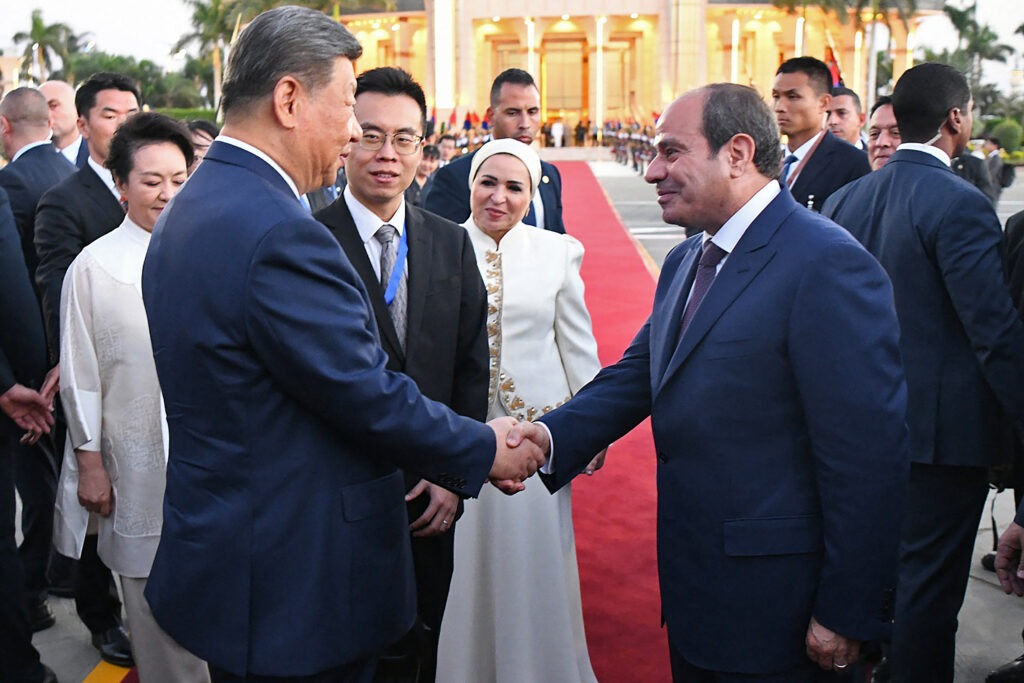
Chinese President Xi Jinping’s visit to Egypt has highlighted Beijing’s growing economic and strategic interest in a country that sits at the intersection of Africa, the Middle East and some of the world’s most important trade routes.
Xi visited Cairo on September 1 and 2, 2026, at the invitation of Egyptian President Abdel Fattah el-Sisi.
The trip marked his first visit to Egypt since 2016 and coincided with the 70th anniversary of diplomatic relations between the two countries.
Egypt was the first Arab and African country to establish diplomatic relations with the People’s Republic of China in 1956.

While the visit was presented as a celebration of a long-standing bilateral relationship, its timing and the agreements announced during the trip gave it a broader economic significance.
China is already deeply involved in Egypt’s infrastructure and industrial development, particularly around the Suez Canal Economic Zone. Beijing’s interest in the country extends beyond traditional trade to manufacturing, technology, energy, logistics and supply chains.
One of the most significant announcements surrounding Xi’s visit came from Chinese tyre manufacturer ZC Rubber, which plans to invest about $500 million in a manufacturing complex in Sokhna on the Gulf of Suez.
The project adds to a growing Chinese industrial presence around the Suez Canal, where the Tianjin Economic-Technological Development Area, known as TEDA, operates a Chinese-managed industrial zone.
The area already hosts major Chinese manufacturers, including fibreglass producer Jushi and home-appliance manufacturer Midea. Jushi alone has invested more than $600 million in its Egyptian operations, according to reporting on the investment landscape.
For Beijing, Egypt offers more than access to a large domestic market.
Its geographic position gives it importance as a gateway between Africa, Asia and Europe. The Suez Canal remains a critical route for global commerce, making Egypt strategically relevant to companies seeking efficient connections between major markets.
That makes industrial investment in Egypt part of a wider effort to strengthen supply chains and production networks.
The visit also demonstrated how economic cooperation between Cairo and Beijing is expanding into newer areas.
The two governments agreed to deepen cooperation in sectors including technology, artificial intelligence, industry, trade and supply chains. Egyptian and Chinese officials also discussed security and broader strategic cooperation.
The economic relationship is already substantial.
According to the Egyptian government, 17 export contracts worth about $168 million were signed in August 2026 for Egyptian agricultural products, textiles, leather goods and engineering products destined for China.
Egypt also began benefiting in May from a Chinese initiative providing full tariff exemptions for imports from African countries that maintain diplomatic relations with Beijing. Cairo sees the arrangement as an opportunity to expand Egyptian exports into the Chinese market and reduce part of the imbalance in bilateral trade.
The developments point to an increasingly important dimension of China’s relationship with Africa.
Rather than focusing only on extracting resources or selling Chinese products into African markets, Chinese companies are also building manufacturing capacity on the continent.
For African economies, the potential benefit lies in whether such investments can create local jobs, strengthen industrial capacity, transfer technology and connect domestic producers to international supply chains.
Egypt is particularly positioned to benefit because of its existing industrial infrastructure and strategic location.
However, China’s expanding presence is also taking place against a changing geopolitical background.
Xi’s visit came as Beijing seeks to strengthen relationships across the Global South and deepen its role in international affairs. His wider September diplomatic schedule included meetings and summits in Central Asia and India before a planned visit to Washington.
Analysts have interpreted the broader travel schedule as part of Beijing’s effort to maintain and expand relationships with countries outside the traditional Western alliance system.
The United States remains an important partner for Egypt, particularly in security and military cooperation. At the same time, Cairo has increasingly sought to diversify its international partnerships, including through its relationship with China and membership in BRICS.
This does not necessarily mean Egypt is choosing one major power over another.
Instead, the country has continued to develop relationships with multiple global partners while seeking investment, technology and economic opportunities.
That approach gives Egypt room to pursue its own economic interests at a time when competition between major powers is reshaping global trade and investment.
For China, Egypt’s importance extends beyond bilateral relations.
The country can provide a platform for Chinese businesses seeking access to African and Middle Eastern markets. Manufacturing in Egypt can potentially allow companies to produce closer to their customers while benefiting from the country’s location, industrial zones and trade connections.
This could become increasingly important as companies rethink global supply chains and look for alternative production bases.
The Suez Canal Economic Zone is therefore becoming a key part of the relationship.
Investment in manufacturing around the canal could gradually transform the area from a transit corridor into a larger industrial and logistics hub.
If successful, that model could create opportunities for Egyptian suppliers and other African businesses connected to the regional production network.
The challenge will be ensuring that investment produces broader economic benefits.
Large foreign projects can generate employment and infrastructure, but their long-term impact depends on the extent to which local businesses participate in supply chains and workers gain new technical skills.
Technology transfer, local sourcing and industrial training will therefore remain important measures of the relationship.
Xi’s visit has shown that China’s engagement with Egypt is moving beyond infrastructure financing and conventional trade.
It increasingly includes manufacturing, artificial intelligence, technology, supply chains and strategic cooperation.
For Egypt, the partnership offers another source of investment and an opportunity to strengthen its position as a regional industrial and logistics centre.
For China, Egypt provides access to one of Africa’s most strategically located economies and a country with influence across both the Arab world and the wider African continent.
The significance of Xi’s visit may therefore extend well beyond the diplomatic ceremonies in Cairo.
As global competition for markets, resources, technology and strategic partnerships intensifies, China’s expanding relationship with Egypt illustrates how economic diplomacy is becoming increasingly important to Africa’s place in the global economy.
The next question is whether the agreements announced during the visit will translate into factories, exports, jobs and deeper industrial capacity.
That will ultimately determine how much economic weight China’s growing partnership with Egypt carries for both countries.




