


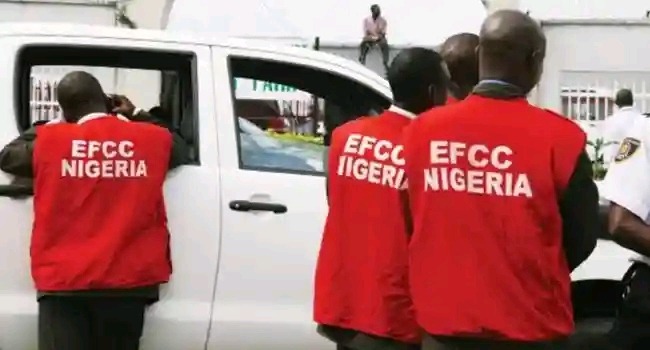
The Economic and Financial Crimes Commission (EFCC) has reopened an investigation into allegations of financial misconduct involving former Vice-President Atiku Abubakar following a petition by former House of Representatives member Ehiozuwa Johnson Agbonayinma.
The renewed investigation concerns allegations dating back to 2005 and 2006, when Atiku served as vice-president under former President Olusegun Obasanjo. The petition calls on the anti-graft agency to revisit findings from an earlier investigation and determine whether further legal action is warranted.
Agbonayinma submitted the petition through his lawyer, Chief Hannibal Egbe Uwaifo, a Senior Advocate of Nigeria. Dated August 27, 2026, the petition was received by the EFCC on September 1, according to reports on the development.

The former lawmaker subsequently visited the commission’s headquarters in Jabi, Abuja, on October 12, where he formally adopted the petition and responded to questions from investigators.
Speaking after the engagement, Agbonayinma maintained that allegations involving influential public figures should not be abandoned without appropriate action. He argued that the law should apply equally to all Nigerians, regardless of their political standing or position in government.
He also urged the EFCC to revisit its September 2006 investigative report on Atiku and consider a February 4, 2010, report by the United States Senate Permanent Subcommittee on Investigations.
According to the petitioner, the documents contain allegations that warrant further examination by the Nigerian authorities. He argued that revisiting the records would help establish whether there are grounds for prosecution or other lawful action.
The renewed petition places the spotlight on an investigation that has remained politically contentious for nearly two decades. At the centre of the matter are allegations relating to financial transactions and the management of funds associated with the Petroleum Technology Development Fund (PTDF), which operated under the supervision of the Office of the Vice-President during the period under review.
The earlier EFCC investigation examined the handling and placement of PTDF funds in commercial banks, alongside transactions that became part of wider inquiries into alleged financial misconduct involving several individuals and business interests.
The investigation also formed part of a broader effort to examine transactions connected with business dealings involving Nigerian and United States entities.
However, the existence of earlier investigative reports does not, by itself, establish criminal liability. Any renewed action would require the authorities to examine the relevant evidence, applicable laws and circumstances surrounding the allegations before determining whether prosecution is justified.
Agbonayinma has argued that the EFCC should reactivate its earlier findings and establish whether the matter was adequately addressed after the initial investigation. He also disclosed that he had petitioned United States President Donald Trump over the allegations, seeking further attention to the issues raised.
The former lawmaker has presented the renewed effort as a matter of accountability, insisting that public institutions must demonstrate their willingness to investigate allegations involving powerful political figures.
The development comes as Atiku remains an influential figure in Nigerian politics and a leading figure in the African Democratic Congress (ADC), with national political attention increasingly focused on the country’s next presidential election cycle.
Atiku has previously rejected allegations of wrongdoing and challenged the suggestion that the renewed petition establishes a basis for criminal prosecution. In a response to the earlier demand for the case to be reopened, he maintained that the allegations had been examined by different Nigerian institutions, including the EFCC, an administrative panel, the National Assembly and the courts.
He also stressed that he had not been convicted by any court over the allegations.
The former vice-president questioned whether the latest petition contained new evidence capable of justifying another investigation, arguing that a petition or an administrative acknowledgement should not be interpreted as proof of guilt.
His position underscores the distinction between an allegation, an investigation and a judicial finding. While the EFCC has acknowledged the petition and begun investigative steps, the process does not automatically mean that the former vice-president has been charged with an offence or found guilty of financial misconduct.
The commission’s handling of the matter is therefore likely to attract public attention, particularly over whether investigators will identify new evidence, revisit existing records or determine that further action is necessary under the law.
The EFCC has faced repeated public demands to demonstrate consistency in its anti-corruption efforts, especially in cases involving prominent political figures. The latest development presents another test of the agency’s ability to address allegations transparently while respecting due process and the rights of those under investigation.
For the petitioner, the central issue is whether the findings and records from the earlier investigations deserve renewed scrutiny. For Atiku, the allegations remain disputed, and any determination of criminal responsibility must be based on evidence examined through the appropriate legal process.
As the investigation progresses, attention will remain on the EFCC’s next steps, the evidence available to investigators and whether the renewed examination will lead to any formal legal action.
No conclusion on Atiku’s criminal responsibility should be drawn solely from the reopening of the investigation. Any prosecution, if pursued, would have to establish the relevant allegations before a competent court.

![Finding verified accommodation and reliable home service professionals across Africa has just become easier.In this episode of DDM Tech Buzz, we host the leadership team behind Nestspot—Jude Obinna (CEO), Emeh Solomon Chiweike (HR), and Odoh Chikamso Emmanuel (Marketing Manager)—to discuss how technology is fixing Africa’s real estate and job markets.Discover how Nestspot allows landlords to seamlessly list properties, empowers tenants to locate verified homes with pinpoint GPS coordinates, and opens up economic opportunities for skilled workers like plumbers, painters, and home decorators.🔥 IN THIS INTERVIEW:
00:00 - Introduction to Nestspot & DDM Tech Buzz
02:15 - The Vision: Bringing Technology to Nigeria & Africa’s Housing Industry
05:30 - How Landlords & Tenants Benefit From Smart Property Listings
08:45 - GPS Verification: Stopping Housing Scams with Human & Location Verification
12:10 - Connecting Skilled Artisans (Plumbers, Decorators) to Real Jobs
16:00 - Expanding Nestspot: From Nigeria to the Rest of Africa & Global Diaspora
19:30 - How to Get Started on the Nestspot App Today💡 KEY FEATURES DISCUSSED:
• GPS Location Verification: Every listed property undergoes physical and GPS verification before hosting to prevent fake listings and scams.
• Seamless Tenant Navigation: Direct GPS coordinates guide users straight to property locations.
• Artisan & Service Provider Network: Connects skilled workers (plumbers, decorators, handymen) directly with homeowners and tenants.
• Pan-African & Diaspora Reach: Built for Nigeria, scaled for Africa, accessible globally.📲 CONNECT WITH NESTSPOT:
• Website / App Download: [Insert Nestspot Link Here]
• Social Media: @Nestspot🔔 Subscribe to DDM TV for deep dives into African tech innovation, startups, and economic opportunities: https://youtube.com/@ddmtvnews#Nestspot #PropTech #NigeriaRealEstate #TechInAfrica #AfricanStartups #DDMTechBuzz #RealEstateAfrica](https://diasporadigitalmedia.com/wp-content/plugins/feeds-for-youtube/img/placeholder.png)


