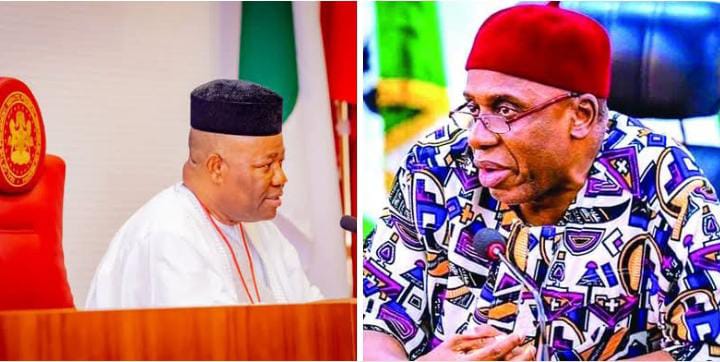
ABUJA, NIGERIA — Senate President Godswill Akpabio has challenged former Rivers State Governor, Rotimi Amaechi, to provide documentary evidence to support his allegation that he introduced a 50 per cent deduction from payments due to contractors handling projects for the Niger Delta Development Commission (NDDC).
Akpabio’s challenge followed an accusation made by Amaechi at an African Democratic Congress (ADC) political rally in Bauchi State on Saturday, November 14, 2026. The former governor alleged that the Senate President was responsible for introducing the practice during his time as Minister of the Niger Delta Affairs.
Amaechi made the allegation while addressing supporters at the Tafawa Balewa Stadium, where he also criticised the administration of President Bola Tinubu over the country’s economic difficulties.
Reacting on Sunday, November 15, Akpabio, through his Special Adviser on Media and Publicity, Eseme Eyiboh, described the allegation as serious and deserving of investigation but insisted that it must be supported by verifiable evidence.
In a statement titled “Amaechi’s NDDC Allegation: Public Accountability Requires Evidence, Not Campaign Declaration,” the Senate President’s office said the former governor had not presented contract documents, payment records, identifiable transactions or other evidence to substantiate his accusation.
The statement challenged Amaechi to identify the specific contracts involved, the contractors allegedly affected, the dates of the deductions and the payment arrangements through which the money was reportedly withheld.
It also demanded evidence establishing Akpabio’s personal involvement in the alleged arrangement, arguing that accusations made at political gatherings should not automatically be treated as established facts.
The Senate President’s office maintained that if Amaechi possessed credible evidence of unlawful deductions involving NDDC contractors, he should submit the relevant documents to appropriate investigative authorities for examination.
It argued that public accountability requires more than political declarations, particularly when allegations concern public institutions and the management of funds intended for development projects.
The response also shifted attention to Amaechi’s record as governor of Rivers State between 2007 and 2015, saying his administration’s expenditure and project implementation should equally be open to public scrutiny.
Eyiboh specifically mentioned the Port Harcourt monorail project, which became controversial over its reported cost, incomplete implementation and failure to deliver the anticipated public transportation service.
He also raised questions about the Malaria-free Rivers State initiative, arguing that public officials should be prepared to account for the money spent on major programmes and the results achieved.
According to the statement, the relevant questions surrounding such projects include the amount of public funds committed, the extent to which their original objectives were achieved and the institutional or contractual decisions that influenced their outcomes.
The Senate President’s office stressed that accountability should apply to every public official who has exercised executive authority, regardless of political affiliation or current position.
The exchange comes amid increasing political activity ahead of Nigeria’s 2027 general elections, with political parties and their prominent figures intensifying criticism of opponents over governance, public spending and national economic policies.
Amaechi, a former Minister of Transportation and a prominent member of the ADC, has been increasingly critical of the Tinubu administration. At the Bauchi rally, he also promised that an ADC government would restore fuel and electricity subsidies if the party takes power in 2027.
His allegation against Akpabio has introduced another controversy into the political exchanges, particularly because the NDDC is responsible for implementing development interventions in the oil-producing Niger Delta region.
Established to address the area’s longstanding infrastructure, environmental and socioeconomic challenges, the commission manages projects intended to improve the living conditions of communities across its mandate states.
Allegations involving deductions from contractors’ payments therefore raise questions about procurement transparency, contract administration and whether funds allocated to development projects are being used for their intended purposes.
However, the specific 50 per cent deduction alleged by Amaechi has not been independently established by the statements currently available. Akpabio’s office has denied the allegation and demanded documentary evidence, while no response from Amaechi to that challenge was contained in the reports reviewed.
The dispute has consequently placed renewed attention on the need for transparent financial records and independent scrutiny of public institutions.
As the political exchanges continue, the central issue remains whether Amaechi can produce verifiable records supporting his allegation and whether the relevant authorities will examine any evidence presented.
For communities in the Niger Delta, the wider concern is that political disagreements should not overshadow the commission’s responsibility to deliver completed projects, accountable spending and measurable development outcomes.