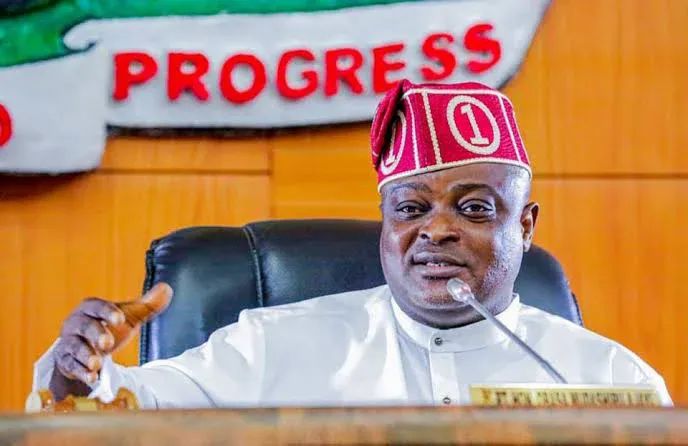
NAIROBI, KENYA — Speaker of the Lagos State House of Assembly, Mudashiru Ajayi Obasa, has called on lawmakers across the world to translate political commitments against hunger and malnutrition into enforceable legislation, adequate budgetary provisions and effective oversight, warning that declarations without practical implementation will do little to improve food security.
Obasa made the call at the Third Global Parliamentary Summit on Hunger and Malnutrition, held from November 16 to 17 at the Parliament of Kenya in Nairobi. The gathering brought together more than 200 parliamentarians and officials from 73 countries to discuss legislative responses to food insecurity and the development of resilient agricultural systems.
Represented by a delegation of legislators, senior Assembly officials and legislative aides, the Lagos Speaker presented Nigeria’s and Lagos State’s approaches to addressing hunger, improving nutrition and strengthening agricultural production.
He said the Federal Government, under President Bola Tinubu’s Renewed Hope Agenda, had approved the National Nutrition Bill 2026 and the revised National Policy on Food and Nutrition.
According to Obasa, the proposed legislative and policy framework is expected to strengthen nutrition governance, establish sustainable funding arrangements, improve coordination among relevant institutions and support the effective implementation of food and nutrition programmes across the country.
He stressed that governments must move beyond policy announcements and ensure that commitments are backed by resources, implementation structures and accountability.
LAGOS’ STRATEGY FOR FOOD SECURITY
Addressing the challenges facing Lagos State, Obasa explained that its large population and limited availability of arable land required a different approach to agricultural development.
He said the state, with a population estimated at more than 22 million, was prioritising productivity, technology, partnerships and efficient distribution rather than relying solely on expanding farmland.
The five-point strategy focuses on the use of technology, collaboration with other states, investment in farmers, reduction of post-harvest losses and improved access to affordable and nutritious food.
Obasa identified the Imota Rice Mill in Ikorodu as one of the major investments supporting local food production. Commissioned in January 2023, the facility has a stated annual production capacity of 2.8 million 50-kilogram bags of rice.
The project is also expected to generate about 1,500 direct jobs and 254,000 indirect employment opportunities, according to figures presented by the Speaker.
He further highlighted the ₦500 billion Offtake Guarantee Fund under the Produce for Lagos initiative, designed to address weaknesses in agricultural supply chains and improve the availability of food in the state.
The initiative is expected to provide working capital for bulk traders and logistics operators, alongside credit support for food producers. Its broader objective is to strengthen the movement of agricultural produce from farming communities to major consumer markets while encouraging private-sector investment.
Another intervention highlighted was the Lagos Fresh Food Hub project, which has completed and commissioned mid-level facilities in Mushin, Abijo in Ibeju-Lekki and Agege.
Obasa disclosed that construction of a 500-hectare central food logistics hub in Epe had reached approximately 70 per cent completion.
The proposed facility is expected to incorporate cold-chain storage, dry-chain infrastructure and other logistics facilities to improve food preservation, handling, transportation and distribution. These interventions are intended to reduce losses associated with inadequate storage and inefficient movement of agricultural products.
LEGISLATION AND ACCOUNTABILITY
On the legislative front, Obasa cited the Lagos State Anti-Open Grazing of Livestock Law, passed in September 2021, as one of the measures intended to regulate livestock movement and protect public spaces and private property.
He also said the state legislature had allocated more than ₦80 billion to agriculture and food systems across recent budget cycles through its appropriation laws.
The Speaker disclosed that the Assembly was advancing a Food Hub Bill intended to formalise market operations, improve food safety standards, address challenges associated with informal trading and strengthen coordination across the agricultural value chain.
He reaffirmed the legislature’s commitment to sustaining budgetary support for agriculture, strengthening oversight and improving laws to promote climate-resilient food production.
AFRICA’S GROWING FOOD SECURITY CHALLENGE
The summit’s discussions reflected growing concern about the scale of hunger and malnutrition, particularly across Africa.
In his keynote address, Kenyan President William Ruto warned that Africa could account for nearly 60 per cent of the world’s hungry population by 2030 if urgent action was not taken.
He called for stronger domestic financing, reduced dependence on food imports, improved irrigation systems and expanded school feeding programmes. He also urged lawmakers to protect food security initiatives from political changes that could undermine long-term implementation.
Emphasising the relationship between rights and public financing, Ruto declared that a right without a budget allocation was merely a slogan.
The Food and Agriculture Organisation of the United Nations said more than 200 parliamentarians and officials from 73 countries attended the summit. It noted that 645 million people still face chronic food insecurity globally, while nearly one in three people cannot afford a healthy diet.
At the conclusion of the meeting, participants endorsed the Nairobi Call on Parliamentary Action against Hunger and Malnutrition, committing to stronger cooperation and practical legislative priorities.
The FAO urged parliamentary institutions to identify specific laws to introduce, financing priorities to pursue and oversight mechanisms capable of tracking public spending and measurable results.
For Nigeria and other African countries, the challenge now lies in ensuring that agricultural policies, nutrition programmes and public investments translate into affordable food, improved household nutrition and stronger livelihoods.
Obasa’s intervention placed particular emphasis on the responsibility of lawmakers to ensure that governments do not merely announce commitments but provide the legislation, funding and accountability required to make food security achievable.