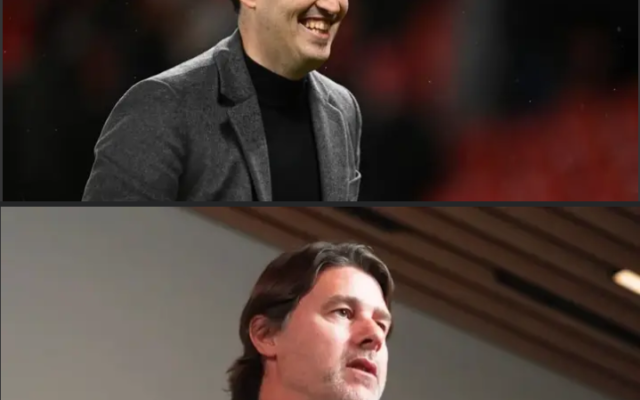
MANCHESTER, UNITED KINGDOM — Italian football manager Antonio Conte has defended his demanding coaching philosophy following his failure to secure the managerial position at Manchester United, insisting that clubs unwilling to embrace hard work and discipline cannot expect to achieve major success.
Conte made the remarks during an interview with Italian football platform Cronache di Spogliatoio, after Manchester United opted for another managerial appointment following the dismissal of Michael Carrick.
The former Chelsea and Napoli manager had been strongly linked with the vacancy, with speculation suggesting that his uncompromising methods and demanding personality could have influenced the club’s decision.
However, Conte rejected the suggestion that Manchester United would have been reluctant to appoint him because of his approach to management.
“If anyone is frightened by my method, then they are frightened of winning, because that methodology leads to victory,” he said.
The 57-year-old argued that a club with Manchester United’s history and reputation should be prepared to embrace the discipline, commitment and collective responsibility required to restore its former status.
He maintained that building a successful football team requires more than signing expensive players or employing a high-profile manager. According to him, every individual within a club must be prepared to work hard and accept the demands of a structured winning philosophy.
Conte also described suggestions that Manchester United might have been discouraged by his methods as almost offensive to the club’s history.
He questioned why a team with such a distinguished record would hesitate to embrace an approach designed to return it to the highest level of English and European football.
The Italian specifically referenced the club’s prolonged wait for another Premier League title, noting that Manchester United have not won the competition since Sir Alex Ferguson’s final season in 2012/2013.
He said the club needed a clear methodology and strong leadership to rebuild its identity and compete consistently for major honours.
Conte also spoke warmly about Ferguson, describing the former Manchester United manager as someone he holds in enormous respect.
He disclosed that he had read Ferguson’s autobiography and had the opportunity to visit the legendary Scottish manager’s home while he was coaching Chelsea.
According to Conte, Ferguson’s achievements demonstrated how a strong managerial philosophy, discipline and consistent standards could transform a football club into a dominant force.
The Italian’s comments also reflected his belief that successful management requires a combination of technical knowledge, authority and fairness.
He explained that managers must be willing to confront problems rather than ignore them, warning that allowing negative habits to develop within a team can gradually undermine collective performance.
Conte cited the importance of treating players fairly, offering encouragement when necessary and delivering criticism when standards fall below expectations.
He also praised former Manchester United midfielder Scott McTominay, who enjoyed an impressive transformation under his management at Napoli.
Conte said positive feedback from players who had worked under him reinforced his belief in the value of his coaching methods. McTominay, who joined Napoli after leaving Manchester United, became an influential figure in the Italian side’s midfield.
The coach said his responsibility was to improve the technical and mental abilities of the players available to him, adding that credibility and fairness were essential qualities for anyone leading a football team.
Conte has enjoyed considerable success across European football. He guided Chelsea to the Premier League title during the 2016/2017 season and won the FA Cup the following campaign.
He also won Serie A with Inter Milan in 2021 and led Napoli to the Italian league title in 2025, further strengthening his reputation as one of Europe’s most successful modern coaches.
His managerial career, however, has also been characterised by intense working relationships, high expectations and occasional disagreements with club executives.
Those characteristics have frequently generated debate over whether his demanding approach is suitable for clubs seeking long-term managerial stability.
Manchester United’s decision to pursue another candidate has therefore renewed discussion about the balance between managerial authority, club structures and the expectations of elite football institutions.
Conte’s remarks do not establish that Manchester United formally offered him the position or that the club rejected him specifically because of his coaching philosophy. Rather, they represent his response to speculation surrounding his suitability for the job.
For Manchester United, the challenge remains restoring the consistency and competitive standards associated with the Ferguson era. For Conte, his position remains that winning requires a willingness to work, maintain discipline and embrace demanding standards.
His message to football’s biggest clubs is unmistakable: success cannot be achieved by avoiding hard work or compromising the principles required to build a winning team.