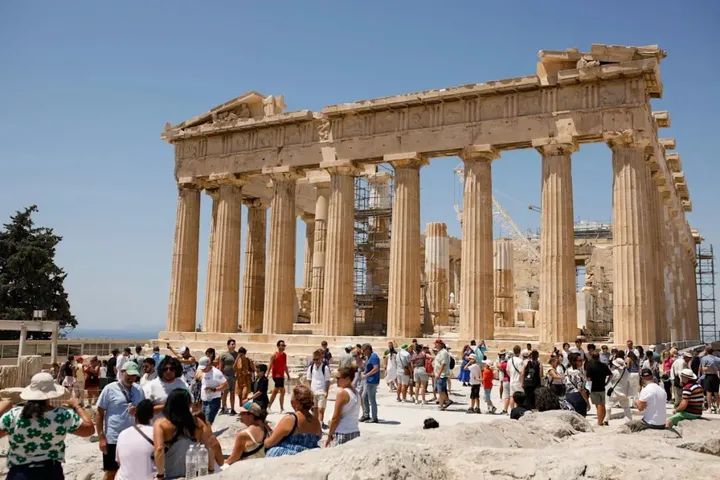
ATHENS, GREECE — Greece has officially reopened the historic Old Acropolis Museum in Athens following an extensive restoration project, with Prime Minister Kyriakos Mitsotakis using the occasion to renew his government’s demand for the return of the Parthenon Sculptures held by the British Museum in London.
The museum, located on the southeastern side of the Acropolis, a short distance from the ancient Parthenon, reopened to visitors on Monday, November 23, 2026. The building, which dates back to the 19th century, had been closed to the public since 2007 after its major archaeological collections were transferred to the newer Acropolis Museum at the foot of the historic hill.
The restoration has given the landmark a renewed cultural purpose, transforming it from a largely administrative and storage facility into a modern exhibition space combining ancient artefacts, contemporary art and digital technology.
However, reports on the project’s cost differ. The Associated Press and Greece’s Culture Ministry put the restoration expenditure at €6.2 million, approximately $6.8 million, while Agence France-Presse reported a €10 million figure, equivalent to about $11 million. The project was supported by public funding and private donations. <Cite refs={[“turn130443news15″,”turn130443search0″,”turn130443search1″,”turn130443search2”]}/>
Speaking at the reopening ceremony, Mitsotakis described the restoration as an important development in the preservation and presentation of Greece’s cultural heritage. He said the historic building deserved to return to its original purpose rather than remain underused after the transfer of its collections.
The prime minister also connected the reopening to Greece’s longstanding campaign to reunite the Parthenon Sculptures, many of which are displayed at the British Museum. He maintained that the sculptures were originally created as part of a single architectural and artistic monument and should be brought together in Athens.
“As we reopen the gates of the Old Acropolis Museum, just a few metres from the iconic Parthenon, our thoughts inevitably turn to what is missing,” Mitsotakis said.
He described the return and reunification of the sculptures as Greece’s major national objective, arguing that the ancient monument was never intended to be separated into pieces displayed in different countries.
Greece has for decades disputed the removal of the sculptures by British diplomat Lord Elgin in the early 19th century. The objects, commonly referred to in Britain as the Elgin Marbles, were subsequently acquired by the British Museum, which maintains that it holds them lawfully.
The disagreement has remained a prominent issue in cultural diplomacy between Athens and London. Greece argues that the sculptures form an inseparable part of the Parthenon and should be displayed in their original historical setting. The British Museum, meanwhile, has defended its ownership and the role of its London collection in presenting world heritage to an international audience.
Mitsotakis insisted that Greece had invested in the facilities and expertise required to preserve and exhibit the sculptures, adding that their return should not be treated merely as a temporary loan.
The restored museum is expected to strengthen the wider Acropolis visitor experience through exhibitions that bring together archaeological discoveries and modern interpretation. Its permanent exhibition includes objects associated with lost structures, religious offerings and inscriptions from the Acropolis.
Three additional exhibitions explore Athens’ historical development, archaeological discoveries and the relationship between ancient heritage and contemporary artistic expression. One of the major attractions is a digital presentation of the Parthenon, using modern technology and artificial intelligence to help visitors understand the monument’s original appearance and history.
The museum will also display archaeological objects that had remained in storage and were not previously accessible to the public. The new arrangements are designed to make the institution a centre for archaeological learning, conservation and cultural dialogue.
Culture Minister Lina Mendoni described the reopening as a new chapter for the historic building, emphasising its importance to the development of Greek archaeology and the study of the Acropolis.
The wider restoration programme has also involved improvements to the ancient site, including conservation work, visitor accessibility and protection against environmental risks. Government figures indicate that more than €35 million has been allocated to restoration, preservation, accessibility and presentation projects around the Acropolis since 2019.
The Acropolis remains one of the world’s most recognised archaeological destinations, attracting more than 4.6 million visitors in 2025, according to figures cited by Greek authorities.
With the reopening of the Old Acropolis Museum, Greece is seeking to expand the way its ancient heritage is presented while reinforcing its cultural claim over the Parthenon Sculptures.
For Athens, the project represents more than the restoration of an old building. It is also part of a broader effort to preserve the country’s archaeological legacy, attract international visitors and strengthen its campaign for the reunification of one of the most prominent collections of ancient Greek art.