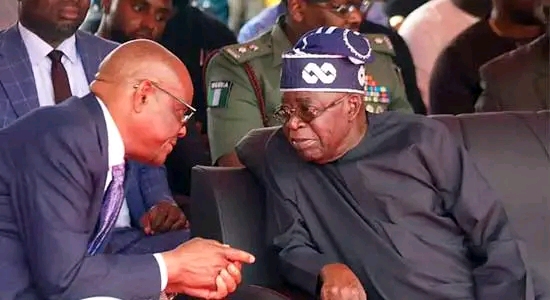
LAGOS, NIGERIA — President Bola Ahmed Tinubu has appealed to Igbo residents and community leaders in Lagos State to support his re-election bid in 2027, recalling his defeat to Labour Party candidate Peter Obi in the state during the 2023 presidential election.
Tinubu made the appeal on Monday, November 23, 2026, while addressing Igbo stakeholders at a political engagement organised under the Ndigbo National Dialogue and Development Initiative at the Wole Soyinka Centre for Culture and Creative Arts, formerly known as the National Theatre, in Lagos.
The meeting, spearheaded by the Minister of State for Budget and Economic Planning, Doris Uzoka-Anite, brought together Igbo leaders, business owners, market women, youths and other community representatives living in Lagos.
The gathering formed part of the President’s efforts to strengthen relationships with different ethnic and interest groups as political activities intensify ahead of the 2027 general election.
Addressing the participants, Tinubu acknowledged that some members of the Igbo community in Lagos did not support his presidential ambition during the 2023 election. He said he was initially disappointed by their voting choices but suggested that the disagreement had been resolved.
“Some of you didn’t vote for me in 2023, I vex o. We don settle. Get your PVC, you will vote this time,” the President told the gathering.
He urged eligible residents to obtain their Permanent Voter Cards and participate in the forthcoming election, stressing that political support should be reciprocated.
Tinubu further appealed to the audience to honour what he described as an understanding between him and the community, using the expression, “Agreement na agreement o. As you do for me, I do for you.”
The President also reminded the gathering that he was seeking a second term in office and called on them to support his ambition at the ballot box.
“I have served the first term. The Constitution said I must ask for a second term. I want a second term,” he said.
He promised to continue working towards economic improvement, better educational opportunities, improved roads and stability in the country’s university system.
Tinubu specifically stressed the importance of ensuring that children from financially disadvantaged families could access university education, arguing that poverty should not prevent young Nigerians from pursuing higher learning.
He also described the Igbo community as an important contributor to Lagos State’s economy and Nigeria’s broader development, acknowledging their participation in commerce, industry and other sectors.
“I am here to listen to you. I am here to work with you,” he told the stakeholders, according to reports from the engagement.
Tinubu’s appeal comes against the background of the 2023 presidential election, when Peter Obi defeated him in Lagos, a state widely regarded as one of the APC leader’s strongest political bases.
The official results showed that Obi secured 582,454 votes in Lagos, while Tinubu received 572,606 votes. The Labour Party candidate therefore defeated Tinubu by 9,848 votes in the state.
Although Tinubu won more local government areas than Obi, the total number of votes secured by the Labour Party candidate was higher, giving him the statewide victory.
The result attracted considerable political attention because Tinubu had previously served two terms as governor of Lagos between 1999 and 2007 and maintained a significant political network in the state.
The 2023 outcome also demonstrated the influence of different voter groups and the importance of electoral participation in determining the results of closely contested elections.
At the Lagos meeting, Uzoka-Anite said the engagement was intended to create an opportunity for direct interaction between the President and Igbo residents, particularly on their concerns, participation in national affairs and contribution to development.
She emphasised the need for sustained dialogue and greater inclusion, noting that members of the community should have opportunities to engage with government and communicate their expectations.
The meeting also featured visible expressions of political support, with some participants displaying placards bearing messages such as “Ndigbo For Tinubu 2027” and “Igbo Lagos Love Tinubu.”
However, the gathering represented the position of the participating stakeholders and should not automatically be interpreted as the political preference of the entire Igbo population in Lagos.
As the 2027 election approaches, Tinubu’s engagement highlights the importance of community outreach and voter mobilisation in Nigeria’s increasingly competitive political environment.
The President’s appeal also places renewed attention on the 2023 Lagos result and the challenge facing political parties in securing support across the state’s diverse population.
Ultimately, the 2027 outcome will be determined by voters through the electoral process, with candidates expected to convince Nigerians through their records, programmes and engagement with the electorate.