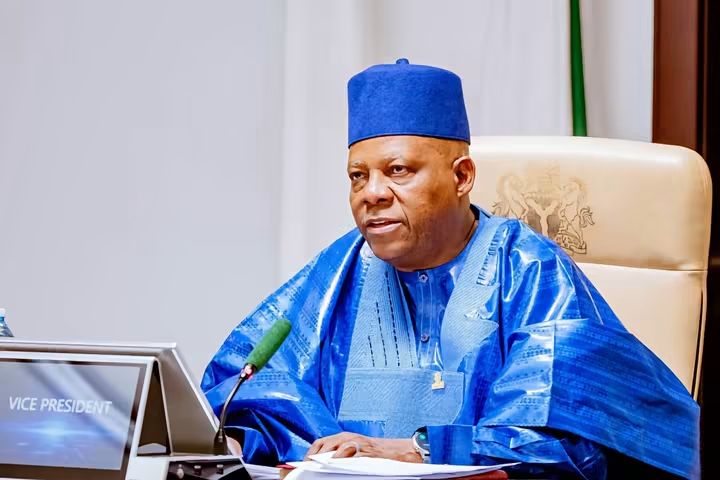
ABUJA, NIGERIA — The Federal Government has unveiled a five-year National Drug Control Master Plan covering 2026 to 2030, calling for urgent and coordinated action against drug abuse and illicit trafficking as Vice-President Kashim Shettima warned that the crisis should be treated as a national emergency.
The plan was officially launched in Abuja on Monday, November 23, 2026, under the theme, Strategic Action for a Drug-Free Nation. It is designed to strengthen Nigeria’s response to drug-related challenges through law enforcement, prevention, treatment, rehabilitation and disruption of the criminal networks financing the illicit drug trade.
Shettima, who was represented at the event by the Special Adviser to the President on Special Duties in the Office of the Vice-President, Dr Modibbo Aliyu Umar, said drug abuse and trafficking had become threats extending beyond the criminal justice system.
He described the problem as a public health concern, a national security threat, a development challenge and an economic burden, warning that its consequences were increasingly affecting families, schools, workplaces and communities.
“That is why drug control must remain a national priority. As a matter of fact, it should be treated as a national emergency,” he said.
The Vice-President stressed that Nigeria could not address the crisis through arrests and seizures alone, arguing that prevention, early intervention, access to treatment, rehabilitation and recovery must form part of a comprehensive national response.
He also called for stronger action against the financial networks sustaining drug trafficking, insisting that criminal organisations must be deprived of the resources that enable them to operate and expand.
Shettima urged federal ministries, departments and agencies, state and local governments, the National Assembly, religious and traditional institutions, the private sector and international development partners to take responsibility for implementing the new policy.
He identified inadequate financing as a major risk to the plan’s success, directing government institutions to incorporate its priorities into their annual budgets, operational plans and implementation schedules.
The Vice-President warned that a national strategy without reliable funding could become an unfulfilled policy declaration.
The six pillars of the 2026–2030 plan are supply reduction; drug demand reduction; access to controlled medicines for scientific and medical purposes; alternative development and sustainable livelihoods; disruption of the illicit drug economy; and governance, financing and coordination.
Chairman and Chief Executive Officer of the National Drug Law Enforcement Agency, Brigadier-General Mohamed Buba Marwa (retd.), said the new framework was developed after an assessment of the previous National Drug Control Master Plan covering 2021 to 2025.
He explained that the evaluation identified achievements as well as weaknesses in coordination, funding, service delivery, data management, monitoring and accountability. The new strategy, he said, was designed to preserve successful interventions while addressing gaps and emerging threats.
Marwa disclosed that the NDLEA recorded 77,736 arrests and secured more than 14,200 convictions for drug-related offences between 2021 and 2025.
During the same period, the agency seized more than 14.8 million kilogrammes of illicit drugs and provided treatment, counselling and rehabilitation services to over 32,400 people.
The figures highlight the scale of the country’s drug-control challenge and the need to combine enforcement with stronger public health interventions.
Marwa said the agency would intensify efforts against sophisticated trafficking networks, synthetic drugs and new psychoactive substances, while strengthening its capacity to track criminal organisations exploiting encrypted communications and cryptocurrency transactions.
He also called for sustainable financing from federal, state and local governments, stressing that the responsibilities outlined in the new plan would require dedicated resources and measurable implementation targets.
The NDLEA chairman cited international cooperation as an important component of the agency’s operations, pointing to joint investigations and intelligence-sharing arrangements that have helped expose transnational drug networks and trace assets linked to suspected traffickers.
He also highlighted the agency’s Alternative Development programme, which encourages communities involved in illicit drug cultivation to adopt legitimate agricultural activities and sustainable livelihoods.
The Attorney-General of the Federation and Minister of Justice, Lateef Fagbemi, described the NDLEA as central to Nigeria’s national drug-control response and pledged support for stronger prosecution and recovery of proceeds from illicit activities.
He emphasised the importance of cooperation between investigators and prosecutors to ensure that drug-related cases are properly prepared and concluded through the courts.
Fagbemi also stressed the need to distinguish between major drug traffickers and individuals struggling with drug dependence. While those involved in trafficking should face the law, he said people experiencing drug-use disorders require evidence-based treatment, counselling and rehabilitation.
The Chairman of the House of Representatives Committee on Drugs and Narcotics, Abass Adigun, represented by Dominic Okafor, reaffirmed the legislature’s commitment to providing oversight, policy support and necessary legal backing for the plan.
The launch was attended by government officials, members of the diplomatic corps, representatives of the European Union, the United Nations Office on Drugs and Crime, ECOWAS, civil society organisations, traditional institutions and other stakeholders.
The new master plan comes as Nigeria confronts persistent concerns over substance abuse, illicit drug markets and the impact of drug dependence on young people and vulnerable communities.
Its success will depend on whether government institutions translate the policy into adequately funded programmes, accessible treatment facilities, effective prevention campaigns and stronger action against trafficking networks.
For the Federal Government, the five-year strategy represents an opportunity to move beyond periodic enforcement operations towards a coordinated national system that addresses both the supply of illicit substances and the conditions that drive drug demand.
Shettima’s central message was that the launch must mark the beginning of practical action, with institutions held accountable for measurable progress before the plan reaches its 2030 deadline.