


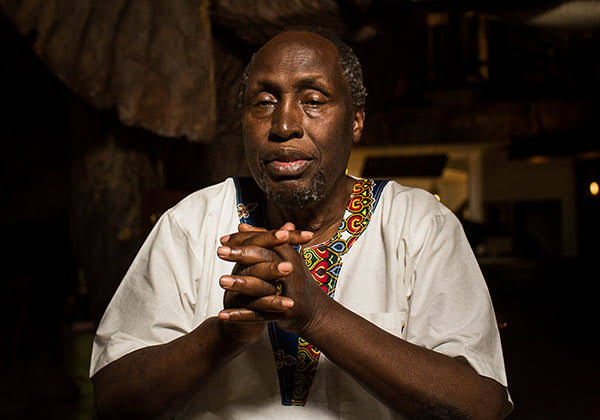
Ngũgĩ wa Thiong’o, Africa’s literary pioneer, has passed away.
He was born on January 5, 1938, is a renowned Kenyan writer, academic, and social activist, widely regarded as one of Africa’s most influential literary figures.
His works, written primarily in English and later in Gĩkũyũ, explore themes of colonialism, neocolonialism, language, and cultural identity.
Ngũgĩ was born in Kamiriithu, near Limuru, in colonial Kenya during British rule. He grew up in a large peasant family and witnessed the Mau Mau uprising, which deeply influenced his political consciousness.

He attended Alliance High School and later Makerere University in Uganda, where he began writing. He earned a degree in English in 1963, the same year Kenya gained independence.
Ngũgĩ initially wrote in English, gaining fame with his first major novel, Weep Not, Child, the first English-language novel published by an East African. His other early works include The River Between and A Grain of Wheat, which critically examine colonialism and its aftermath in Kenya.
In the 1970s, Ngũgĩ’s work became more radical. He rejected Christianity, renaming himself from James Ngugi to Ngũgĩ wa Thiong’o, and began writing in Gĩkũyũ, advocating for African languages in literature. His play Ngaahika Ndeenda, co-written with Ngũgĩ wa Mirii, criticized neocolonial elites, leading to his imprisonment without trial in 1978. While detained, he wrote Devil on the Cross on toilet paper.
After his release, Ngũgĩ faced government persecution and went into exile in 1982, living in the UK, the U.S., and later teaching at Yale, NYU, and the University of California, Irvine. His later works include Matigari, a novel banned in Kenya, Wizard of the Crow, a satirical epic on dictatorship, and Dreams in a Time of War, a memoir of his childhood.
Ngũgĩ argues in Decolonising the Mind that African literature must break from European languages to reclaim cultural identity.
His works expose corruption and Western exploitation in post-independence Africa. He also promoted grassroots theater with the Kamiriithu Community Centre before its shutdown by the Kenyan government.
Ngũgĩ returned to Kenya in 2004 but faced an armed attack, likely politically motivated, forcing him back to the U.S.
He continued to write and advocate for African languages and social justice
He was named a contender for the Nobel Prize in Literature multiple times.
Among his major awards are the Lotus Prize for Literature, the Nonino International Prize, the Park Kyong-ni Prize, and a nomination for the Man Booker International Prize.




