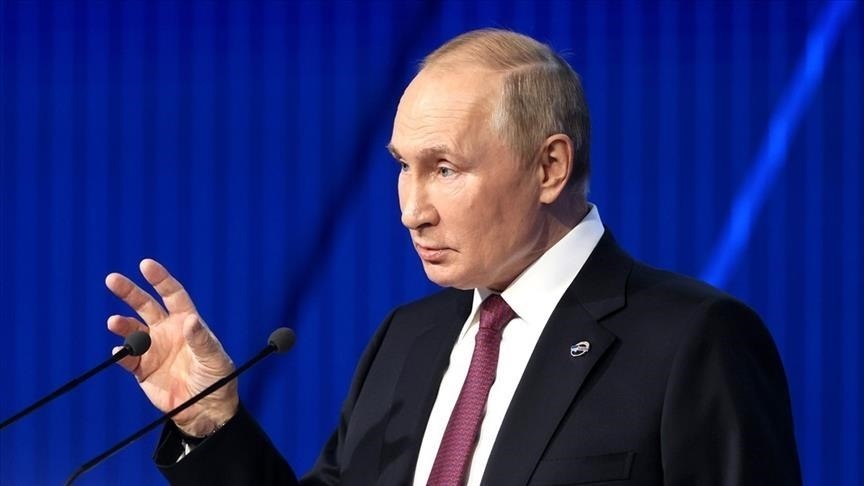
President Vladimir Putin on Wednesday, June 11, 2025, declared that Russia now possesses the world’s most advanced and formidable nuclear arsenal.
Addressing a high-level government meeting, he emphasized that 95 percent of the country’s strategic nuclear forces are currently equipped with state-of-the-art systems.
This, he asserted, reflects the significant progress Russia has made in modernizing its military capabilities.
A central focus of Putin’s speech was the nuclear triad, which he described as a crucial pillar of both national and international security.

The triad consists of three primary components: land-based intercontinental ballistic missiles (ICBMs), submarine-launched ballistic missiles, and long-range strategic bombers.
According to Putin, the triad plays a vital role in ensuring strategic stability and preventing potential aggression against Russia.
He stressed that maintaining and advancing this system is essential for deterring threats and preserving global balance.
Putin’s remarks did not go unnoticed by international defense observers.
Senior military officials in the United States acknowledged that Russia currently maintains a more diverse and modernized nuclear arsenal than their own.
This admission from top American defense personnel highlights a growing concern in Western security circles over the shift in nuclear capabilities.
It also highlights the broader implications for strategic deterrence between major powers.
One of the most significant announcements made during Putin’s address was the confirmation that the Sarmaat intercontinental ballistic missile, referred to by NATO as “Satan II”, has now become operational.
The Sarmaat is one of the most powerful ICBMs ever developed and represents a key component of Russia’s nuclear deterrence strategy moving forward.
Designed to carry multiple nuclear warheads, it is capable of delivering strikes over intercontinental distances.
Moreover, it is engineered to penetrate advanced missile defense systems, making it an especially formidable addition to Russia’s strategic forces.
Its massive payload and near-unlimited range enhance its value as a deterrent and symbol of Russia’s military might.
Beyond nuclear advancements, Putin also addressed the broader scope of Russia’s military development.
He called for further modernization across all branches of the armed forces, citing lessons learned from the ongoing war in Ukraine.
Since the beginning of Russia’s military operation in Ukraine in 2022, the conflict has offered both tactical and strategic insights.
Putin argued that these battlefield experiences should inform future upgrades to Russia’s weapons systems, training protocols, military infrastructure, and overall defense planning.
The conflict in Ukraine, now in its third year, continues to shape Russia’s military priorities.
Putin indicated that practical experience from combat operations is driving innovation and leading to improvements in both technology and military organization.
He stressed the importance of not only maintaining strategic capabilities like nuclear weapons but also enhancing conventional military power to meet emerging threats and changing geopolitical dynamics.
Putin’s statements come amid escalating global tensions, especially between Russia and the West.
Relations with the United States and NATO allies have deteriorated significantly since the outbreak of the war in Ukraine, with military buildups and political rhetoric intensifying on both sides.
Against this backdrop, Russia’s demonstration of nuclear and conventional military strength serves multiple purposes:
- signaling deterrence,
- reinforcing internal confidence, and,
- projecting Russia’s role as a dominant global military power.
By combining a modernized nuclear arsenal with lessons from active conflict zones, Putin seeks to convey a clear message that Russia is not only enduring international pressure.
According to him, Russia is also actively evolving and strengthening its military posture.
The dual emphasis on strategic weapons and conventional capabilities suggests a comprehensive approach to national defense.
This supposedly positions Russia as adaptable, resilient, and prepared to assert its interests in a rapidly changing world order.
Ultimately, Putin’s announcement reinforces the image of Russia as a formidable force in global military affairs, determined to maintain its strategic edge and influence in a time of ongoing geopolitical uncertainty.