


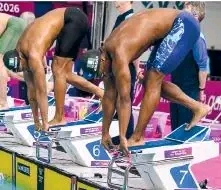
Nigeria’s teenage swimming sensation Abduljabar Adama may have missed out on a place in the final of the men’s 50 metres freestyle at the 2026 Commonwealth Games, but his remarkable performance has given the country every reason to believe that a new era is emerging for Nigerian swimming.
The 17-year-old swimmer bowed out in the semi-finals after finishing sixth in his race with a time of 22.44 seconds, ending an inspiring campaign that captured the attention of sports lovers across Nigeria and beyond.
Although he did not progress to the medal race, Adama’s achievement stands as one of the biggest success stories for Team Nigeria at the Games. Reaching the semi-finals in an event traditionally dominated by swimming powerhouses such as Australia, Canada and England highlights both his exceptional talent and the growing potential of Nigerian swimming.

For a country that has struggled to make a significant impact in international swimming competitions, Adama’s performance represents a major breakthrough.
The young swimmer entered the semi-finals full of confidence after producing an impressive display during the heats, where he became the first Nigerian swimmer at the Glasgow Games to qualify for the last 16.
Competing against some of the fastest sprinters in world swimming, Adama showed maturity beyond his years as he maintained his composure from the start to the finish of the race.
The event was eventually dominated by Australia’s Jamie Jack, who won the semi-final in an impressive 21.55 seconds, while Canada’s Joshua Liendo and Australia’s Flynn Southam also secured places in the final.
For Adama, however, the experience of competing shoulder to shoulder with world-class athletes could prove even more valuable than a medal.
His Commonwealth Games journey is another chapter in what has already become an inspiring career for one of Nigeria’s brightest young sporting talents.
Born with a passion for swimming, Abduljabar Adama has steadily developed into one of Africa’s most exciting prospects through years of discipline, intensive training and consistent improvement.
His breakthrough came on the international stage during the World Aquatics Junior Swimming Championships, where he made history by becoming the first Nigerian swimmer to win a medal at the prestigious competition.
Competing against the world’s best junior swimmers, Adama claimed a silver medal in the men’s 50 metres butterfly while also rewriting Nigeria’s national records.
His success did not happen by chance.
Behind every outstanding performance lies years of dedication, early morning training sessions, strict fitness programmes and countless hours spent perfecting technique.
Swimming is one of the world’s most physically demanding sports, requiring athletes to combine explosive speed, endurance, precision and mental toughness within races that are often decided by fractions of a second.
At just 17 years old, Adama has already demonstrated those qualities.
His progress has been particularly encouraging because Nigeria has historically struggled to compete with countries that invest heavily in aquatic sports.
Limited access to world-class swimming facilities, coaching programmes and international competitions has often slowed the development of talented swimmers across the country.
Despite those challenges, Adama has continued to break barriers and inspire a new generation of young athletes.
Earlier at the Commonwealth Games, he also competed in the men’s 100 metres butterfly, where he delivered another respectable performance against elite opposition.
Although he did not advance beyond the heats, every race provided valuable international experience that will contribute to his long-term development.
Sports analysts believe the teenager possesses all the attributes needed to become one of Africa’s leading swimmers over the coming years.
His explosive starts, powerful stroke technique and competitive mentality have earned praise from coaches and swimming experts who believe he has enormous room for improvement.
Many of the world’s greatest swimmers reached their peak in their early and mid twenties.
With several years still ahead of him, Adama has ample time to develop physically while refining his race strategy and technical ability.
If provided with consistent international exposure and access to advanced training facilities, he could become one of Nigeria’s strongest medal prospects at future Commonwealth Games, World Championships and even the Olympic Games.
His performances have also highlighted the importance of investing in grassroots sports development.
Experts believe Nigeria possesses many talented young swimmers whose potential can only be unlocked through better infrastructure, professional coaching and regular participation in international competitions.
Adama’s achievements prove that Nigerian athletes can compete with the world’s best when given the right opportunities.
His courage and determination have already inspired many young Nigerians to consider swimming as a competitive sport rather than simply a recreational activity.
Beyond the results, his journey sends an important message that talent, discipline and perseverance can overcome many obstacles.
Although his Commonwealth Games campaign has come to an end, Abduljabar Adama leaves Glasgow with his reputation greatly enhanced.
He may not have won a medal this time, but he has gained something equally valuable: international recognition, invaluable experience and the confidence that he belongs among the world’s rising swimming stars.
For Team Nigeria, his emergence is one of the brightest stories of the Games.
For Nigerian swimming, it marks another important step towards a future where competing for medals at the highest level becomes an expectation rather than an ambition.
As the teenager returns home to continue his development, one thing is becoming increasingly clear.
Nigeria has discovered a swimmer capable of carrying the nation’s hopes for many years to come, and Abduljabar Adama’s journey is only just beginning.




