
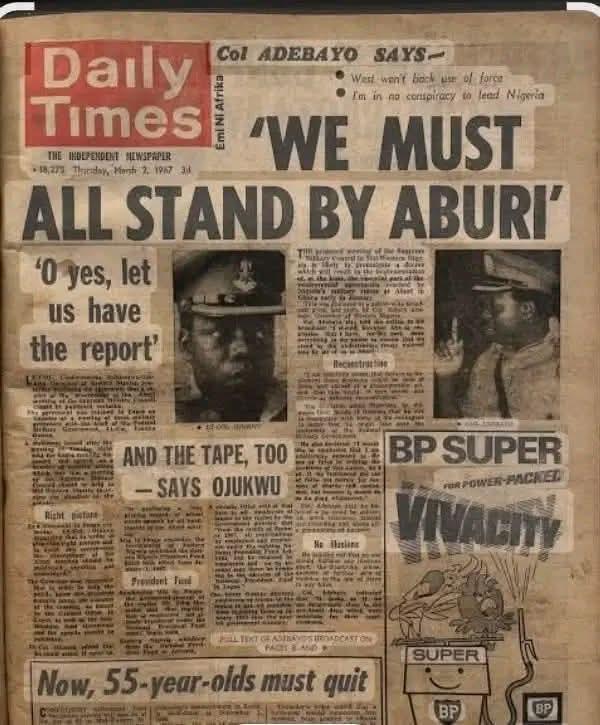
Exactly fifty-nine years ago, on March 2, 1967, a striking headline appeared on the front page of the influential Nigerian newspaper Daily Times. At a time when the country stood dangerously close to collapse, the newspaper published a powerful message that captured the hopes of many Nigerians: “We must all stand by Aburi.” The statement referred to the historic Aburi Accord, a political agreement that many believed represented Nigeria’s last opportunity to resolve its deep national divisions peacefully before the outbreak of the devastating Nigerian Civil War.
In early 1967, Nigeria was already struggling under the weight of intense ethnic suspicion, political instability, and growing violence. The country, which had gained independence from Britain only a few years earlier, was still attempting to forge a unified national identity among its diverse ethnic, religious, and cultural groups. The political structure inherited from colonial rule had concentrated enormous authority in the central government, leaving many regions feeling marginalized and fearful of domination by others.
The tensions intensified following the military coups of 1966, which dramatically altered the political landscape and further deepened mistrust among Nigeria’s major ethnic groups. In response to the growing crisis, leaders from across the country gathered in the quiet town of Aburi in Ghana in January 1967 in a last-ditch effort to negotiate a peaceful solution. The meeting brought together Nigeria’s military leadership, including representatives of the federal government and leaders from the Eastern Region.
The Aburi talks were widely viewed as a moment of hope. After intense discussions, the leaders reached an agreement that proposed a new framework for governing Nigeria. The essence of the Aburi Accord was simple yet profound: power would be significantly decentralized. Rather than concentrating authority in the central government, the accord proposed granting substantial autonomy to Nigeria’s regions. Each region would have greater control over its security, resources, and internal governance, while the central government would retain only limited responsibilities such as foreign affairs and national defense.
At the time, many observers believed this approach represented the most realistic way to preserve Nigeria’s unity while acknowledging the country’s immense diversity. By empowering the regions and reducing fears of domination by any single ethnic group, the Aburi Accord offered what many considered a balanced solution to Nigeria’s mounting political tensions. It was this hope that prompted the Daily Times editorial board to urge Nigerians to “stand by Aburi,” emphasizing that the agreement might be the country’s best chance to avoid catastrophic conflict.

Unfortunately, the optimism surrounding the accord proved short-lived. Soon after the leaders returned from Ghana, disagreements began to emerge over the interpretation and implementation of the agreement. Political and military authorities in different parts of the country held conflicting views about what the Aburi Accord actually required. These disagreements quickly eroded the fragile trust that had been built during the negotiations.
Within months, the situation deteriorated rapidly. Political tensions escalated, violence intensified, and diplomatic efforts to salvage the agreement collapsed. By May 1967, the Eastern Region declared independence as the Republic of Biafra, setting the stage for one of the most tragic chapters in Nigerian history. The Nigerian Civil War, which lasted from 1967 to 1970, resulted in the deaths of more than a million people, many of them civilians who perished from starvation and disease.
Looking back nearly six decades later, many historians and political analysts argue that the collapse of the Aburi Accord marked a turning point that fundamentally shaped Nigeria’s political trajectory. For critics of the current centralized system of governance, the failure to implement the agreement represents a missed opportunity that might have prevented the war and perhaps led Nigeria down a very different path.
Supporters of regional autonomy often point out that the issues the Aburi Accord sought to address have not disappeared. Nigeria continues to grapple with complex challenges, including insecurity, economic inequality, political tensions, and widespread dissatisfaction with governance. For some commentators, these persistent problems highlight the limitations of an overly centralized federal system that struggles to accommodate the country’s vast diversity.
Advocates of restructuring argue that Nigeria’s current political framework still reflects many of the structural imbalances that existed in the 1960s. They believe that granting greater autonomy to the regions—similar to what the Aburi Accord proposed—could empower local governments to address their unique economic and security challenges more effectively. Others go further, suggesting that if meaningful restructuring proves impossible, peaceful constitutional arrangements that allow regions greater self-determination might become part of future national discussions.
However, many Nigerians strongly disagree with such perspectives. Supporters of the existing federal structure argue that the lessons of the civil war demonstrate the importance of preserving national unity at all costs. They contend that fragmentation or excessive decentralization could weaken the country and create new sources of instability.
Despite these differing views, the Aburi Accord remains one of the most frequently referenced historical events in discussions about Nigeria’s political future. The memory of the agreement continues to serve as a reminder of a moment when dialogue and compromise briefly appeared capable of resolving the country’s deepest divisions.
For historians, the story of Aburi is not only about political negotiations but also about the fragile nature of trust in a diverse nation struggling to define itself. The leaders who met in Aburi in 1967 faced an extraordinarily complex challenge: balancing the aspirations of multiple regions while preserving a unified national state.
Nearly sixty years later, the debates sparked by the Aburi Accord remain deeply relevant. Nigeria is now a far larger and more complex country than it was in 1967, with a population exceeding 200 million people and an economy that plays a crucial role in Africa’s development. Yet the fundamental questions raised during the Aburi negotiations—how power should be shared, how diversity should be managed, and how national unity can coexist with regional autonomy—continue to shape political discourse.
For many observers, the anniversary of the Daily Times headline serves as a moment for reflection. It recalls a time when a negotiated political settlement seemed within reach and when the hope of avoiding conflict briefly united voices across the country.
Whether Nigeria could have followed a different path if the Aburi Accord had been fully implemented remains one of the great “what if” questions of the nation’s history. What is certain, however, is that the lessons of that moment still resonate today, reminding Nigerians that the search for a stable, inclusive, and effective system of governance remains an ongoing journey.