


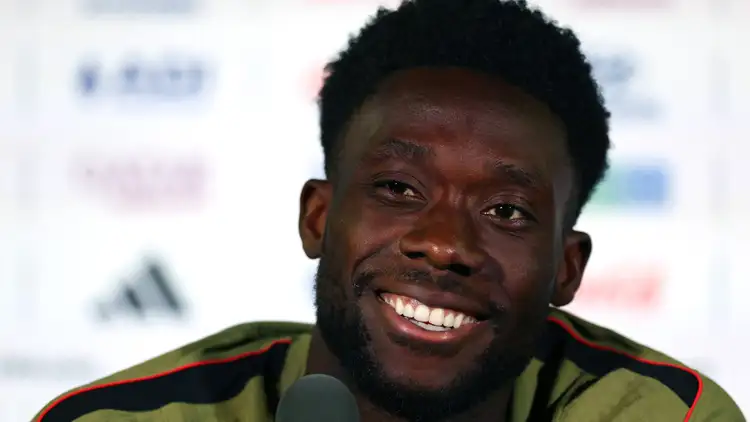
Canada’s long-awaited breakthrough into the knockout stage of the 2026 FIFA World Cup has been overshadowed by one of the tournament’s most intriguing subplots, the uncertain status of star defender Alphonso Davies, whose fitness, role, and readiness remain closely guarded secrets ahead of a historic Round of 32 clash against South Africa in Los Angeles.
The match marks Canada’s first appearance in a men’s World Cup knockout stage, a milestone that reflects the rapid growth of football in the country and the impact of sustained investment in youth development, coaching structures, and international player exposure. However, attention has increasingly shifted toward Davies, the nation’s most influential player, whose recovery journey has become a defining storyline of Canada’s campaign.
Davies, who suffered a serious knee injury in March 2025 during international duty, has been officially included in the squad but remains a highly uncertain figure in terms of match involvement. While he has returned to training and is considered fit enough to be available, Canada’s coaching staff have not confirmed whether he will start, feature as a substitute, or remain unused in a precautionary role.

Head coach Jesse Marsch has carefully managed public communication around Davies’ condition, at times offering optimistic updates that did not align with matchday decisions. This approach has sparked speculation that Canada have deliberately adopted a controlled messaging strategy to mask their internal recovery timeline and tactical planning ahead of the knockout phase.
Inside the camp, Davies’ rehabilitation has been supported by a dedicated performance specialist, Matthias Blankenburg, a German strength and conditioning expert whose presence has drawn attention throughout the tournament. Blankenburg, who has previously worked with elite European players including those at Bayern Munich, has been working closely with Davies on individualized training programs designed to restore full match sharpness while minimizing injury risk.
His visible role during training sessions has added to the intrigue surrounding Canada’s preparation. Observers note that Blankenburg often operates independently of the main coaching group, focusing exclusively on Davies’ physical workload, recovery routines, and on-field reintegration exercises. His approach reflects a highly tailored strategy commonly used for elite athletes returning from long-term injuries.
Marsch has defended the arrangement, comparing top-level footballers to high-performance machines requiring precise management. He emphasized that Davies’ recovery is being treated with extreme caution, given his importance to Canada’s tactical structure and long-term football future. According to Marsch, every decision regarding Davies is based on medical benchmarks rather than competitive urgency.
Despite the uncertainty, Davies remains an influential presence within the squad. Even while not fully active in matches, he has played a leadership role in the dressing room, offering encouragement to younger players and maintaining a visible connection with team preparations. His presence alone has been described as a psychological boost for Canada as they navigate uncharted knockout-stage territory.
Canada’s journey to this stage has been built on structured tactical evolution, improved defensive discipline, and a more cohesive attacking system that has matured significantly over the past two years. The team’s group stage performances demonstrated resilience and adaptability, securing enough points to progress into the Round of 32 and set up a historic encounter with South Africa.
South Africa, meanwhile, arrive in the fixture with confidence following an impressive group stage campaign that showcased their tactical organization and counterattacking efficiency. Their qualification represents a major achievement for African football, reinforcing the continent’s growing competitiveness on the global stage.
The matchup presents a compelling contrast in footballing identity. Canada rely on structured buildup play, disciplined positioning, and pace in wide areas, while South Africa emphasize compact defensive organization and quick transitions into attack. Analysts expect a tightly contested match where individual moments of quality could determine the outcome.
A major tactical question revolves around whether Canada will risk introducing Davies into such a high-pressure environment. His explosive pace, defensive versatility, and ability to transition rapidly from defense to attack make him a potentially decisive factor. However, his recent injury history raises concerns about durability over a full ninety minutes.
The psychological dimension of Davies’ situation has also become a focal point of media attention. Reports from within the Canadian camp suggest that even his availability for selection has been kept deliberately ambiguous, with coaching staff avoiding clear indications during press conferences. This has created what many describe as a “controlled uncertainty” around Canada’s most valuable asset.
For Canada, the stakes could not be higher. A victory would not only secure a place in the Round of 16 but also represent the most significant achievement in the history of Canadian men’s football. For South Africa, the match offers an opportunity to continue their breakthrough tournament run and further establish themselves as a rising force in international football.
The encounter will take place in Los Angeles, a neutral yet symbolically significant venue for Canadian football, where Davies last appeared before his long injury layoff. That previous match ended in disappointment due to his injury, adding emotional weight to his potential return in the same city.
Supporters from both nations are expected to create a vibrant atmosphere, with thousands of Canadian fans traveling to support their team alongside a strong South African contingent. The global audience for the fixture underscores its importance as one of the standout ties of the Round of 32 stage.
As kickoff approaches, attention remains fixed on one central question, whether Alphonso Davies will finally step onto the pitch and mark his return on football’s biggest stage. Whatever the decision, Canada’s historic knockout debut and South Africa’s resurgence ensure a high-stakes encounter defined by ambition, uncertainty, and global attention.




