
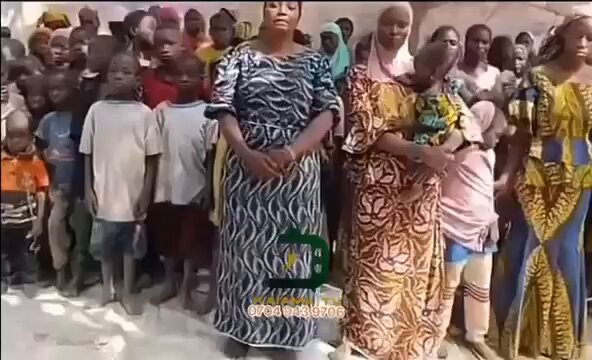
In an unfolding tragedy that has gripped the nation and ignited fresh outrage over Nigeria’s ongoing security crisis, suspected Boko Haram insurgents have released a disturbing video showing scores of abducted villagers from Kwara State being paraded in captivity — a stark spectacle that lays bare both the brutality of extremist violence and the growing frustration with government responses to such attacks. The footage circulating online on February 14, 2026 shows nearly 176 captives — men, women, children and even a nursing mother — held in distressing conditions, raising urgent questions about the scale of recent violence and the capacity of the state to protect its citizens.
The incident traces back to a deadly assault on the rural Woro community within Kaiama Local Government Area of Kwara State, where fighters from the extremist group linked to Boko Haram stormed the village in early February, killing a reported dozens of residents and abducting scores more. Local sources tied the attack to larger patterns of violence in the region, which has seen thousands of Nigerians killed or kidnapped over the past year alone amid an expanding militant presence.
What transforms this already harrowing episode into something unprecedented — and profoundly unsettling for communities across Nigeria — is the video itself. Circulated widely on social media platforms and picked up by outlets like SaharaReporters, the clip shows rows of captives, many of them visibly shaken and wearing tattered clothing, standing under the watchful eyes of armed men in a wooded area. At one point, an insurgent interrogates the captives in Hausa, repeatedly asking them to identify where they were abducted from. Time and again, they reply in unison that they were taken from the Woro community in Kaiama.
Watch the Video below:
In the same recording, a militant speaker steps beyond the chilling display. He directly accuses the Kwara State Government — and by extension the federal authorities — of spreading misinformation about the scale of the abductions, alleging that officials had publicly stated only 20 to 30 people were taken, while the group claims to be holding many more. “Your infidel government lied about your number to be around 20 to 30 people,” the man says in the video, a statement that has since fueled social media outcry and intense debate over transparency in reporting such incidents.

The video’s release has struck a raw nerve with Nigerians both within and beyond Kwara State. For families of the abducted, the footage has turned anxiety into anguish, while for critics of the government’s handling of the security crisis, it has become evidence of official underreporting and a broader pattern of miscommunication that erodes public trust. Across the platform X — formerly Twitter — posts condemning both the attack and what some see as government complacency have proliferated, with users accusing authorities of failing in their constitutional duty to protect lives and property. Many remarked bitterly that the video itself had become a form of propaganda, though not in a sense that protects Nigeria’s image, but rather in exposing how deeply the crisis has penetrated communities.
In response to the video and mounting concerns, the Kwara State Government acknowledged that some of the victims shown had been identified and emphasised ongoing efforts to secure their safe release in collaboration with security agencies. The state Commissioner for Communications affirmed that authorities were taking the situation seriously, even as calls for stronger and more decisive action grow louder among civic groups and human rights advocates.
The Human Rights Writers Association of Nigeria (HURIWA) has been one of the most vocal organizations calling for immediate federal intervention, urging President Bola Ahmed Tinubu to declare a state of emergency in Kwara State to enable a more coordinated military response to the insurgent threat. HURIWA’s National Coordinator, Comrade Emmanuel Nnadozie Onwubiko, warned that continued inaction would represent a profound governance failure, given that over 300 people were reported killed in similar violence across the state this year alone.
The scale and imagery of the video have also renewed focus on the severe security challenges facing Nigeria, particularly in its rural and frontier communities. Despite ongoing efforts by the Nigerian Armed Forces and security agencies to contain militant groups across the northeast and parts of the northwest, episodes like the Woro attack underscore how insurgent actors like Boko Haram and affiliated factions exploit ungoverned spaces, porous borders and overstretched security resources. (Wikipedia)
Security analysts warn that Nigeria’s insecurity has evolved beyond sporadic banditry into coordinated extremist operations that combine killings, kidnappings, arson and now — as the parading of captives demonstrates — psychological warfare. By releasing footage of their captives and leveling accusations against state authorities, these groups are not just committing atrocities on the ground but are shaping the narrative that reaches millions online, amplifying fear and undermining confidence in government responses.
This brutal strategy marks a worrying trend in conflict communication — one where militants use visual propaganda to influence public perception, weaken state authority, and recruit sympathisers. In the context of global security, violent extremist actors increasingly blend physical violence with digital messaging, exploiting gaps in local governance and international awareness to broaden their impact.
For the families whose loved ones appear in that video, the consequences are more than theoretical or political; they are painfully personal. Each face in that row of captives represents a shattered life, a community in grief and a national crisis that refuses to fade into statistics. They punctuate the grim reality that in much of Nigeria’s countryside, extremist violence remains a daily threat — one that has claimed thousands of lives and uprooted countless more.
Amid the shock and outrage, one question looms larger than any other: can Nigeria’s government and security architecture rise to meet the scale of this threat, or will such heartbreak become yet another chapter in a perennial cycle of violence? This latest episode in Kwara — a stark, brutal broadcast of human suffering — has not only intensified pressure on his administration but also reminded a nation of the human toll of insecurity that no official narrative can fully contain.
The Woro captives’ ordeal, as revealed in the chilling video, is a sobering call to action — a reminder that beyond political debate and policy statements, real human lives hang in the balance. For Nigeria and its people, the imperative is clear: security must move from rhetoric to relentless, effective execution, lest more families experience the anguish now exposed to the world.