
“The new finance minister, an accountant who cleaned up the books of one of Nigeria’s smaller states, is poorly qualified for the job. Her counterpart in the investment ministry is a respected businessman, but he may lack the clout to stand up to a president with statist leanings. “It’s a government with local professionals and without superstars,” says Shehu Sani, a senator of the ruling party.” – The Economist
ABOVE: Finance minister Kemi Adeosun signs the register before Nigerian President Mohammadu Buhari after taking the oath of office.

 Before her nomination to the cabinet, Kemi Adeosun — a former investment banker with Chapelhill Denham, and UK-trained accountant, she worked as senior manager with price waterhouse coopers — was working as the finance commissioner for Ogun State. Now she will oversee Africa’s largest economy as finance minister, tasked with shoring up an economy that has struggled since the oil price crashed last year.

She also acquired B. Sc (hons) applied economics from university of east london (1986-1989)
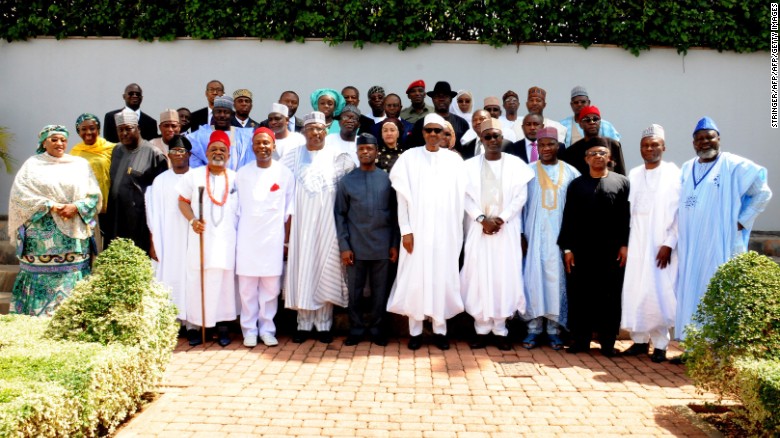 Nigerian President Mohammadu Buhari poses for a family photo with newly-appointed ministers after the swearing in ceremony in Abuja.
Six months after taking office, Nigerian president Muhammadu Buhari finally named his cabinet, who will oversee Africa’s largest economy. The country has experienced a decade of economic growth, but a 40% fall in the price of oil — which makes up most of the government’s budget — and a damaging insurgency in the north have undermined growth and confidence.
Buhari, who won elections in March on a platform of fighting corruption, inequality and militancy, has named a combination of technocrats, political allies and relative unknowns to his ministry.
The president has failed to please all as he juggles the demands of his party and people. His decision to keep the oil post for himself, while appointing the Nigerian National Petroleum Corporation’s new head as his deputy, was designed to keep the valuable resource in hands he can trust. But it raises concerns over the centralisation of power. Ethnic groups of the south-east who mostly voted for Mr Jonathan in this year’s election are feeling neglected. Critics also fret over an absence of desperately needed financial expertise.
The respected publication, The Economist however states: “Africa’s biggest economy, which relies on oil for 70% of its revenue, is sputtering as prices fall. Economic policy has been adrift since Mr Buhari came to power, and investors complain about the central bank’s use of trade controls and import restrictions. However, the new finance minister, an accountant who cleaned up the books of one of Nigeria’s smaller states, is poorly qualified for the job. Her counterpart in the investment ministry is a respected businessman, but he may lack the clout to stand up to a president with statist leanings.
“It’s a government with local professionals and without superstars,” says Shehu Sani, a senator of the ruling party.”
According to Bloomberg however, Adeosun may struggle to convince Nigerians she is right for the job because she doesn’t have a high profile like her predecessor. Ngozi Okonjo-Iweala, who stepped down as finance minister after Jonathan lost the election to Buhari in March, was previously a managing director at the World Bank.
www.elombah.com