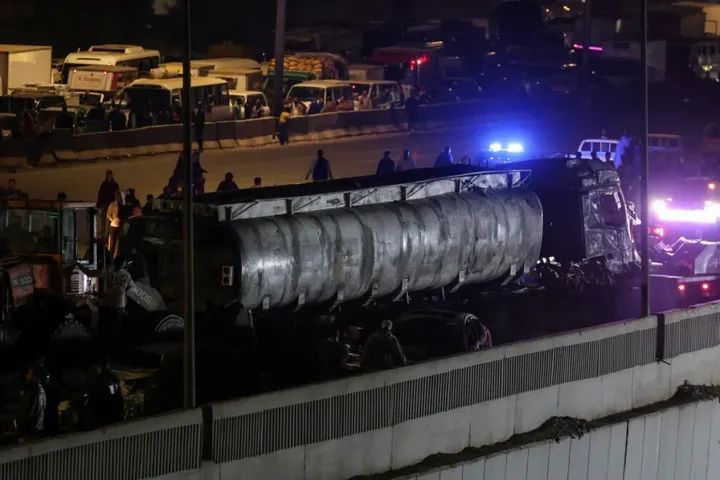
CAIRO, EGYPT — At least 30 people have been killed and 15 others injured after a vehicle transporting petroleum products overturned and burst into flames on a major highway in Egypt’s Greater Cairo area, triggering a massive fire that engulfed several vehicles.
The accident occurred on Wednesday, November 25, 2026, along Cairo’s Ring Road in the Al-Warraq district of Giza Governorate, near the Imbaba area. The Egyptian Ministry of Health and Population confirmed the initial casualty figures, warning that the situation remained under assessment.
According to the ministry, the vehicle carrying petroleum products overturned near a tunnel, causing an intense fire that rapidly spread to nearby vehicles travelling along the busy highway.
The incident transformed a section of the road into a major emergency scene, with thick smoke rising above the area as firefighters and rescue personnel battled the flames and attempted to reach people trapped inside burning vehicles.
Egyptian authorities deployed 39 ambulances to the scene to evacuate victims and provide emergency medical assistance. The 15 injured people were transported to nearby hospitals, including Sheikh Zayed Specialist Hospital, Imbaba General Hospital and Warraq Central Hospital.
Health Minister Khaled Abdel Ghaffar said he was monitoring the medical response and directed hospitals in the surrounding area to increase their emergency preparedness to accommodate casualties.
The minister also indicated that the reported death toll was preliminary, leaving open the possibility of further updates as rescue operations and casualty assessments continued.
Egyptian state media reported that the tanker was privately operated. The Petroleum Ministry said the vehicle veered off the road and crashed before exploding.
However, the precise circumstances that caused the driver to lose control remained under investigation. Local media reported claims that a high-voltage electricity cable may have fallen in front of the truck, forcing it off course and causing it to cross the concrete median barrier before overturning.
Authorities have yet to establish that account as the definitive cause of the disaster.
The impact of the explosion and subsequent fire extended beyond the tanker itself. More than two dozen cars and motorcycles were reportedly left charred, while rescue workers worked to remove victims and clear the wreckage.
The Public Prosecution has opened an investigation into the incident, directing security authorities to establish the circumstances surrounding the crash. Forensic experts were also assigned to examine the scene, determine the origin and spread of the fire, and assess the damage.
Prosecutors visited the location and began gathering evidence, including questioning injured survivors about what happened before and during the explosion.
Prime Minister Mostafa Madbouly has been monitoring developments through consultations with relevant ministers. He directed authorities to ensure that injured victims receive necessary medical treatment and that affected families receive appropriate support and compensation.
President Abdel-Fattah el-Sisi also expressed condolences to the families of those who lost their lives, as the government faced pressure to establish how the deadly incident occurred.
The disaster disrupted traffic along the Ring Road, one of the most important transport routes serving Greater Cairo. The highway connects major roads across Cairo, Giza and Qalyubia, making it a critical route for commuters and commercial transportation.
Sections of the road were closed following the incident, causing congestion and affecting Bus Rapid Transit operations. The BRT operator said it activated emergency measures to manage passenger demand and minimise disruption to services.
The tragedy has renewed concerns about road safety and the transportation of highly flammable petroleum products through densely populated urban areas.
Egypt has recorded several deadly road accidents in recent years, with speeding, poor road conditions, inadequate vehicle maintenance and weak enforcement of traffic regulations frequently identified as contributing factors.
The latest disaster, however, raises additional questions about the safety requirements governing petroleum tankers, emergency response arrangements and the measures available to prevent fuel-related accidents from spreading to other road users.
Investigators are expected to examine the vehicle’s condition, its operational arrangements, the circumstances of the reported loss of control and the factors that allowed the fire to spread across the highway.
For families awaiting information about missing relatives and survivors receiving treatment, the immediate priority remains the identification of victims, medical care and access to support.
Authorities have not yet announced a final casualty assessment or concluded their investigation into the cause of the crash.