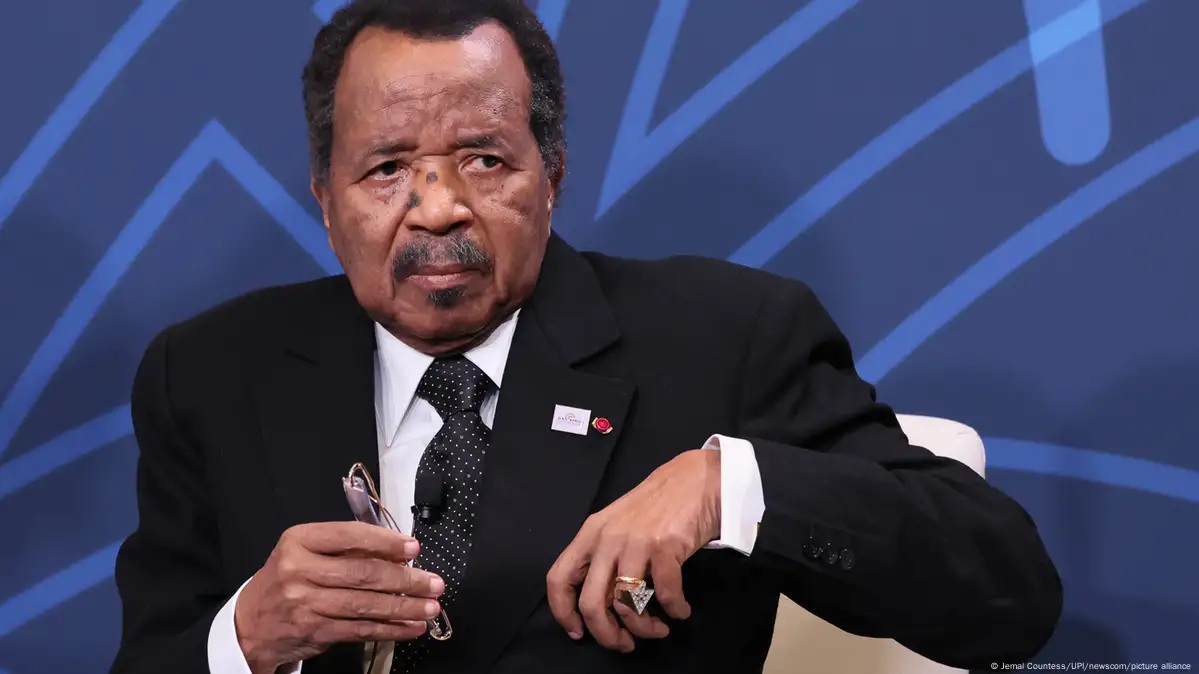
At 92 years old, Paul Biya, the longest-serving president in Cameroon’s history, and the world’s oldest and longest serving non-royal head of state, .has announced his candidacy for the upcoming presidential election in October. Biya, has made the announcement in posts on X on Sunday,July 13th in both French and English. “I am a candidate in the presidential election,..Rest assured that my determination to serve you matches the urgency of the challenges we face.”
This will be his eighth consecutive bid for the presidency, solidifying his position as Africa’s second-longest-serving head of state after Equatorial Guinea’s Teodoro Obiang.The phenomenon of “sit-tightism” among African leaders has become a recurring pattern, hindering development and sparking conflicts across the continent. This trend is exemplified by leaders like Robert Mugabe of Zimbabwe, Yoweri Museveni of Uganda, and the late Hosni Mubarak of Egypt, who clung to power for decades. In fact in 2009, Biya was ranked 19th in Parade Magazine’s Top 20 list of “The World’s Worst Dictators”.
Biya has been at the helm of Cameroon’s government since 1982, when he succeeded his predecessor, Ahmadou Ahidjo. Over the years, he has maintained a firm grip on power, often through a combination of strategic maneuvering and repression. In 2008, Biya removed presidential term limits, allowing him to seek re-election indefinitely . This was followed by civil unrests throughout the country, with major violent riots in the Western, English-speaking part of the country starting with a “strike” initiated by taxi drivers in Douala, allegedly causing more than 200 casualties in the end.
Despite his advanced age, Biya has dismissed concerns about his health, which have been a subject of speculation for years. In 2023, the government banned public discussion of Biya’s health, labeling it a national security issue. However, this directive has been largely ignored by Cameroon’s outspoken media. Biya’s prolonged absences from public life have fueled rumors about his well-being, with many questioning whether he is truly fit to lead the country .He seldom makes public appearances, while he has been known for delegating responsibilities to the powerful chief of staff of the president’s office.
Under President Paul Biya’s leadership, Cameroon has faced numerous pressing issues that have significantly impacted the country’s stability and development. One of the major challenges is the separatist crisis in the English-speaking regions, where violent clashes between government forces and armed separatist groups have resulted in significant human suffering, including unlawful killings, abductions, and raids on villages. This conflict, now in its sixth year, has led to the displacement of over 638,000 people and left at least 1.7 million individuals in need of humanitarian aid. The crisis has also severely impacted the education sector, with over 2,245 schools not functioning due to attacks and threats from armed separatists .
In addition to the separatist crisis, Cameroon has also, just like Nigeria struggled with the Boko Haram insurgency in the far North region. In fact, Boko Haram militants have launched numerous attacks on civilians, resulting in killings, abductions, and lootings. According to reports, at least 169 civilians died in attacks by non-state actors between January and July 2023. The government’s response to these attacks has been marked by serious abuses, including extrajudicial killings and arbitrary detentions .
Also, the economic challenges facing Cameroon have been further exacerbated by the ongoing security crises. The country continues to grapple with high levels of unemployment and poverty, which contribute to instability. Limited access to quality education and healthcare services has also worsened societal tensions. According to the World Bank, Cameroon’s economic structure and performance do not meet the criteria for a socially responsible market democracy, with the country ranking low in human development indicators .
The combination of these security and economic challenges have had a devastating impact on Cameroon’s development and stability. There is no doubts that the government’s handling of these crises will be crucial in determining the country’s future prospects. With presidential elections scheduled for 2025, the international community is closely watching Cameroon’s progress, urging the government to prioritize human rights, accountability, and inclusive dialogue to address the country’s multifaceted crisis .
Worthy of note is that Biya’s regime is supported by France, one of the former colonial powers in Cameroon, which supplies it with weapons and trains its military forces. France is also the leading foreign investor in Cameroon.
Indeed , it is believed in many quarters that France’s tactical support for Biya has engineered his ability to shore up his tenuous hold on power.
Undoubtedly, Biya’s decision to seek re-election has been met with widespread criticism from opposition parties and civil society groups. Many argue that his prolonged rule has hindered both economic progress and democratic growth in Cameroon. Several opposition figures have announced their candidacy, including Maurice Kamto of the Cameroon Renaissance Movement and Joshua Osih of the Social Democratic Front.
One fact of history is now going to be certain, If President Paul Biya wins the upcoming election, he will be nearly 100 years old by the end of his term, sparking concerns about Cameroon’s future leadership and stability. Given his advanced age and recent health issues, there are fears that Biya’s absenteeism could lead to a vacuum in leadership, potentially allowing non-elected officials to direct the country’s affairs without accountability.
In other words, Biya’s prolonged absence could create a governance vacuum, characterized by decision-making paralysis and increased bureaucratic inefficiency. This situation is reminiscent of past instances in other countries, such as Nigeria, like during the Yar’Adua regime, where a faceless cabal took control of the government.
The uncertainty surrounding Biya’s health and potential succession could lead to power struggles within the ruling party, potentially destabilizing the country. Unfortunately, Cameroon’s stability would be seriously compromised, particularly given the ongoing separatist conflict in the Anglophone regions and the threat of Boko Haram attacks .
Although, several opposition figures have also declared their intention to run in the 2025 elections , including 2018 runner-up Maurice Kamto of the Cameroon Renaissance Movement, Joshua Osih of the Social Democratic Front, lawyer Akere Muna and Cabral Libii of the Cameroon Party for National Reconciliation, but it is extremely hard to see how any of these could up stage the well oiled political hegemony of Paul Biya.
And not unexpectedly, Biya’s announcement has sparked a wave of public backlash, with many Cameroonians calling for democratic change and accountable leadership. Therefore, the outcome of the October 12 election will have significant implications for Cameroon’s future, with many citizens calling for democratic change and accountable leadership. The international community is also watching closely, given Cameroon’s strategic importance in Central Africa and its role in regional security . Human rights lawyer Nkongho Felix Agbor argues that “after over 40 years in power, what the country needs is renewal and not repetition. Cameroonians deserve democratic change and accountable leadership” .
In conclusion President Paul Biya’s prolonged rule has sparked intense debate about the impact of long-standing leadership on Cameroon’s development. Of a truth, Biya’s tenure has been marked by a certain level of stability and continuity, but also stagnation and missed opportunities. There is no iota of doubts that the country’s economic and social progress has been hindered by Biya’s reluctance to relinquish power, leading to a lack of fresh perspectives and innovative ideas.
The implications of Biya’s potential reelection are far-reaching, with many Cameroonians calling for democratic change and accountable leadership. As the world rapidly evolves, countries with dynamic leadership and a tradition of progressive ideas are better positioned to harness the benefits of globalization and technological advancements. In contrast, nations with entrenched leaders often struggle to adapt to changing circumstances, leading to stagnation and underdevelopment.
The outcome of the October 12 election will therefore have significant implications for Cameroon’s future. A new generation of leaders could bring much-needed reforms, injecting fresh energy and ideas into the country’s development trajectory. Conversely, another term for Biya would likely perpetuate the status quo, potentially exacerbating existing challenges and limiting opportunities for growth and progress.
Ultimately, Cameroon’s future depends on its ability to break free from the shackles of prolonged leadership and embrace a new era of democratic change and accountable governance. As the country stands at a crossroads, the world watches with bated breath, hoping that Cameroonians will seize the opportunity to shape their own destiny and forge a brighter future for themselves and future generations.