


By Chris Agbedo
Mortality, Political Vanity and the Broken Mortar of Public Life
Part I established the immediate question: can Nigeria translate its public-health commitments into demonstrable preparedness? Part II turns to the deeper moral and political implications of the crisis.
Ebola’s appearance in Abuja has disturbed the comfortable distance between political spectacle and human vulnerability. It has reminded us all that the institutions, resources and privileges accumulated around public office cannot abolish the biological conditions of existence.
But will the fear generated by this moment produce a more responsible political culture? Or will the country return to its familiar routines once the immediate danger recedes?
The answer cannot be supplied by virology alone. It requires an interrogation of the values through which Nigerians understand wealth, power, leadership and the meaning of a life well lived.

The final arbiter and the theology of mortality.
The phrase final arbiter carries a theological resonance that deepens the editorial’s central argument.
Ecclesiastes 3:20 declares that all return to dust. James 4:14 describes human life as a mist that appears briefly before disappearing. Psalm 90:12 asks for wisdom in numbering our days. In Luke 12:16–21, the rich man whose barns overflow with accumulated produce discovers that his possessions cannot guarantee the continuation of his life.
These passages do not condemn material prosperity or suggest that every wealthy person is morally deficient. Their deeper concern is the illusion that accumulation can abolish finitude, that status can defeat vulnerability or that power can make its possessor permanently independent of the human condition. The rich man in Luke’s parable is particularly instructive. His calculations are organised around abundance, expansion and private security. His possessions become the centre of his imagined future, but he fails to reckon with the limits of that future. He has planned for storage but not for mortality; he has calculated his surplus but not the obligations that accompany it.
Does this not offer a searching metaphor for a political culture in which electoral ambition can consume the national imagination while the ordinary conditions of human security remain inadequately addressed?Consider the contrast. Political actors spend enormous energy negotiating alliances, calculating defections, positioning loyalists and projecting themselves towards the elections of 2027 and even 2031. Yet a confirmed infectious-disease case immediately raises questions about the adequacy of hospitals, laboratory capacity, emergency financing and public communication.
The point is not that electoral politics is unimportant. Democratic competition is indispensable to accountable government. The point is that electoral ambition loses its moral legitimacy when the pursuit of office displaces the responsibilities for which office exists. The theological lesson is therefore not that Ebola has arrived to punish Nigerian politicians. Such a claim would be irresponsible. Infection is not proof of sin, and illness should never become a weapon of religious condemnation.
Rather, mortality supplies a moral test. It asks what people do with the time, authority and resources entrusted to them. It asks whether wealth becomes stewardship or self-enrichment, whether public office becomes service or private possession, and whether political leadership is measured by the grandeur of ceremonies or the security of citizens. In this sense, Ebola may function as a metaphorical final arbiter—not of who deserves to live or die, but of the credibility of our claims to compassion, civilisation and responsible governance.
The phantasmagoria of 2027 and 2031.
Nigeria’s political imagination is already crowded with the next electoral cycle. Presidential permutations, coalition negotiations, zoning calculations, defections, campaign machinery and speculative calculations about succession occupy the public arena. Some of these activities are legitimate expressions of democratic competition. The danger emerges when political ambition becomes an end in itself and public institutions are treated merely as instruments for acquiring and retaining office.
What is the value of a presidential ambition in a country where access to reliable emergency healthcare remains uncertain? What does an extravagant campaign promise mean to a family that cannot afford prompt medical attention? What is the significance of a political convoy if the institutions that protect the public are unable to demonstrate operational readiness? These questions are not intended to diminish the importance of political leadership. They are intended to restore politics to its proper purpose.
Government exists to organise collective life, protect citizens, manage shared resources and create conditions in which human beings can live with dignity. Elections matter because government matters; government matters because human lives matter.
When these priorities are reversed, political life becomes a theatre in which the actors mistake the applause for the substance of their achievement. The stage is crowded with personalities, the language is saturated with promises, and the future is repeatedly presented as the private possession of those seeking power. An emergency changes the terms of the performance. It asks what remains when the campaign slogans are set aside and citizens require practical protection. Ebola does not make the 2027 election irrelevant. It makes the quality of leadership more urgent. Every aspirant should be judged not merely by the office sought, but by the institutions strengthened, the public services improved and the human vulnerabilities reduced under his or her leadership.
Political legitimacy cannot rest indefinitely on promises about tomorrow while the elementary requirements of public security remain uncertain today.
Trillions appropriated, lives exposed.
And what of the money?
What becomes of the trillions appropriated in public budgets, the projects announced with fanfare, the contracts awarded, the infrastructure promised and the expenditures whose actual public value remains contested? What happens when the language of development becomes more impressive than the services citizens can verify?
These questions must be asked without confusing allegations with established findings. An uncompleted project is not automatically proof of theft, and an opaque expenditure is not, by itself, a judicial determination of corruption. Evidence, audit and due process remain indispensable. Yet, the obligation to ask hard questions does not disappear merely because a government is confronted with an emergency. On the contrary, emergency expenditure requires rigorous accountability precisely because urgent procurement can involve accelerated timelines and substantial discretion.
The ₦10 billion Ebola preparedness fund therefore becomes a useful test case. The public needs an account of the resources released, the procurement undertaken, the equipment delivered, the personnel trained and the operational capabilities established.
A budgetary announcement is not a hospital bed. A contract is not a functioning laboratory. A press release is not protective equipment. An appropriation cannot trace a contact or diagnose an infection.
Public money must become public capability.
This is the point at which the Broken Mortar and Rotten Palm-Nut Metaphor becomes an illuminating lens for Nigerian governance. Imagine a society pounding rotten palm nuts in a broken mortar, expecting oil to emerge from a process whose basic conditions have already been compromised. The effort may be vigorous, the pounding noisy and the expectations extravagant. Yet, the desired result remains elusive because the material and the instrument are defective. The metaphor captures the absurdity of expecting effective public services from systems in which resources are inadequately tracked, institutions are weakly coordinated, procurement is insufficiently transparent and political publicity substitutes for measurable performance.
The question is not whether Nigeria lacks money in every sector. It is whether public resources are converted into the capacities required to secure collective well-being.
Ebola makes that question immediate. If a government announces billions for preparedness, the public is entitled to ask what that money has achieved. If the answer is satisfactory, transparent evidence should establish it. If gaps remain, the government should identify them and act.
The moral failure would be to allow the emergency to pass without learning whether the public expenditure delivered the protection promised.
Fear is not reform.
There is a danger in imagining that a frightening disease will automatically make a nation wiser. Fear can awaken responsibility, but it can also encourage stigma, misinformation and irrational suspicion. A crisis can generate solidarity, but it can equally create opportunities for political manipulation.
We must not assume that collective anxiety will produce institutional reform by itself. The proper response requires practical action. Public-health authorities must maintain clear communication, strengthen surveillance, protect healthcare workers, trace contacts and provide reliable guidance. Citizens should follow official health advice, avoid spreading unverified claims and seek assistance through established public-health channels if they believe they have been exposed.
The government must also ensure that emergency funding is transparently accounted for and that identified gaps in preparedness are addressed. Such measures are not partisan concessions. They are obligations of public administration.
WHO’s advice against blanket travel and trade restrictions in response to the current outbreak is equally important. Responses should be proportionate to assessed risk, not driven by indiscriminate fear. The confirmed case requires serious containment efforts, but it does not justify stigmatising an entire nationality, community or group of travellers.
A society that responds to uncertainty by inventing enemies merely transfers its fear from the disease to other human beings. A society that responds through evidence, cooperation and institutional competence has a better chance of containing the danger.
The objective is not to manufacture panic sufficient to frighten political leaders into temporary humility. It is to build institutions that remain competent when the headlines have moved elsewhere.
BrushStrokes: the final arbiter and the portrait of power.
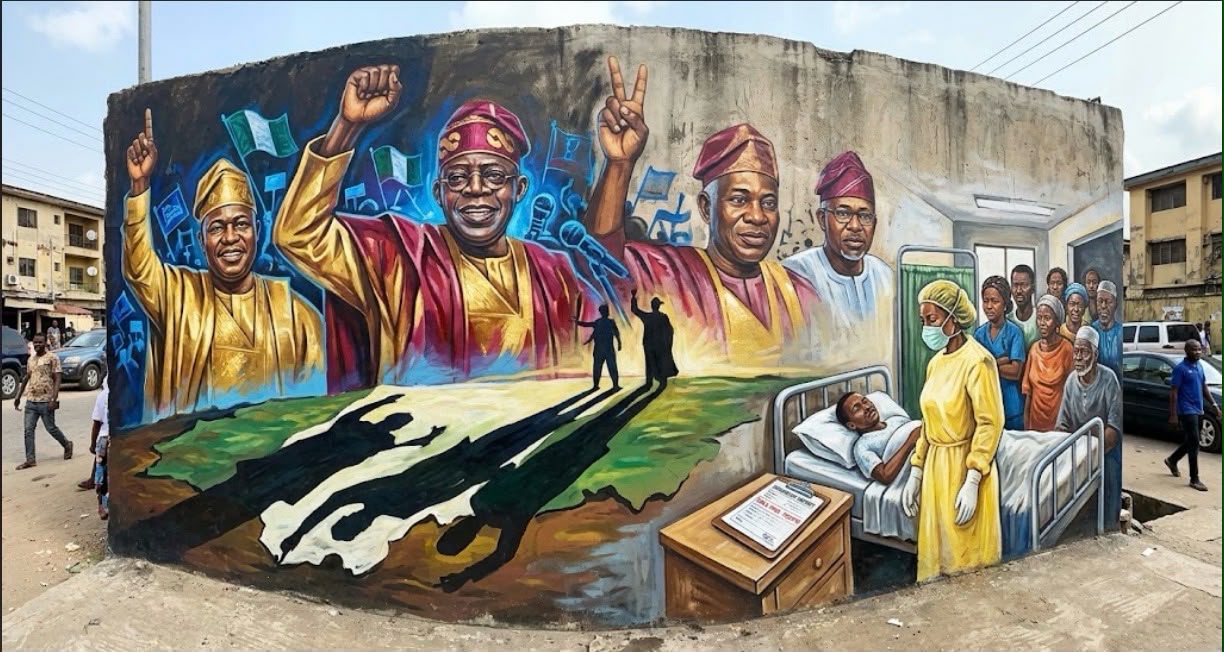
Imagine a mural depicting Nigeria’s political landscape. Gold represents accumulated wealth. Crimson evokes the violence of political rhetoric. Electric blue illuminates the promises of electoral campaigns. Oversized portraits of political gladiators dominate the canvas, their hands raised in triumph, their expressions radiating invincibility. Their shadows stretch across the national landscape as though they were permanent features of the horizon. Then, in one corner, a hospital bed appears. Beside it stands a healthcare worker in protective clothing. A laboratory report rests on a table. Beyond the hospital, citizens wait anxiously for information about their families and the adequacy of the institutions charged with protecting them. The composition begins to change. The oversized political portraits recede. Their colours lose some of their brilliance. The hospital bed, once a minor detail at the edge of the picture, becomes the visual centre.
The image makes an argument without spelling out every proposition. The contrast between political grandeur and human vulnerability invites the viewer to reconsider the relationship between power and public responsibility.
This is the interpretive promise of Visual Pragmatics: meaning emerges through the interaction of image, context, social knowledge and inference. The viewer does not merely see the painted objects; the viewer connects them, interprets their arrangement and draws conclusions about the social world they represent. The mural’s most consequential detail is not the imposing portrait or the hospital bed in isolation. It is their juxtaposition. The portrait represents the spectacle of political power; the hospital represents the conditions of human vulnerability that political power is supposed to address. The final brushstroke must resist portraying Ebola as a triumphant executioner. Such an image would turn human suffering into spectacle and confuse a medical emergency with a theatrical device. A more searching composition presents the nation at a crossroads: fear can expose institutional weaknesses and then fade, or it can become the impetus for accountability, preparedness and humane governance.
The virus challenges the body. The response reveals the state. The image invites society to infer what its political priorities have become.
Cautious optimism.
The latest reports offer a cautiously encouraging turn in this unfolding drama. By 24 October 2026, the Federal Government reported that the Abuja patient was showing signs of recovery, following earlier reports of multiple-organ failure. Contact tracing continued among 44 identified contacts, while laboratory findings reportedly established a genetic relationship between the virus and one identified in a case in Kenya—without proving direct transmission between the patients. No community transmission had been reported in the updates reviewed. These developments warrant relief, not premature celebration. The patient’s recovery would be a triumph of medical care, not proof that Nigeria’s preparedness systems are beyond reproach. Nor does the absence of detected secondary cases extinguish the questions surrounding the ₦10 billion emergency allocation: what was released, what was spent, what capabilities were established, and what independently verifiable outcomes followed? The epidemic may yet be contained; the accountability question must not be quarantined with it. Political officeholders can return to their campaigns, calculations and succession intrigues, but the public-health test remains: can the state protect citizens before the next emergency arrives?
Conclusion: will the final arbiter knock sense into our mental landscape?
Ebola has placed an uncomfortable question before Nigeria, but it has not predetermined the answer. It may expose the hollowness of political vanity, the fragility of public trust and the distance between budgetary commitments and institutional readiness. It may also summon scientific competence, professional courage, public accountability and social solidarity. The decisive issue is what the country does with the revelation.
Will the ₦10 billion preparedness fund become demonstrable public-health capacity? Will conflicting official accounts give way to transparent, coherent communication? Will emergency preparedness become a sustained institutional obligation rather than a temporary response to frightening headlines? Will political leaders rediscover that public office is a trust rather than a private possession? And will citizens demand verifiable performance instead of mistaking political spectacle for governance?
The final arbiter in this editorial is both biological and metaphorical. Biological mortality reminds every human being that power has limits. Public judgement follows when citizens compare the resources entrusted to their leaders with the protection those resources actually provide.
The crisis cannot guarantee wisdom. Time cannot substitute for action. Fear cannot replace reform.
Ebola may be knocking at the door of our collective consciousness. The decisive question is whether, after the immediate danger has passed, Nigeria will remember what the knocking revealed.
The word tells; the crisis exposes; mortality interrogates. What remains is whether power will listen.




