


By Chris Agbedo
Nigeria’s last-place position in the 2026 global life-expectancy ranking should provoke a fundamental reconsideration of the country’s development priorities. As the 2027 general elections approach, the question confronting political leaders is no longer merely who should govern Nigeria, but what governance should mean to the lives of Nigerians. A country’s development story is often told through the language of impressive numbers. Gross Domestic Product growth, foreign reserves, external investments, kilometres of roads constructed, megawatts of electricity generated and billions of dollars committed to infrastructure dominate official narratives. Political leaders take turns presenting these figures as evidence of progress, while opposition politicians subject them to competing interpretations. Yet, beneath this familiar contest of economic statistics lies a more fundamental measure of national development that deserves considerably greater attention: how long do the citizens of a country live?
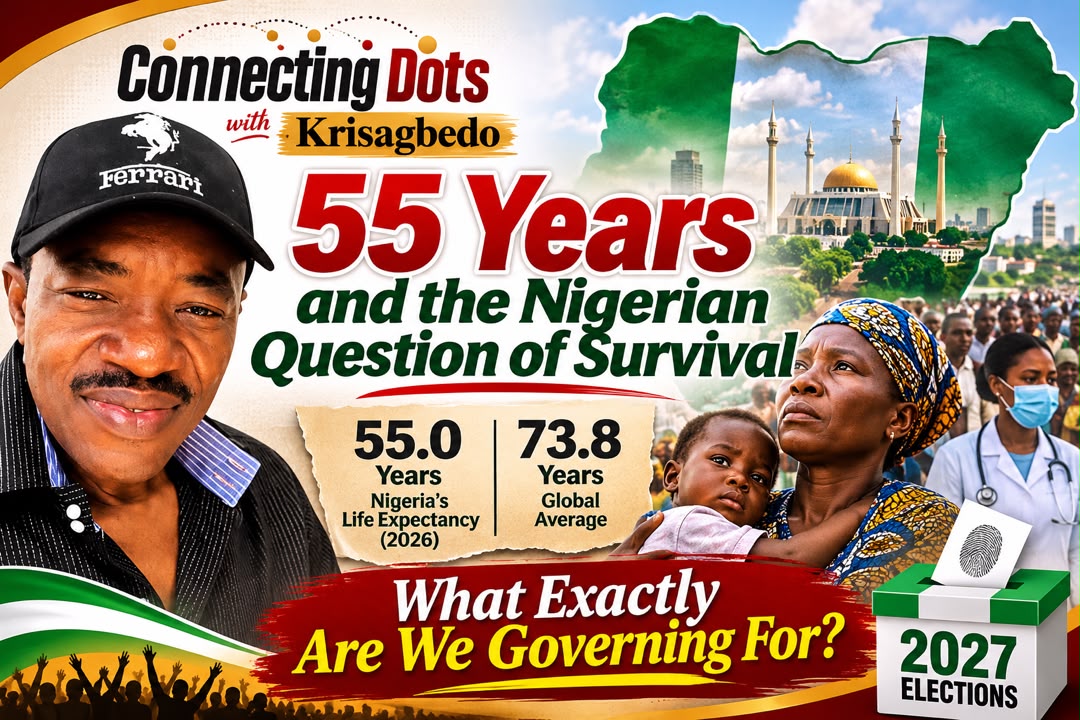
A 2026 global ranking published by Visual Capitalist, drawing on the United Nations’ World Population Prospects 2024, presents Nigeria with an uncomfortable answer. With an estimated life expectancy of 55 years at birth, Nigeria occupies the 237th and final position among the 237 countries and territories covered by the ranking. The global average is 73.8 years, while Monaco leads with 86.7 years. Even more troubling, Nigeria falls below Chad, whose corresponding estimate is 55.6 years.
Read that again. Africa’s most populous country, endowed with enormous human and natural resources, finds itself at the bottom of a global league table measuring the expected duration of human life. This is not simply another statistical embarrassment to be dismissed with the familiar explanation that Nigeria is a developing country. It is a sobering invitation to interrogate the relationship between political authority, public policy and the everyday conditions of human survival.

Life expectancy is not merely a demographic statistic. It is a cumulative reflection of the circumstances in which people are born, grow, work, raise families, encounter disease and eventually die. It is influenced by healthcare, nutrition, education, sanitation, household income, environmental conditions and public security. In other words, it offers a window into the lived consequences of governance. And that is precisely why the ranking deserves a place in Nigeria’s unfolding 2027 electoral conversation.
The arithmetic of an uncomfortable comparison.
Nigeria’s position becomes even more revealing when placed alongside other African countries. Ghana records 66.1 years, Rwanda 68.5, Kenya 64.2 and Cameroon 64.5. Even Chad, another country confronted by serious development challenges, records 55.6 years. Nigeria’s 55 years is therefore not simply a reflection of Africa’s wider developmental difficulties; it raises questions about the country’s relative performance within the continent.
The historical comparison is equally instructive. Nigeria’s life expectancy has increased from 35.5 years in 1950 to 55 years in 2026, a gain of approximately 19.4 years. The global average, however, has increased by 27.4 years over the same period. Nigeria has made progress, but its progress has fallen behind the global trajectory. There is an important statistical qualification. The 55-year figure is a 2026 medium-variant projection derived from the UN’s World Population Prospects 2024, not a direct count of the ages at which Nigerians are dying today. The WHO’s separate country profile reports a 2023 life expectancy of 61.4 years for males and 64.5 for females, while healthy life expectancy stands at 54.1 years. These estimates arise from different statistical series and modelling approaches and should not be casually combined. Indeed, the divergence reinforces the need for stronger Nigerian vital-registration and mortality data. The point, nevertheless, remains: whichever statistical series is consulted, Nigeria has a formidable human-development challenge.
When survival becomes a governance question.
Consider the fate of Nigerian children. The UN Sustainable Development Goals country profile records an under-five mortality rate of approximately 115.6 deaths per 1,000 live births in 2024. It also estimates that more than 855,000 Nigerian children under five died that year. Behind these figures are preventable illnesses, inadequate nutrition, delayed treatment and unequal access to essential healthcare. Maternal mortality presents another disturbing dimension. The WHO’s African health systems scorecard puts Nigeria’s maternal mortality ratio at 993 deaths per 100,000 live births in 2023. This is not simply a health-sector statistic. It speaks to the risks women encounter in pregnancy and childbirth, the availability of skilled birth attendants, emergency obstetric services, blood supplies and functioning referral systems. A country that cannot adequately protect mothers and children must examine the institutional and economic arrangements that make preventable deaths possible.
Healthcare financing is consequently central to the discussion. President Bola Tinubu’s proposed 2026 federal budget provides ₦2.48 trillion for health out of a proposed ₦58.47 trillion expenditure, approximately 4.2 per cent. This remains considerably below the 15 per cent benchmark African leaders committed themselves to under the 2001 Abuja Declaration. Premium Times’ examination of federal health budgets also identifies a persistent shortfall relative to that commitment.
The issue, however, goes beyond percentages. What matters is how much of the allocation is released, how efficiently it is spent and what actually reaches the primary healthcare centre in a rural community. A budgetary increase that produces no corresponding improvement in the availability of doctors, nurses, medicines, diagnostic services and emergency care cannot be celebrated as a sufficient development outcome. And healthcare is only one part of the equation. Hunger, unemployment, unsafe drinking water, poor sanitation, environmental pollution and insecurity all influence the conditions under which Nigerians live and die. A household that cannot afford nutritious food or hospital treatment is experiencing an economic crisis with potentially fatal health consequences. A community displaced by armed violence loses not only its homes and livelihoods but also access to schools, clinics and other essential services. This is why economic policy, public health and national security must be understood as interconnected responsibilities of government.
The 2027 question: Beyond the competition for political power.
As political parties begin positioning themselves for the 2027 general elections, Nigerians should demand a change in the substance of electoral debate. The familiar competition over political alliances, defections, personalities, campaign slogans and the arithmetic of electoral victory cannot substitute for a serious discussion of human development. The fundamental question should be: what concrete improvements in the lives of Nigerians will the next administration deliver?Presidential candidates should explain how they intend to reduce maternal and child mortality, expand universal access to primary healthcare, improve health insurance coverage, address malnutrition and reduce the financial burden of medical treatment on households. They should also demonstrate how their economic policies will improve food affordability, household purchasing power, access to clean water and the security of vulnerable communities. These commitments must be supported by identifiable funding arrangements, implementation timelines, measurable targets and independent monitoring. The same scrutiny must apply to the incumbent administration. Its record should be assessed against the conditions inherited, the policy choices made since assuming office, the resources committed and the results achieved. No administration can reasonably be held responsible for every structural problem accumulated over decades; neither should the historical nature of a problem become an alibi for failing to address it.
The opposition, equally, must move beyond denunciation to demonstrate the feasibility of its alternative policy proposals. Criticism becomes more meaningful when accompanied by credible solutions. Nigeria would benefit from a National Human Development Scorecard against which governments and political parties can be assessed. Such a framework should track life expectancy, maternal mortality, under-five mortality, nutrition, access to primary healthcare, household health expenditure, safe water and sanitation. Results should be disaggregated by state, gender and rural-urban location to expose inequalities that national averages may conceal. The purpose is not to turn elections into a competition over statistical promises. It is to make political accountability measurable.
The real meaning of development.
There is a deeper contradiction here that Nigeria’s political establishment must confront. The country possesses enormous natural resources, a large youthful population, substantial agricultural potential and considerable entrepreneurial energy. Yet its human-development outcomes remain deeply troubling. The experience of countries such as South Korea and Rwanda demonstrates that improvements in longevity are possible through sustained investment in healthcare, education, nutrition and public institutions. Their experiences are not templates to be mechanically transplanted, but they offer valuable lessons about the relationship between policy consistency, institutional capacity and human welfare. Nigeria must therefore reconsider its conception of national development. Infrastructure is important, but infrastructure should ultimately serve people. Economic growth is desirable, but its benefits should be reflected in improved living conditions. National security is indispensable, but its ultimate purpose is the protection of human life. What is the value of a new highway if pregnant women cannot reach emergency medical care? What is the significance of impressive GDP figures if millions of households struggle to afford nutritious food? What is the meaning of political stability if citizens remain exposed to preventable disease, violence and premature death?
These are not rhetorical diversions. They go to the heart of the social contract. The 2027 general elections should provide an opportunity for Nigerians to interrogate this contract afresh. Political authority is not an end in itself. It is a public trust whose legitimacy must ultimately be reflected in the welfare, dignity and security of the people.
Fifty-five years. That is the number staring Nigeria in the face in the Visual Capitalist ranking. It should not become a partisan weapon, nor should it be treated as an immutable national destiny. It should become a national call to action. The ultimate test of leadership is not how eloquently political leaders describe their achievements, how grand their campaign promises sound or how long they retain the instruments of state power. It is whether the conditions of human existence improve under their watch. Nigeria must begin to measure development not merely by what government builds, borrows, earns or announces, but by what happens to the lives of the people in whose name it governs. After all, what exactly are we governing for if the fundamental business of governance is not to enable citizens to live longer, healthier, safer and more dignified lives?
The word tells; the image shows; context makes sense; inference fills the gap; power gives meaning consequence.




