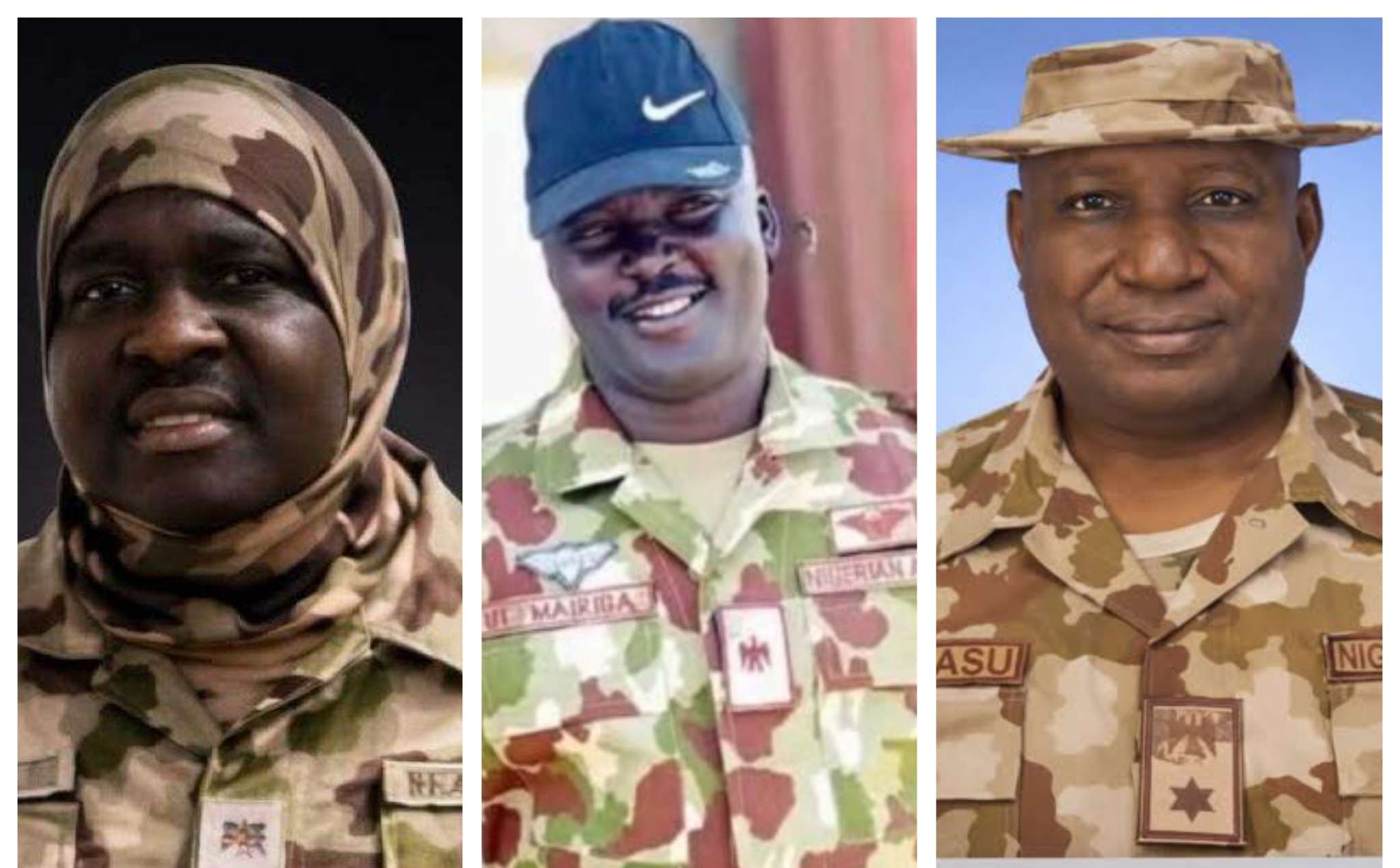
The recent loss of three commanding officers of the Nigerian military within a single week in Borno State is not just another grim statistic in the long war against insurgency.
It is a painful reminder that behind every uniform lies a life of dedication, leadership, and sacrifice.
When such officers fall on the battlefield, the loss reverberates far beyond the military barracks it echoes through the conscience of the nation.
War, as history often teaches us, is never merely a contest of weapons; it is a test of endurance, leadership, and national resolve.
For over a decade, Nigeria has confronted the persistent threat of insurgent groups such as Boko Haram and the Islamic State West Africa Province (ISWAP).

In that time, countless soldiers have stood as the nation’s shield, absorbing the blows meant for innocent civilians.
The recent attacks on military bases in Kukawa, Mayenti, and Konduga serve as a stark reminder that while progress has been made, the struggle is far from finished.
According to media reports, the three commanding officers recently killed were Major U.I. Mairiga, who headed the Mayenti base; Lt-Col Umar Faruq, commander of the Kukawa base and the 101 Brigade; and Lt-Col S.I. Iliyasu, who served in Konduga.
The deaths of commanding officers are particularly alarming because such individuals are the backbone of military coordination and morale.
A commanding officer is more than a rank or title; he is the guiding compass in the fog of war.
He makes the difficult decisions when seconds matter, steadies the nerves of younger soldiers, and stands at the frontline when danger draws near.
When such leaders fall, it is as though a pillar of a great structure has suddenly been removed. The building may still stand, but the tremor is felt everywhere.
Reports from the affected areas suggest that insurgents are becoming increasingly bold and strategic.
Attacks are often launched under the cover of night, with fighters approaching from multiple directions in an attempt to overwhelm military positions.
These tactics resemble waves crashing relentlessly against a fortress wall probing for weaknesses, exploiting every crack.
While troops have shown remarkable resilience in resisting these assaults, the pattern of attacks signals that the insurgents remain capable of adapting and reorganizing.
This development should serve as a wake-up call, not a moment of despair. In every conflict, there comes a time when strategy must evolve to match the changing nature of the threat.
The battlefield of today is not what it was ten years ago.
Technology, intelligence gathering, surveillance, and rapid-response coordination now play an even greater role in determining success.
Nigeria’s armed forces have demonstrated bravery and commitment in the face of enormous challenges.
Many operations in the North-East have successfully dismantled terrorist camps, rescued hostages, and pushed insurgents away from several communities.
Yet war against asymmetric forces groups that avoid conventional confrontation and rely on surprise attacks is rarely straightforward.
Victory is often measured not in dramatic moments but in slow, persistent progress.
Beyond the battlefield itself lies another crucial dimension of the fight against insurgency: the role of the wider society.
Security is not sustained by soldiers alone. It is a collective responsibility shared by government institutions, community leaders, and ordinary citizens.
In many rural communities, residents possess valuable information about suspicious movements or hidden insurgent networks. When such information is shared promptly and responsibly, it can prevent attacks and save lives.
Building trust between communities and security agencies is therefore essential. A society divided by fear and suspicion weakens the fight against terrorism.
But when citizens and security forces work together, the result is a powerful alliance capable of resisting even the most determined threats.
At the national level, this moment also calls for deeper reflection about long-term security reforms.
Security experts have repeatedly pointed to the need for stronger intelligence networks, better equipment for frontline troops, and improved welfare for military personnel.
Soldiers who risk their lives for the nation deserve not only recognition but also the tools necessary to perform their duties effectively.
There is also growing debate about broader structural reforms such as decentralized policing and enhanced collaboration between federal and state security institutions.
While such changes require careful legislative consideration, they highlight an important truth: security challenges evolve, and the systems designed to address them must evolve as well.
Yet amid all the policy discussions and strategic analysis, it is important not to lose sight of the human dimension of these tragedies.
The officers who recently lost their lives were fathers, brothers, mentors, and friends.
They were individuals who chose a path of service knowing fully well the risks that lay ahead.
Their courage is a reminder that the defence of a nation often rests on the quiet heroism of those willing to stand in harm’s way.
In moments like this, the nation must pause not only to mourn but also to renew its commitment to peace and security.
The sacrifices made by soldiers on the frontline should not fade into the background of daily headlines.
Instead, they should inspire a deeper sense of unity and determination among all Nigerians.
History has shown that nations facing persistent threats can overcome them through resilience, strategic thinking, and collective effort.
Nigeria’s story need not be different. The path to lasting peace may be long and difficult, but it is not beyond reach.
The fallen officers have played their part with honour and bravery.
They stood their ground in the face of danger so that others might live in safety. Their sacrifice, like a torch passed from one generation of defenders to the next, must illuminate the path forward.
Now the responsibility rests with the nation to strengthen its resolve, support its defenders, and ensure that the blood shed on the frontline becomes the foundation for a safer and more secure Nigeria.