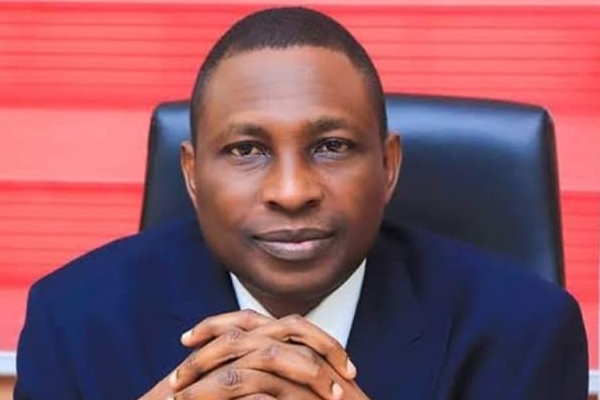
When news broke last week, the operatives of Nigeria’s Economic and Financial Crimes Commission (EFCC) stormed the Olusegun Obasanjo Presidential Library.
My reaction was not shock but recognition. I had seen this pattern before — the sudden spectacle, the images of armed men, the swift headlines — and I knew the uneasy feelings it could leave behind.
I first walked into the EFCC headquarters years ago not as a suspect but as a citizen who believed in its mission. I came with information and resources that I believed could strengthen the fight against corruption.

In those early moments, there was optimism — the sense that this was an institution committed to fairness, thoroughness, and results.
But as time passed, that optimism was tested. Processes slowed. Meetings shifted. What I had imagined would be a model of transparency became, to my eyes, more opaque. I had also worked on a public reporting initiative with the EFCC, designed to make petitions traceable by citizens. Over time, that vision for open tracking did not take root in the way I had hoped.

My view of the EFCC began to change. It was not that the institution was incapable of decisive action — quite the opposite. It could act with speed and force when it chose to. But that force seemed, in my perception, unevenly applied. Some matters blazed into the public eye; others dimmed quietly in the shadows.
That is why, when EFCC Chairman Ola Olukoyede recently warned that Nigeria’s real estate sector had become a haven for money laundering, I agreed with the diagnosis.
Anyone who drives through certain high-end districts in Lagos or Abuja can see properties that stand empty, owned on paper, but not in life are priced far beyond the reach of most Nigerians The challenge is not seeing the problem — it is pursuing it with the same intensity in every case, no matter whose name appears on the deeds.
Raids like the one on the Obasanjo Library generate headlines. They display power. But Nigerians have long memories. For every dramatic operation, there are questions about the cases that remain invisible — the files not announced, the investigations never heard of again.
If the EFCC is to be the institution Nigerians need, it must not only fight corruption without fear or favour; it must do so in a way the public can see and trust.
Without that trust, the EFCC risks becoming something the law never intended: a force whose power is remembered more for its theatre than for its justice.
Selective Justice and the Shielding of the Powerful
Go to the EFCC headquarters in Industrial Area, Abuja, and you’ll see some hungry boys arrested for stealing a few hundreds of dollars.
That doesn’t mean that what they did was right. What I’m saying here is that EFCC leaves the big thieves and always goes after petty thieves.
Or how many powerful politicians and influential figures have truly faced prison in Nigeria? The answer is painfully clear: very few, if any.
The harsh reality is that accountability disproportionately targets the vulnerable—the so-called “yahoo boys,” the hungry and desperate youth who often become scapegoats for systemic failure.
Meanwhile, the elites who wield power and influence glide through the cracks of the justice system, shielded by networks of patronage, political alliances, and wealth.
Consider Godwin Emefiele, the former Central Bank Governor. Despite serious allegations and public outcry, he has remained protected within the corridors of power.
His case is emblematic of a broader problem—one where the scales of justice tip heavily in favor of the privileged, while ordinary Nigerians bear the brunt of corruption and abuse.
This selective enforcement not only betrays the principle of equality before the law but corrodes public trust in our institutions. When justice becomes a tool wielded only against the powerless, it fosters cynicism, apathy, and social fragmentation.
True reform demands that the judiciary break free from this pattern of selective justice. No one, regardless of political stature or wealth, should be above the law. For Nigeria to rise and thrive, the law must be applied fairly, transparently, and without fear or favor.
My fight is not just personal—it is a fight for every Nigerian who dreams of a nation where justice is not a privilege but a right.
Truly, if eyes can bleed blood, given what I’ve seen in Nigeria, my eyes should have by now be bleeding blood. Thank God eyes only shed tears.