



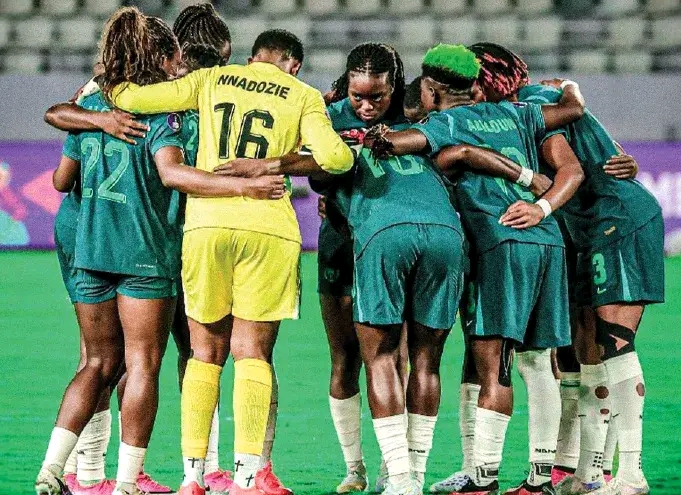
Former Super Falcons captains Desire Oparanozie, Patience Avre and Kikelomo Ajayi have called for a major rethink of Nigeria’s women’s national team as the Falcons prepare for their 2028 Olympic qualifying campaign.
The former internationals believe Nigeria can no longer depend solely on its impressive history, individual talent and reputation on the African continent. They have urged the Nigeria Football Federation and other football authorities to use the team’s recent setbacks as an opportunity to rebuild the structure surrounding the Super Falcons.
The warning comes after a difficult period for Nigeria’s women’s national team.

The Falcons suffered their earliest ever exit from the Women’s Africa Cup of Nations when they lost 1-0 to Cameroon in the quarter finals of the 2026 tournament in Morocco. The defeat ended their hopes of securing one of Africa’s automatic places at the 2027 FIFA Women’s World Cup.
Nigeria were subsequently given another opportunity to qualify through the CAF playoff, but that chance also disappeared after a 2-1 defeat to South Africa in Casablanca. The results ended the country’s remarkable record of appearing at every Women’s World Cup since the competition began in 1991.
The disappointing campaign has already resulted in major changes within the national team setup.
The Nigeria Football Federation asked head coach Justine Madugu and members of his technical crew to step down following the World Cup qualification failure. Former Falcons goalkeeper Ann Chiejine, goalkeeper coach Auwal Makwalla, video analyst Igor Krulj and fitness coach Per Karlsson were also affected by the decision.
Attention has now shifted towards the next major assignment, with Nigeria expected to resume their 2028 Olympic qualifying campaign in October.
The Falcons are scheduled to face Comoros in the next stage, with Comoros reaching the round after an emphatic 30-0 aggregate victory over Sudan.
For Ajayi, the upcoming Olympic qualifiers represent an opportunity for Nigeria to begin building a new era rather than continuing to depend on achievements from previous generations.
The former captain acknowledged that Nigeria has not suddenly lost its footballing pedigree but warned that the rest of Africa has improved significantly.
She believes the growing competitiveness of women’s football across the continent should serve as motivation for Nigeria to raise its standards.
Ajayi called for better planning, continuity, preparation, investment and accountability around the national team.
Her message is particularly important because Nigeria remains one of the most decorated teams in African women’s football. The Super Falcons have won the Women’s Africa Cup of Nations more times than any other nation and have traditionally been regarded as the continent’s dominant women’s football force.
However, that historical advantage is being challenged by countries that have invested heavily in women’s football.
South Africa, Morocco, Zambia and other emerging teams have made significant progress in recent years, creating a more competitive African football landscape.
Oparanozie, who is currently a member of the NFF fact finding committee investigating the poor performance of Nigeria’s national teams, also believes the Falcons require a comprehensive rebuild.
She argued that Nigeria can no longer rely on raw talent and past achievements to remain competitive.
For her, the recent disappointment should become the starting point for a serious evaluation of the entire system.
That evaluation should include coaching, player development, preparation and the overall management of the women’s national team.
Avre also called for a broader examination of the structure surrounding the Falcons rather than placing the blame entirely on the players.
The former four time African champion pointed to several areas that require attention, including tactics, coaching, grassroots development, the domestic league, player welfare and investment.
Her comments reflect a growing concern that Nigeria’s enormous pool of footballing talent must be supported by a stronger football development system if the country is to maintain its position among Africa’s elite.
The Falcons’ Olympic ambitions are also significant because Nigeria only returned to women’s football at the Olympics at the Paris 2024 Games after a 16 year absence.
Their return ended a long period away from the competition, but the team was eliminated during the group stage.
With another Olympic campaign approaching, officials are now under pressure to make the necessary changes quickly.
National Sports Commission Director General Bukola Olopade has indicated that the NSC and NFF will work together to restructure the Falcons’ technical setup before the Olympic qualifiers resume.
The aim is clear: Nigeria wants to avoid another major disappointment and secure a place at the Olympic Games.
The challenge, however, will be ensuring that any changes go beyond simply appointing a new coach.
The former Falcons captains’ comments suggest that Nigeria needs a long term strategy capable of producing sustainable success.
That means improving domestic women’s football, developing younger players, providing better preparation for international tournaments and creating a professional environment in which players can perform at their best.
The Falcons still possess considerable quality and experience.
Players such as Rasheedat Ajibade, Asisat Oshoala and other established internationals have demonstrated repeatedly that Nigeria has enough individual talent to compete with the strongest teams in Africa.
The question is whether that talent can be supported by the right technical, administrative and developmental structure.
The October Olympic qualifiers will provide the first major test of Nigeria’s response to the recent crisis.
The Falcons cannot afford another disappointing campaign, particularly after missing the 2027 Women’s World Cup.
For a team with Nigeria’s history, the next chapter must be about more than restoring its reputation.
It must be about building a stronger and more sustainable future.
The message from the former captains is therefore clear. Nigeria must respect its past, but it cannot continue living on it.
The Super Falcons now have an opportunity to turn a painful setback into the beginning of a new era of success.




