


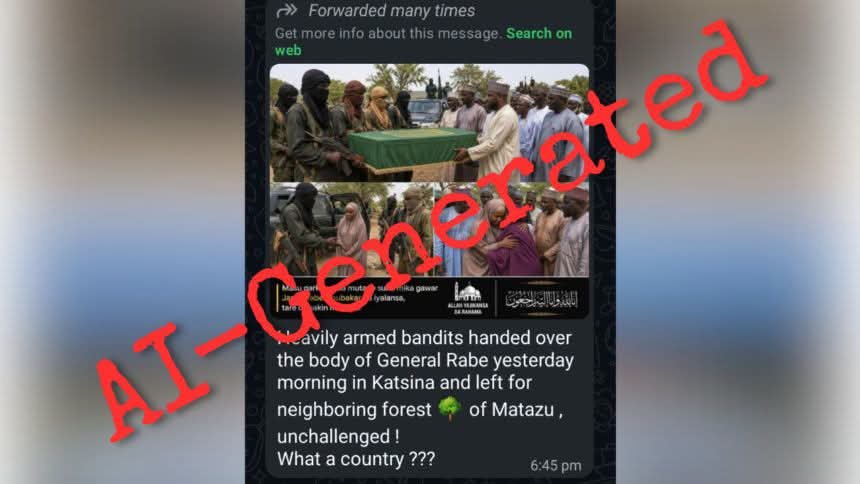
ABUJA, Nigeria — A picture collage circulating online, purportedly showing the release of the corpse of retired Major-General Rabe Abubakar by bandits, has been confirmed to be an AI-generated image, raising fresh concerns about the spread of misinformation in Nigeria’s security crisis.
The picture, which surfaced on social media on Sunday, features a collage of three similar images with inscriptions in Hausa and Arabic. The Hausa inscription reads: “Masu garkuwa da mutane suna mika gawar Janar Rabe Abubakar ga iyalansa, tare da sakin matarsa,” which translates to: “Kidnappers hand over the body of General Rabe Abubakar to his family and release his wife.”
However, fact-checking investigations by multiple platforms have confirmed that the image was artificially generated using AI tools and does not depict any real event. The image shows glaring inconsistencies and distortions typical of AI-generated content, including unnatural facial features, lighting discrepancies, and irregularities in the background.
The picture was posted by a user on X (formerly Twitter), who accompanied it with the caption: “The body of General Rabe Abubakar and his wife as they were released. I don’t care if this breaks the Internet, let’s spread the truth. The caption gained traction before it was deleted, but not before users began to question its authenticity.”

Checks by TheCable using an AI detection tool revealed that the image has a 95 percent probability of being AI-generated. Additionally, the image has not appeared in any credible media report covering the story. All authoritative news outlets that reported the general’s death used file photos or wire images, none of which match the viral image.
The image is also absent from the Google reverse image search results, which would have shown if it had been published online before. The image appears to have been generated using an AI image generation tool, using a prompting technique to produce a collage in a single frame.
Major-General Rabe Abubakar (retired) was killed by bandits in Katsina State last week after being abducted from his farm. His death has sparked widespread outrage and renewed calls for intensified military action against bandits operating in the North-West region. The Nigerian Army has since launched Operation Clean Sweep III to flush out bandits from their enclaves in Katsina and neighbouring states.
The circulation of the AI-generated image highlights the growing challenge of misinformation in Nigeria’s security landscape. In recent months, fake images, videos, and narratives have been used to manipulate public perception, incite ethnic tensions, and undermine trust in security institutions.
Security analysts have warned that the use of AI-generated content in conflict reporting poses a significant threat to information integrity. They have called on social media platforms to strengthen their content moderation policies and on users to verify information before sharing.
The Defence Headquarters has not issued an official statement on the viral image. However, military sources have confirmed that the family of the deceased general has not released any photographs or footage of the handover of his remains. The authorities have urged the public to rely only on official sources for updates on security operations and related incidents.
As the fight against misinformation intensifies, fact-checking organisations in Nigeria have urged citizens to exercise caution and critical thinking when consuming content online. The message is clear: not everything that trends on social media is true, and the cost of believing fake news can be as high as the loss of public trust itself.




