
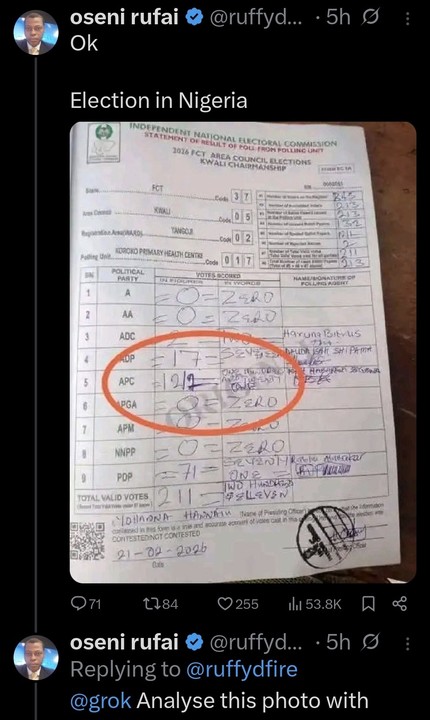
DDM NEWS can exclusively report that the Independent National Electoral Commission (INEC) has issued a detailed clarification following a wave of outrage on social media over an alleged case of result manipulation at the Kuroko Health Centre polling unit in Yangoji Ward, Kwali Area Council of the Federal Capital Territory (FCT). The controversy, which spread rapidly across online platforms after images of a visibly altered Form EC8A result sheet surfaced, triggered accusations that INEC had recorded an impossible figure of 1,219 votes for a political party in a polling unit with only 345 registered voters and 213 accredited voters during Saturday’s FCT Area Council elections.
In a strongly worded press statement released by the INEC FCT office, the Commission dismissed the claims as false, misleading, and capable of undermining public confidence in the electoral process. According to INEC, what appeared to some observers as evidence of manipulation was, in fact, a clerical error that was immediately detected, openly corrected at the polling unit, and subsequently verified through the Commission’s technological safeguards, including the Bimodal Voter Accreditation System (BVAS) and the INEC Result Viewing Portal (IReV).
INEC explained that the confusion stemmed from a mistake made by the Presiding Officer while recording the score of one political party on Form EC8A after the counting of ballots. Following the close of voting and the sorting of ballots, the Presiding Officer initially entered a figure of 122 votes for the party in question. However, upon tallying the total votes, it became clear that the figures exceeded the actual number of valid ballots cast by one vote. In line with INEC guidelines, the ballots were recounted in the open at the polling unit, in the presence of party agents and observers. The recount revealed that the correct figure should have been 121 votes, not 122.
DDM NEWS gathered that the Presiding Officer corrected the error by cancelling the final digit “2” in the originally written “122” and inserting “1” before the cancelled digit, effectively correcting the figure to 121. The officer also amended the written words to reflect the corrected numerical figure. It was this manual correction on the Form EC8A that later became the basis of viral claims that 1,219 votes had been recorded for a single party, an interpretation INEC described as a deliberate or careless misreading of the corrected figure.

The Commission stated unequivocally that the official result from the polling unit, as uploaded to the INEC Result Viewing Portal (IReV), clearly shows that the party scored 121 votes, not 1,219 as alleged on social media. INEC further disclosed that party agents present at the polling unit witnessed the recount, observed the correction process, and duly signed the result sheet, affirming its accuracy at the point of declaration. The same corrected figure of 121 votes was subsequently entered into the Ward Collation Form EC8B and carried through the collation process at both the ward and Area Council levels, meaning that at no point did the figure of 1,219 form part of the official results used to determine outcomes.
Beyond addressing the specific incident at Kuroko Health Centre, INEC used the opportunity to highlight what it described as the built-in safeguards within Nigeria’s current election technology architecture, insisting that the type of manipulation alleged by critics is technically impossible under the BVAS and IReV framework. According to the Commission, every Presiding Officer is mandated to upload a clear image of the completed Form EC8A to the IReV portal immediately after results are declared at the polling unit. In addition, Presiding Officers must input the scores of each political party directly into the BVAS device, which performs automatic validation checks.
INEC explained that these checks are designed to ensure that the total number of votes entered cannot exceed the number of accredited voters recorded by the BVAS on election day. The system also performs mathematical consistency checks to flag irregularities such as over-voting or impossible figures. In the case of the Kuroko Health Centre polling unit, INEC disclosed that the number of accredited voters recorded by BVAS was 213 and that the score entered for the party in question was 121. The total votes recorded were consistent with the accreditation figures, and no over-voting was detected or flagged by the system. The same validated figures were used during collation at higher levels, further reinforcing the Commission’s position that the allegation of 1,219 votes was baseless.
Addressing claims that the incident represented a “mathematical impossibility,” INEC stated that if such an inflated figure had indeed been entered into the BVAS device, the system would have automatically rejected it and prevented the Presiding Officer from finalising the entry. The total votes cast at the polling unit would also have reflected the inflated number, triggering alerts during collation at the ward and Area Council levels. None of these red flags occurred because, according to INEC, the official figure recorded and transmitted was 121, not 1,219. DDM NEWS notes that this explanation is central to INEC’s defence of the integrity of the FCT Area Council elections.
The Commission also sought to reassure the public that the IReV portal is designed as a transparency tool that mirrors results uploaded directly from polling units, allowing citizens, political parties, and observers to independently verify figures. INEC said that all results circulating on social media and alleged to have been altered were cross-checked in line with the Electoral Act and found to be consistent with the data captured in the BVAS and used for collation. According to the Commission, the FCT Area Council elections were conducted in substantial compliance with the Electoral Act and INEC guidelines, despite isolated clerical errors that were promptly corrected in accordance with established procedures.
DDM NEWS understands that INEC’s intervention comes amid heightened public sensitivity around election integrity, particularly in the wake of past controversies surrounding result transmission and collation in Nigeria’s recent electoral cycles. The Commission warned that the spread of unverified claims and misleading interpretations of election documents could erode public trust and inflame tensions unnecessarily. INEC therefore urged citizens, political actors, and media commentators to rely on official records and verified information before drawing conclusions about alleged irregularities.
In reaffirming its commitment to transparency and accountability, INEC acknowledged that genuine human errors can occur during elections but stressed that such errors are subject to investigation and immediate correction. The Commission insisted that the present controversy was not evidence of manipulation but rather a case of a corrected clerical mistake that had been misrepresented online. INEC pledged to continue strengthening the integrity of the electoral process through technology-driven safeguards, strict adherence to legal frameworks, and continuous training of election officials.
The statement, signed by the Resident Electoral Commissioner for the FCT, Aminu K. Idris, concluded with an appeal to the public to engage constructively with the electoral process and to seek clarification from official INEC channels when doubts arise.