


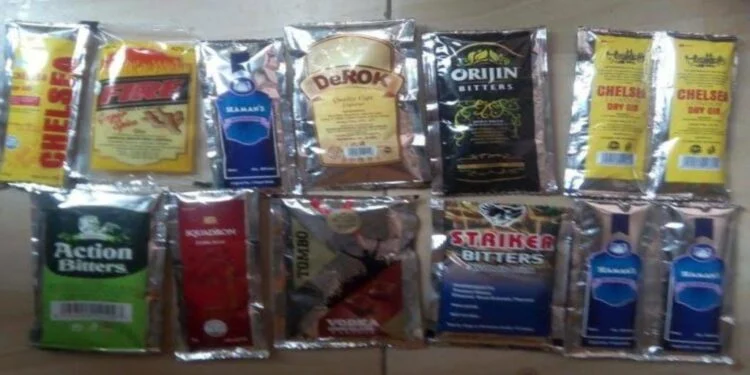
The Federal Government has ordered the National Agency for Food and Drug Administration and Control (NAFDAC) to immediately suspend all enforcement activities related to the proposed ban on sachet alcohol and 200ml PET bottle alcoholic products.
The directive also instructs the regulatory agency to cease the sealing of factories and warehouses linked to the policy.
The announcement was contained in an official statement issued Wednesday in Abuja by the Special Adviser on Public Affairs to the Secretary to the Government of the Federation (SGF), Mr. Terrence Kuanum. According to the statement, the decision followed a joint intervention by the Office of the SGF and the Office of the National Security Adviser (NSA), both of which raised concerns about potential security implications arising from continued enforcement before the full implementation of a National Alcohol Policy.
“Accordingly, all actions, decisions, or enforcement measures relating to the ongoing ban on sachet alcohol are to be suspended pending final consultations and implementation of the National Alcohol Policy and the issuance of a final directive,” the statement said.
Kuanum noted that although the Federal Ministry of Health had already signed the National Alcohol Policy in line with a directive from President Bola Tinubu, both the SGF’s office and the NSA insisted that NAFDAC must refrain from enforcement actions until the policy framework is fully operational and additional directives are issued.

The government clarified that the suspension covers measures such as factory shutdowns, warehouse sealing, and public enforcement campaigns targeting sachet alcohol products.
It further warned that the continued sealing of warehouses and what it described as a “de facto ban” without a harmonised policy framework had begun to trigger economic disruptions and security concerns. Officials cited the potential impact on employment, supply chains, and informal distribution networks across the country as key risks.
The latest directive reinforces an earlier order issued by the SGF’s office in December 2025, which also suspended enforcement actions pending consultations and a final decision.
Kuanum added that the SGF had received a letter dated November 13, 2025, from the House of Representatives Committee on Food and Drugs Administration and Control. The correspondence, referenced NASS/10/HR/CT.53/77 and signed by the committee’s Deputy Chairman, Hon. Uchenna Okonkwo, expressed concern over NAFDAC’s proposed enforcement actions and cited existing National Assembly resolutions on the matter.
According to the government, ongoing reviews are considering legislative resolutions, public health implications, economic factors, and broader national interest concerns before a final decision is reached.
Officials also emphasized that the involvement of the National Security Adviser indicates the issue has expanded beyond routine regulatory oversight. They cautioned that premature enforcement without coordinated policy implementation could destabilize communities, worsen unemployment, and heighten security challenges.
The Federal Government assured Nigerians, industry stakeholders, and public health advocates that a final position will be communicated after comprehensive consultations and inter-agency coordination, with the aim of balancing public health priorities, economic stability, and national security interests.



 and then