
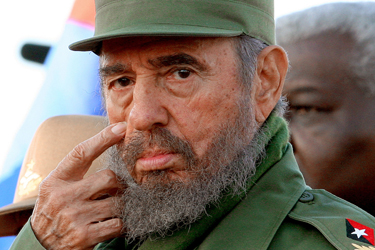

Cuban former revolutionary and powerful president ever Fidel Alejandro Castro Ruz or simply Fidel Castro is dead. He was aged 90.
His younger brother and successor as president Raul Castro announced the news on state television.
Ashen and grave, President Castro told the nation in an unexpected late night broadcast on state television that Fidel Castro had died and would be cremated later on Saturday.
“The commander in chief of the Cuban revolution died at 22:29 hours this evening (03:29 GMT Saturday),” he said. “Towards victory, always!” he added, using a revolutionary slogan.

A period of official mourning has been declared on the island until 4 December, when his ashes will be laid to rest in the south-eastern city of Santiago.
Fidel Castro was Prime Minister of Cuba from 1959-1976 and president from 1976-2008.
He temporarily handed over power to his brother in 2006 as he was recovering from an acute intestinal ailment. Raul Castro officially became president two years later.
Castro toppled the government in 1959, introducing a Communist revolution. He defied the US for decades, surviving many assassination plots.
His supporters said he had given Cuba back to the people. Critics saw him as a dictator.
Years on he would meet Pope John Paul II, despite declaring Cuba an atheist state.
Meanwhile, the Cuban government has fixed the funeral of the late revolutionist for December 4, 2016.
How he defied the US
Throughout the Cold War, Fidel Castro was a thorn in Washington’s side.
An accomplished tactician on the battlefield, he and his small army of guerrillas overthrew the military leader Fulgencio Batista in 1959 to widespread popular support.
Within two years of taking power, he declared the revolution to be Marxist-Leninist in nature and allied the island nation firmly to the Soviet Union.
Despite the constant threat of a US invasion as well as the long-standing economic embargo on the island, Castro managed to maintain a communist revolution in a nation just 90 miles (145km) off the coast of Florida.
Despised by his critics as much as he was revered by his followers, he maintained his rule through 10 US presidents and survived scores of attempts on his life by the CIA.
He established a one-party state, with hundreds of supporters of the Batista government executed. Political opponents have been imprisoned, the independent media suppressed. Thousands of Cubans have fled into exile.
The Soviet Union’s last leader, Mikhail Gorbachev, said: “Fidel stood up and strengthened his country during the harshest American blockade, when there was colossal pressure on him”.
Russian President Vladimir Putin described him as a “reliable and sincere friend” of Russia, while Chinese President Xi Jinping said “Comrade Castro will live forever”.
For French President Francois Hollande, Castro embodied Cuba’s revolution in both its “hopes” and its later “disappointments”.
In Miami, where there is a large Cuban community, there have been celebrations in some parts of the city, with people banging pots and cheering.
A Cuban exile group, the Cuban Democratic Directorate, said Castro left “legacy of intolerance” and had set up a “vicious totalitarian regime”.
© Copyright 2016 www.elombah.com; Send eyewitness accounts/reports/articles to publisher@elombah.com; follow us on twitter handle @Elombah; like our Facebook page: “Elombah.com”