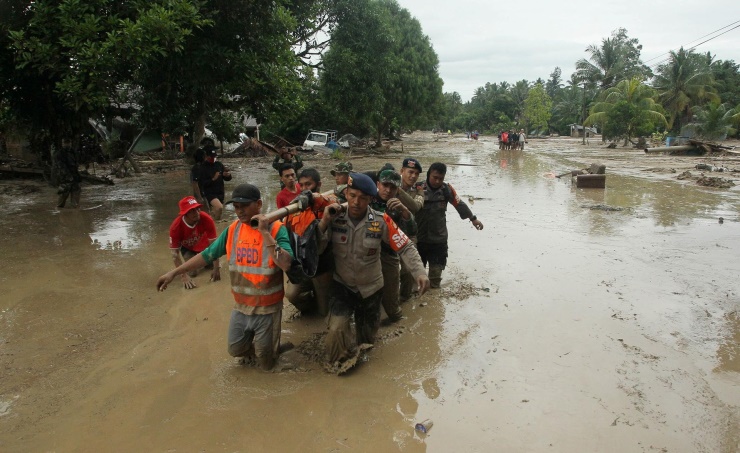
Torrential rains triggered a deadly flash flood on Indonesia’s Siau Island, north of Sulawesi, leaving at least 16 people dead and hundreds displaced, authorities confirmed Tuesday.
Three more residents remain missing as rescue teams continue their search, according to the National Disaster Mitigation Agency.
The disaster struck on Monday after heavy rainfall caused a local river to overflow, inundating four towns on the small island.
Agency spokesman Abdul Muhari explained that the intense rain since early morning suddenly increased the river’s flow, sweeping away homes, uprooting trees, and dislodging large rocks.
“So far, sixteen fatalities have been confirmed, 22 people are injured, and nearly 700 villagers have been displaced,” Muhari said. Access to some roads was cut off, and dozens of homes, public buildings, and infrastructure suffered damage.

Images shared by the search and rescue teams revealed the scale of destruction, showing debris, uprooted trees, and flooded streets.
Relief efforts are ongoing as authorities work to reach affected areas and provide assistance to displaced residents.
Floods are a common hazard during Indonesia’s rainy season, which lasts from October to March, but this event adds to a series of devastating weather disasters in the region.
Late last year, tropical storms and intense monsoon rains caused landslides and floods across South and Southeast Asia, including Indonesia’s Sumatra, where at least 1,178 people were killed and more than 240,000 displaced.
The recent Siau Island flooding is a stark reminder of the country’s vulnerability to extreme weather events, particularly in small islands and coastal regions prone to rapid river surges.
Authorities have urged residents to remain vigilant, especially as heavy rains continue across parts of Sulawesi and nearby islands.
AFP reports that while annual monsoon rains are expected, disasters of this magnitude like the November deluge in Sumatra are among the worst in recent years, rivaling even the devastation caused by the 2004 tsunami.
Emergency teams continue to prioritize search-and-rescue operations and relief distribution to ensure the safety of those affected.