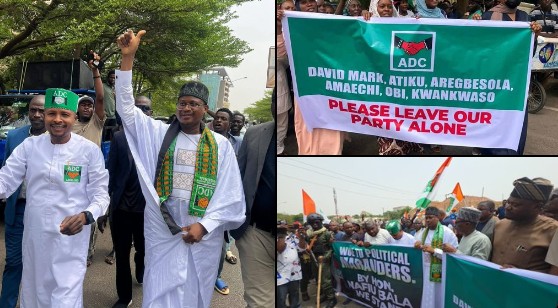
A fresh wave of political tension unfolded earlier today in Nigeria’s capital as Nafiu Bala, a key figure in the ongoing leadership crisis within the African Democratic Congress (ADC), staged a protest at the office of the Independent National Electoral Commission (INEC), demanding to be recognized as the legitimate National Chairman of the party. The demonstration, which drew attention from political observers and the public alike, marked a significant escalation in the internal conflict that has continued to cast uncertainty over the party’s leadership structure.
Nafiu Bala, who has been at the center of a protracted dispute over the control of the ADC, arrived at the INEC premises earlier in the day accompanied by a group of supporters, including Leke Abejide, a serving member of the House of Representatives under the ADC platform. Also present were members of the National Youth Council of Nigeria, lending a visible and vocal dimension to the protest. Together, they called on INEC to reverse what they described as an unjust refusal to acknowledge Bala’s claim to the party’s top leadership position.
The protest, which was conducted peacefully but with clear determination, reflected growing frustration among Bala’s supporters, who argued that due process had not been followed in determining the party’s leadership. Carrying placards and chanting slogans, the demonstrators insisted that Bala remained the rightful chairman of the ADC, despite competing claims from a rival faction led by former Senate President David Mark. The situation had effectively split the party into opposing camps, each asserting legitimacy and seeking recognition from the electoral body.
DDM News gathered that the dispute had its roots in earlier internal party decisions and subsequent legal challenges. Bala, a former Deputy National Chairman of the ADC, had maintained that his rights within the party were sidelined and that the process which produced the current leadership did not adhere to the party’s constitution. On the other hand, the faction aligned with David Mark had insisted that all procedures were duly followed, including a National Executive Committee meeting monitored by INEC, which ratified the current leadership arrangement.
The presence of Leke Abejide at the protest added a significant political dimension to the unfolding events. As a federal lawmaker, his participation underscored the seriousness of the dispute and suggested that the crisis extended beyond internal party disagreements to broader political alignments. His support for Bala also indicated divisions within the party’s elected representatives, further complicating efforts to present a united front ahead of future elections.
Equally notable was the involvement of the National Youth Council of Nigeria, whose members joined the protest in solidarity. Their participation highlighted the role of youth organizations in Nigeria’s political processes and signaled a growing interest among young people in issues of party governance and democratic accountability. For many of the protesters, the demonstration was not just about leadership positions but about the broader principles of fairness, transparency, and adherence to democratic norms.
DDM News understands that INEC had not issued an official response at the time of reporting, leaving Bala’s demands hanging in uncertainty. However, the commission’s role in the matter remained pivotal, as it is responsible for recognizing party leadership and maintaining official records of political parties in Nigeria. Any decision it takes will have significant implications not only for the ADC but also for the broader political landscape, particularly as the country moves closer to the 2027 general elections.
The unfolding situation raised concerns among political analysts about the potential impact on the ADC’s prospects as a viable opposition platform. The party has recently been at the center of efforts to build a coalition capable of challenging the dominance of the ruling All Progressives Congress (APC). However, internal divisions such as the current leadership dispute could undermine these efforts, weakening the party’s ability to mobilize support and present credible candidates.
Observers noted that leadership crises are not uncommon in Nigerian political parties, but the manner in which they are resolved often determines the party’s future trajectory. In the case of the ADC, the stakes are particularly high, given its emerging role in the opposition landscape. A prolonged dispute could erode public confidence and discourage potential allies, while a swift and transparent resolution could strengthen the party’s credibility.
For Nafiu Bala and his supporters, the protest at INEC represented a decisive step in their quest for recognition and justice. By taking their grievances directly to the electoral body, they aimed to draw attention to what they perceived as institutional bias and to compel a review of the decision-making process. Whether this strategy will yield the desired outcome remains uncertain, but it has undoubtedly brought the issue to the forefront of national discourse.
As the situation continued to develop, all eyes remained on the Independent National Electoral Commission and how it would navigate the competing claims. The commission’s response will not only determine the immediate outcome of the ADC leadership dispute but will also send a broader signal about the integrity and independence of Nigeria’s electoral system.
The protest, which unfolded earlier today, served as a vivid reminder of the dynamic and often contentious nature of Nigeria’s political environment. It highlighted the ongoing struggle for power and recognition within parties, as well as the critical role of institutions in mediating these conflicts. As DDM News continues to monitor developments, the events at INEC are likely to shape the narrative of Nigeria’s political landscape in the days ahead.