


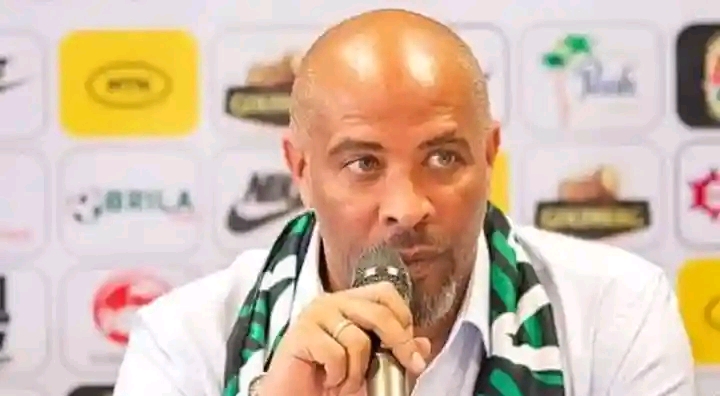
Former Super Eagles midfielder Garba Lawal has raised concerns over the Nigeria Football Federation’s ability to consistently finance the newly approved contract of Super Eagles head coach Eric Chelle, cautioning that long-term financial sustainability should be given as much attention as sporting ambition.
Lawal made the remarks following reports that the National Sports Commission approved a contract extension for Chelle until 2030, with the Franco-Malian tactician set to earn $100,000 per month, double the estimated $50,000 monthly salary he received when he was appointed as Nigeria’s head coach in January 2025.
The revised agreement also reportedly places the responsibility for paying Chelle’s backroom staff on the Nigeria Football Federation, increasing the federation’s financial commitment over the duration of the contract.

While Lawal welcomed the decision to retain the coach, he stressed that the federation must ensure it has the financial capacity to honour every aspect of the agreement without encountering the payment delays that have affected Nigerian football in the past.
According to the former international, employing a quality coach is important for the continued progress of the Super Eagles, but maintaining financial discipline is equally essential if the relationship is to succeed.
Lawal explained that Nigerian football has previously witnessed situations where coaches and players experienced delays in receiving salaries and bonuses, creating unnecessary distractions that affected performances on and off the pitch.
He said the federation should avoid repeating those mistakes by ensuring adequate financial planning before committing to a long-term contract with improved remuneration.
The former midfielder believes that when contractual obligations are fulfilled consistently, coaches are able to concentrate fully on improving the team rather than worrying about administrative issues.
Lawal, who represented Nigeria at the FIFA World Cup and several Africa Cup of Nations tournaments during his playing career, described Chelle as a capable coach who has already made a positive impact on the Super Eagles since taking charge.
He, however, maintained that the success of any coaching project depends not only on technical ability but also on institutional stability and financial responsibility.
Eric Chelle arrived as Super Eagles coach at the beginning of 2025 after establishing an impressive reputation both as a player and as a manager.
Born in Ivory Coast to a French father and a Malian mother, Chelle enjoyed a successful playing career in France before moving into coaching.
His managerial career gained international recognition during his time with the Mali national team, where he introduced an organised, attacking style of football that earned widespread praise across the African continent.
Following his appointment as Nigeria’s head coach, Chelle quickly began rebuilding the Super Eagles with a renewed emphasis on tactical discipline, defensive organisation and fast attacking transitions.
His calm leadership style and willingness to trust young players have helped create healthy competition within the national team.
Since taking charge, the Super Eagles have shown steady improvement.
Under his guidance, Nigeria revived its FIFA World Cup qualifying campaign with a series of impressive performances that restored confidence among supporters after a difficult period.
The team also reached the latter stages of major continental competitions, demonstrating greater consistency and tactical maturity.
Those achievements convinced football authorities that Chelle was the right man to lead Nigeria into the next phase of international competition.
The improved contract is therefore viewed as both a reward for his work and a statement of confidence in his long-term vision for Nigerian football.
In addition to managing the Super Eagles, Chelle has reportedly been given responsibility for overseeing the country’s Under-23 national team as preparations begin for qualification for the Los Angeles 2028 Olympic Games.
The expanded role has generated mixed reactions within Nigerian football circles.
Some stakeholders believe having one coach supervise both teams will create continuity in playing philosophy and ease the transition of talented young footballers into the senior national team.
Others, however, fear the dual responsibility could place excessive pressure on the coach.
Former Super Eagles head coach Finidi George recently questioned the decision, arguing that Nigeria possesses enough qualified indigenous coaches to manage the Under-23 side independently.
He suggested that allowing Chelle to focus exclusively on the Super Eagles would improve efficiency and reduce the risk of burnout.
Despite the debate, many football analysts agree that Chelle’s tactical knowledge, leadership qualities and experience make him one of the most respected coaches currently working in African football.
His reported salary of $100,000 per month would also place him among the highest-paid national team coaches on the continent, reflecting Nigeria’s ambition to compete consistently with Africa’s leading football nations.
Supporters believe that investing in elite coaching is necessary if the country hopes to challenge successfully for future Africa Cup of Nations titles and secure qualification for the FIFA World Cup.
However, they also recognise that financial commitments of this magnitude require careful planning and transparent management.
The Nigeria Football Federation has, in previous years, faced criticism over delayed salary payments, unpaid bonuses and contractual disputes involving coaches and players.
Those experiences have made many stakeholders cautious whenever new financial commitments are announced.
Lawal’s comments therefore resonate with many football followers who believe that maintaining financial credibility is just as important as appointing a talented coach.
For Chelle, attention remains firmly focused on football matters.
The Super Eagles are preparing for upcoming international fixtures, including the next phase of qualification for major tournaments, where expectations from supporters remain extremely high.
The coach is expected to continue monitoring Nigerian players across Europe, Africa and domestic competitions as he builds a squad capable of competing with the world’s best.
His emphasis on tactical flexibility, disciplined defending and attacking football has already earned praise from many supporters who believe the national team is moving in the right direction.
As Nigeria looks ahead to future continental and global competitions, Chelle’s success will ultimately be measured by results on the pitch.
Whether the federation can consistently fulfil the financial obligations attached to his improved contract remains to be seen.
What is certain, however, is that the partnership between Eric Chelle and the Nigeria Football Federation now carries enormous expectations.
If properly supported both financially and administratively, the coach has an opportunity to guide the Super Eagles into a new era of stability, competitiveness and international success.




