

The U.S. pushed the U.K. into military action in Iraq “too early,” a former British ambassador to the United Nations has said in the wake of the Chilcot report.
The long-awaited report, published Wednesday, found that then-prime minister Tony Blair had overstated the threat posed by Saddam Hussein and that military action that commenced in 2003 was “not a last resort.”
The Chilcot report took seven years to compile and Sir John Chilcot—chairman of the inquiry—concluded Blair had sent ill-prepared troops into battle with “wholly inadequate” plans for the aftermath.

ABOVE PHOTO: Sir Jeremy Greenstock leaves the Iraq Inquiry after giving evidence, London, November 27, 2009. Sir Jeremy Greenstock held the position of U.K. ambassador to the United Nations for five years, from 1998 to July 2003.
Speaking on BBC Radio 4’s The World Tonight program Wednesday, Sir Jeremy Greenstock, U.K. ambassador to the U.N. in 2003, said it would have been “much safer” to give weapons inspectors in Iraq another six months to continue their work before intervening.
Sir Jeremy Greenstock said Mr Blair had wanted a UN resolution backing action.
But he told the BBC senior US officials thought it was a “waste of time”.
“I felt that at the time, the British felt it at the time, I think the prime minister felt it at the time, that the Americans pushed us into going into military action too early,” Sir Jeremy said.
“The Americans weren’t genuine about it—but the prime minister was genuine about it—because he thought there was a chance that Saddam could be made to back down before we had to use military force.”
“And George Bush for a while agreed with him. But other people behind George Bush didn’t agree with him and thought it was a waste of time.”
General Tim Cross – the most senior British officer involved in planning the war – said former US Defence Secretary Donald Rumsfeld would not listen either to the UN or the UK about the aftermath of the invasion.
 In a 2002 memo, Mr Blair suggested he would be with the US president “whatever”
Following the publication of the report, Mr Blair said he took responsibility for “mistakes in planning and process” identified by the inquiry.
He said he felt “more sorrow, regret and apology than you may ever know” for the grief of those whose loved ones died.
Tony Blair, ministers and advisers in the run-up to the Iraq war
But he insisted he could look the families in the eye – and the nation – and state that he did not mislead anyone over the invasion, the service personnel did not die in vain, and he was right to do what he did.
A spokesman for some of the families of the 179 British service personnel and civilians killed in Iraq between 2003 and 2009 said their loved ones had died “unnecessarily and without just cause and purpose”.
He said all options were being considered, including asking those responsible for the failures identified in the report to “answer for their actions in the courts if such process is found to be viable”.
Tony Blair memo to George Bush, 28 July 2002
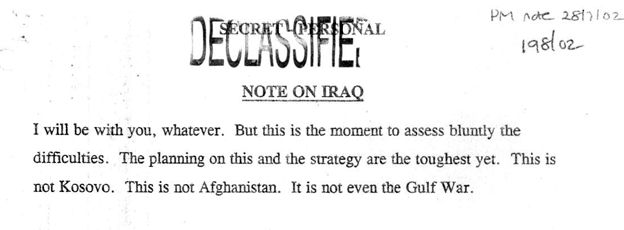
“I will be with you, whatever…
Getting rid of Saddam is the right thing to do. He is a potential threat. He could be contained. But containment as we found with Al Qaida is always risky. His departure would free up the region. And his regime is probably, with the possible exception of North Korea, the most brutal and inhumane in the world.
The first question is: In removing him, do you want/need a coalition? The US could do it alone, with UK support. The danger is, as ever with these things, unintended consequences.
Suppose it got militarily tricky. Suppose Iraq suffered unexpected civilian casualties. Suppose the Arab street finally erupted. Suppose Saddam felt sufficiently politically strong, if militarily weak in conventional terms, to let off WMD [weapons of mass destruction]. suppose that, without any coalition, the Iraqis feel ambivalent about being invaded and real Iraqis, not Saddam’s special guard, decide to offer resistance.
If we win quickly, everyone will be our friend. If we don’t and they haven’t been bound in beforehand, recriminations will start fast.”
This extract comes from the start of a six-page note, marked Secret Personal, to the US president, which was seen only by Number 10 officials before being sent, the report stated.
In another memo Tony Blair told George Bush, on 28 July 2002’Our best ally might be Russia’
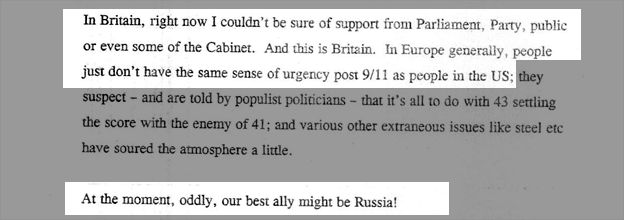 Mr Blair told Mr Bush that if he wanted a wider military coalition he would have to get UN backing, make progress on Middle East peace and engineer a “shift” in public opinion. He acknowledged that there would be “reluctance” in the US about taking the issue to the UN Security Council, but insisted it was the best way to provide them with a legitimate case for military action.
Tony Blair yesterday apologised to the families of those killed in the 2003 Iraq Warr, accepting that they will never “forget or forgive him”.
The former prime minister said he felt sorrow and regret beyond what “people may ever know” at the loss of life.
He accepted intelligence had been wrong and post-war planning had been poor.
But he insisted that he did what he thought was the “right thing” at the time and he still believed Iraq was “better off” without Saddam Hussein.