


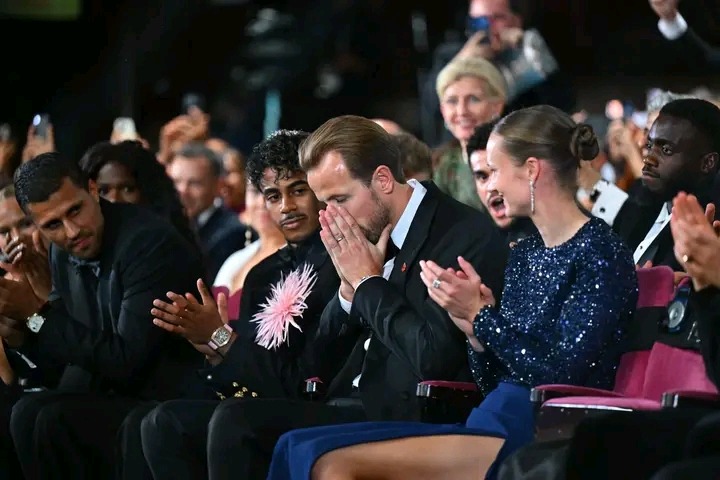
Harry Kane has finally reached the summit of individual football recognition, winning the 2026 Ballon d’Or despite missing out on two of football’s most coveted team achievements, the UEFA Champions League and the FIFA World Cup.
The Bayern Munich striker claimed the prestigious award at the London Palladium on Monday, October 26, ending England’s 25-year wait for another male Ballon d’Or winner following Michael Owen’s triumph in 2001.
His victory has raised an important question among football supporters: how did Kane emerge as the world’s best player when he failed to win the Champions League with Bayern Munich and England fell short of lifting the World Cup?

The answer lies in a remarkable season in which individual excellence, goalscoring consistency and domestic success combined to make an exceptionally strong case for the England captain.
Kane finished the 2025/26 campaign with an astonishing 73 goals and eight assists in 65 appearances for club and country. His performances placed him among the most prolific players in modern football and provided the foundation for his successful Ballon d’Or campaign.
At Bayern Munich, the Englishman scored 61 goals in 51 appearances across competitions, helping the German giants secure the Bundesliga title and the DFB-Pokal. Those achievements demonstrated that his contribution extended beyond individual statistics, with his goals helping Bayern translate attacking superiority into silverware.
However, his campaign was not without disappointment.
Bayern failed to reach the Champions League final after losing 6-5 on aggregate to Paris Saint-Germain in the semi-finals. Kane scored 14 goals in the competition, but his impressive individual return could not prevent the German club from falling short of European glory.
England also failed to win the World Cup, finishing third after their campaign ended in a 2-1 defeat against Argentina in the semi-finals.
For many football supporters, those setbacks appeared to weaken Kane’s chances, particularly in a year when international football’s biggest tournament played a significant role in the award race.
Yet the absence of those trophies did not erase what he accomplished throughout the season.
The Ballon d’Or is an individual award, and its official assessment criteria place individual performances and a player’s decisive influence ahead of collective achievements and trophies. Team success remains important, while sporting conduct and fair play also form part of the evaluation.
That distinction helps explain why Kane’s candidacy remained compelling despite Bayern’s European elimination and England’s failure to win the World Cup.
His greatest argument was the sheer scale of his goalscoring achievement.
Scoring 73 goals in 65 appearances across club and international football is an extraordinary return. Kane consistently delivered throughout the season, demonstrating the ability to influence matches in different competitions rather than relying on one exceptional tournament or a short spell of form.
His productivity also earned him the Gerd Müller Trophy, awarded to the leading goalscorer under the competition’s statistical criteria. Although that prize is separate from the Ballon d’Or, it reinforced the significance of his attacking contribution during the assessment period.
Kane’s domestic achievements strengthened his case further. Winning the Bundesliga and German Cup with Bayern meant that his season was not an individual statistical success without team honours. He contributed heavily to a campaign that delivered major domestic silverware, even though the Champions League remained beyond his reach.
His victory also reflected the importance of consistency over the entire assessment period. Unlike a competition decided by a handful of knockout matches, the Ballon d’Or evaluates performances across the designated season, including domestic leagues, cup competitions and international football.
That gave Kane an opportunity to build his case through months of sustained excellence.
However, the competition was far from straightforward.
Kylian Mbappé finished second after another prolific campaign for Real Madrid and France. His ability to score consistently, including at the World Cup, made him one of Kane’s most serious challengers.
Barcelona’s Lamine Yamal finished third, having combined outstanding individual performances with Spain’s World Cup triumph. The teenage forward’s influence demonstrated that a player could build a powerful Ballon d’Or case through creativity, attacking intelligence and contributions to a successful national team, rather than goals alone.
Both players had compelling arguments, but Kane’s overall production and domestic achievements ultimately proved sufficient to secure the award.
The voting process is another important part of the story.
The men’s Ballon d’Or is decided by an international jury of specialist football journalists, with representatives from the 100 highest-ranked nations in FIFA’s men’s rankings. Each voter ranks 10 nominees, awarding 15 points to their first choice, 12 to their second, 10 to their third and progressively fewer points to the remaining selections.
The player who accumulates the highest total wins.
Voters are instructed to consider individual performances, collective achievements and sporting conduct. They are not required to award the prize automatically to the Champions League winner, the World Cup winner or the player who collects the most team trophies.
That does not mean trophies are irrelevant. Winning major competitions can significantly strengthen a candidate’s case, particularly when several players produce similarly impressive individual performances.
Instead, Kane’s victory illustrates how the different criteria can produce a result that does not necessarily align with the outcome of the biggest team competitions.
It would be inaccurate to claim that every voter chose Kane for the same reason. Without individual ballot explanations, the precise motivation behind each vote cannot be established. Nevertheless, his 73 goals, domestic double and substantial Champions League contribution provide a clear statistical and competitive basis for understanding his triumph.
The achievement is also significant for English football. Kane becomes the first Englishman to win the men’s Ballon d’Or since Owen in 2001, joining a select group that includes Stanley Matthews, Bobby Charlton and Kevin Keegan.
His journey makes the recognition particularly meaningful. For years, Kane established himself as one of the world’s most dependable strikers without winning a major team trophy at Tottenham. His move to Bayern Munich eventually provided the opportunity to combine his extraordinary scoring record with domestic titles.
Now, at 33, he has secured the individual honour that long eluded him.
Ultimately, Kane did not need to win the Champions League or the World Cup to convince the Ballon d’Or jury. He needed to produce a season that stood above those of his rivals when individual performance, decisive influence and collective success were considered together.
His 73 goals supplied the headline statistic. Bayern’s domestic double added the trophies. His sustained performances across competitions completed the argument.
The debate over whether another player deserved the award will continue, as it does almost every year. But Kane’s triumph sends a clear message about how the Ballon d’Or is judged: winning the biggest team competitions can strengthen a player’s candidacy, but individual excellence remains the central consideration.




