NIGERIA – Nigeria’s long and complex journey toward institutional stability has often been influenced by individuals whose leadership defined critical sectors at pivotal moments.
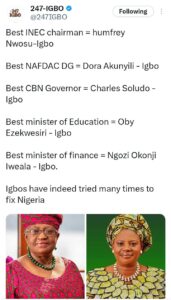
DDM gathered that a resurfaced social media post is drawing attention to the contributions of several Igbo technocrats who once led major national institutions.
The post highlights figures who served in strategic roles, presenting them as some of the most effective leaders in Nigeria’s public sector history.
Among those referenced is Humphrey Nwosu, a former chairman of the Independent National Electoral Commission, widely associated with the historic June 12, 1993 election.

That election is often described as one of the freest and fairest in Nigeria’s history, despite its eventual annulment by the military government.
Nwosu’s tenure is frequently cited in discussions about electoral credibility and the challenges of sustaining democratic reforms in Nigeria.
The post also mentions Dora Akunyili, who led the National Agency for Food and Drug Administration and Control.
Akunyili became a national figure during her campaign against counterfeit drugs, a problem that had previously undermined public health and trust in the pharmaceutical system.
Her reforms strengthened regulatory enforcement and significantly reduced the circulation of fake medications across Nigeria.
Another figure identified is Charles Soludo, who served as governor of the Central Bank of Nigeria.
Soludo is known for banking sector reforms, particularly the consolidation policy that reshaped Nigeria’s financial institutions in the mid-2000s.
The policy increased the capital base of banks and reduced systemic risks, though it also led to mergers and acquisitions that transformed the industry landscape.
The post further references Oby Ezekwesili, who also held positions in the World Bank and Nigeria’s transparency initiatives.
Ezekwesili played a key role in education reform and public sector accountability, becoming a prominent advocate for governance transparency.
Her involvement in the “Bring Back Our Girls” campaign further amplified her voice on issues of leadership and citizen engagement.
Also mentioned is Ngozi Okonjo-Iweala, a globally recognized economist and current Director-General of the World Trade Organization.
Okonjo-Iweala served multiple terms as Nigeria’s finance minister and was instrumental in debt relief negotiations with international creditors.
Her leadership contributed to Nigeria’s exit from the Paris Club debt burden, freeing resources for development priorities.
The social media commentary concludes by suggesting that Igbo professionals have repeatedly contributed to efforts aimed at stabilizing and improving Nigeria’s governance structures.
This claim reflects a broader national conversation about merit, regional representation, and the role of technocrats in public service.
Historically, Nigeria’s federal character principle has sought to balance representation across its diverse ethnic and regional groups.
However, debates persist about whether competence or geopolitical considerations should take precedence in appointments to critical national positions.
Experts note that while individual achievements are important, institutional success often depends on broader political support and continuity of reforms.
Analysts also caution against framing national progress solely along ethnic lines, emphasizing that contributions to governance come from all parts of the country.
Nonetheless, the highlighted figures remain widely respected for their roles in shaping policy, strengthening institutions, and influencing public discourse.
Their legacies continue to serve as reference points in discussions about leadership quality and national development.
As Nigeria navigates ongoing political and economic challenges, the performance of past public officials remains a benchmark for evaluating current and future leaders.
The renewed attention to these individuals underscores the enduring impact of technocratic leadership in a country still striving to consolidate democratic and institutional gains.