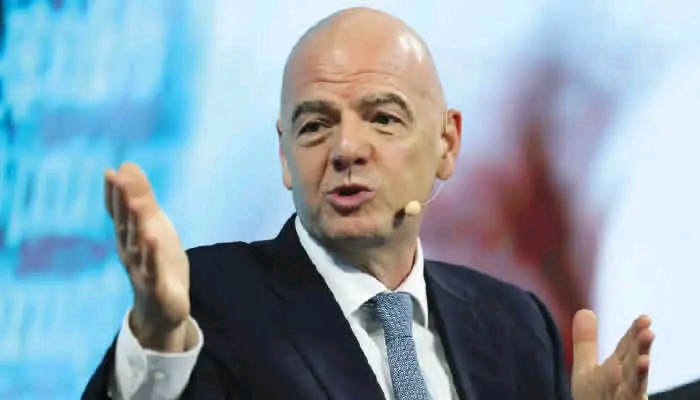
Gianni Infantino is facing renewed scrutiny over his eligibility to seek a fourth term as FIFA president, following growing concerns about the interpretation of the governing body’s presidential term-limit regulations.
The controversy has intensified after the English Football Association (FA) considered taking legal action to challenge Infantino’s eligibility ahead of the FIFA presidential election scheduled for March 2027 in Morocco.
However, the FA has decided against pursuing the legal challenge, arguing that such an attempt would be unlikely to succeed under FIFA’s existing governance procedures.
The debate centres on FIFA’s regulation limiting its president to a maximum of three terms in office. Infantino, who first assumed the presidency in 2016 following the resignation of Sepp Blatter, is seeking another four-year mandate that would keep him in charge until 2031.
Under the current interpretation of the rules, his initial period between 2016 and 2019 does not count towards the three-term limit.
FIFA’s Council reached that decision in 2022, arguing that Infantino’s first spell was the completion of Blatter’s interrupted mandate rather than a full presidential term.
The ruling effectively cleared the Swiss administrator to seek another term, but it has continued to attract criticism from governance campaigners who believe the interpretation undermines the purpose of presidential term limits.
Human rights organisation FairSquare has been particularly vocal in challenging the decision. The group urged the FA to ask FIFA’s governance committee to review Infantino’s eligibility, arguing that the regulations do not provide an exemption for shortened presidential terms.
FA chair Debbie Hewitt confirmed that the organisation had examined the possibility of challenging the decision but concluded that the process would not produce the desired outcome.
Hewitt explained that FIFA had followed its internal governance procedures before deciding to exclude Infantino’s initial period from the calculation of his presidential terms.
However, FairSquare has criticised the FA’s decision not to proceed, warning that abandoning the challenge could weaken efforts to promote accountability and transparency within world football’s governing body.
The organisation also encouraged the English FA to maintain pressure on FIFA and seek further explanations regarding the 2022 ruling.
Former FIFA governance committee chairman Miguel Maduro has also questioned the decision, suggesting that a national football association or confederation could take the matter to the Court of Arbitration for Sport (CAS) to establish whether Infantino is eligible to stand again.
The controversy comes amid wider disagreements between FIFA and European football authorities over Infantino’s leadership.
UEFA previously withdrew its confidence in the FIFA president following disagreements over his proposed FIFA Forward Enterprise project, which involved attracting private investment into the commercial operations of the World Cup and other FIFA competitions.
The proposal generated concerns among European football associations, particularly regarding transparency, accountability and the potential implications of bringing private investors into FIFA’s commercial structure.
UEFA has subsequently backed French Football Federation president Philippe Diallo as its preferred candidate to challenge Infantino in the upcoming election.
FIFA has also confirmed that Japan’s Kozo Tashima will contest the presidency, making the 2027 election Infantino’s first contested re-election battle since 2023.
Despite the growing opposition, Infantino remains a strong contender, having maintained considerable support among football associations across different confederations.
FIFA has previously defended its 2022 interpretation, maintaining that the Council unanimously agreed that Infantino’s initial 2016–2019 period should not count towards his presidential term limit.
The latest controversy has therefore reopened an important debate about leadership accountability, institutional transparency and the effectiveness of term limits within international football administration.
With the presidential election approaching, questions surrounding Infantino’s eligibility could remain a major talking point as football authorities prepare to decide who will lead the organisation for the next four years.
FIFA has been approached for further comment on the latest development.