
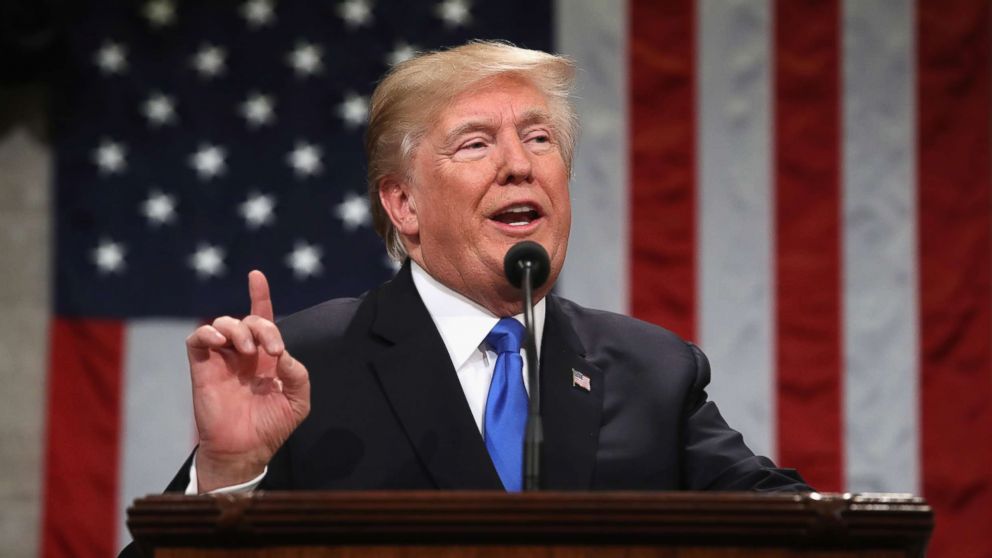
DDM NEWS brings you an exclusive, in-depth account of President Donald Trump’s first State of the Union address of his second term, delivered Tuesday night at the US Capitol in a speech that blended political brinkmanship, theatrical moments, partisan confrontation and strategic omissions, all unfolding against the backdrop of mounting legal, economic and foreign policy pressures facing his administration. Clocking in at nearly one hour and forty-seven minutes, the address shattered the previous record for length set by Trump himself during his earlier speech to Congress, underscoring a presidency once again defined by spectacle as much as substance.
The address came at a tense political moment. Only days earlier, the United States Supreme Court had struck down Trump’s sweeping global tariffs, a major blow to one of his signature economic policies. At the same time, his administration was weighing the possibility of further military strikes on Iran following earlier operations targeting Tehran’s nuclear infrastructure, while domestic polling suggested that his political standing had slipped to some of the lowest levels of either of his terms. Against this backdrop, DDM NEWS observed that Trump’s speech appeared carefully calibrated to reframe the national conversation ahead of the 2026 midterm elections, rally his base, and provoke sharp contrasts with Democrats seated before him in the House chamber.
From the opening moments, immigration returned to centre stage as Trump sought to revive one of his most reliable campaign themes. He invoked grieving parents he referred to as “angel moms,” whose children had been victims of crimes involving undocumented immigrants, and framed the coming election as a stark choice between what he called border security under Republicans and “open borders” under Democrats. Trump told lawmakers and the nation that many Democrats in the chamber had not only allowed what he described as a “border invasion” to happen in the past but would repeat it if given the chance. In a moment of deliberate provocation, he urged members of Congress to stand and applaud if they agreed that the first duty of government was to protect American citizens rather than undocumented migrants. Republicans rose in unison, clapping for an extended period, while Democrats remained seated in visible defiance. The president then scolded his opponents for not standing, prompting shouted responses from Democratic lawmakers Rashida Tlaib and Ilhan Omar, despite party leaders having urged restraint to avoid turning the address into a spectacle. DDM NEWS notes that while immigration no longer dominates public opinion for Trump as strongly as in 2016, polling still suggests Republicans retain an advantage over Democrats on the issue, even as concerns grow about aggressive enforcement actions by federal agencies in cities such as Minneapolis.
On the economy, Trump struck a notably different tone regarding tariffs after the Supreme Court’s ruling. He avoided repeating his recent public attack on the justices and instead insisted that he retained sufficient executive authority to maintain leverage in trade negotiations, a claim many legal experts dispute. In a striking admission, Trump told lawmakers that Congress need not bother codifying his tariffs into law, even though the Constitution grants Congress the power to levy tariffs. DDM NEWS analysts interpreted this as a tacit acknowledgment of the political discomfort tariffs have caused within Republican ranks and the legal uncertainty surrounding his authority to impose them unilaterally. Trump nevertheless made an audacious prediction, claiming that tariffs paid by foreign countries could one day substantially replace income taxes for Americans, harking back to the early years of the United States when tariffs were a primary source of federal revenue. Economists and historians have long argued that such a shift would be unrealistic in the modern global economy, but the claim played well with supporters who view tariffs as a tool for economic nationalism.

The night was punctuated by multiple protests from Democratic lawmakers, turning the chamber into a stage for partisan drama. Early in the speech, Representative Al Green was escorted out after holding up a sign behind the president reading “Black people aren’t apes,” a pointed reference to a racist video Trump had recently shared and later deleted. Green had been censured for a similar outburst during Trump’s previous address to Congress. Other lawmakers shouted interruptions, including calls for Trump to release more files related to the late financier Jeffrey Epstein, while another lawmaker echoed the famous “You lie!” outburst once directed at President Barack Obama. Several Democrats staged a quiet protest by walking out of the chamber mid-speech, signaling their refusal to lend legitimacy to what they described as a performance rather than a policy address.
Showmanship, as always, was central to Trump’s approach. DDM NEWS observed that he devoted an extended portion of the early speech to celebrating the gold medal-winning US men’s Olympic hockey team, with most of the players present in the gallery. Trump announced that he would award goaltender Connor Hellebuyck the Presidential Medal of Freedom, reprising his long-standing campaign line about winning so much that people would grow tired of it. He repeatedly pointed to whether Democrats joined Republicans in standing ovations, joking that it was the first time he had ever seen them rise when many applauded the athletes. The night also featured a cascade of honours, including the awarding of the Legion of Merit and two Medals of Honor, one to 100-year-old Korean War veteran Royce Williams and another to Chief Warrant Officer 5 Eric Slover for his role in a Trump-ordered mission targeting Venezuela’s leadership. A carefully staged family reunion for Enrique Márquez, described as a political prisoner of the Maduro regime, added a human-interest moment designed to reinforce Trump’s hardline stance on Venezuela.
Equally notable were the issues Trump chose to sidestep. Despite sharp criticism of Democrats over the shutdown of the Department of Homeland Security, he avoided mentioning the specific controversy that had fueled Democratic resistance, namely the killing of two US citizens, Renee Nicole Good and Alex Pretti, by immigration agents in Minneapolis. He barely mentioned the embattled US Immigration and Customs Enforcement agency and offered little detail on the scope of his deportation efforts. Trump also steered clear of discussing the Epstein files, despite his administration’s claims of transparency following their release under congressional pressure. Most strikingly, DDM NEWS noted the absence of a sustained focus on economic affordability and cost-of-living pressures, issues that continue to weigh heavily on voters and represent a key vulnerability for Republicans heading into the midterms.
On foreign policy, Trump made one of his clearest public cases yet for the possibility of renewed military action against Iran. Eight months after authorizing strikes on Iranian nuclear facilities, he warned that further action remained on the table if Tehran failed to reach an agreement with Washington. Trump cited attacks by Iranian proxies that he said had killed and maimed thousands of American service members with roadside bombs, as well as the alleged killing of tens of thousands of protesters by the Iranian regime. Most notably, he focused on Iran’s nuclear ambitions, attempting to reconcile his earlier claim that he had “obliterated” Iran’s nuclear program with the current reality that further strikes were being considered. DDM NEWS analysts viewed this as an attempt to build public support for a potential escalation while maintaining his long-standing narrative of strength and decisive action.
By the end of the marathon address, it was clear that Trump’s second-term State of the Union was less about detailed policy prescriptions and more about shaping the political battlefield ahead. Through immigration rhetoric, tariff bravado, choreographed moments of patriotism, and pointed provocations toward Democrats, Trump sought to dominate the national conversation and reassert control over a narrative that has increasingly slipped from his grasp.