

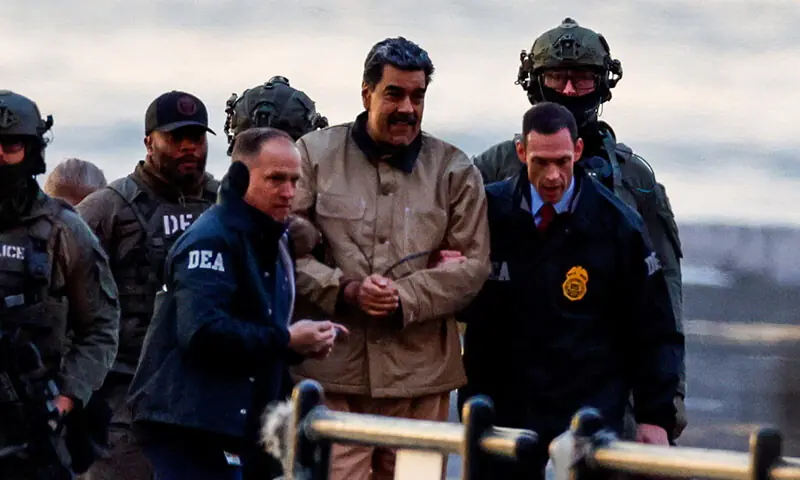


Deposed Venezuelan President Nicolás Maduro has pleaded not guilty to charges of narco-terrorism in a United States federal court, days after his dramatic arrest by American forces in Caracas. Maduro, 63, appeared before a federal judge in Manhattan on Monday, where he told the court that he had been “kidnapped” from Venezuela during a US military operation carried out in the early hours of Saturday. According to US media reports, the former leader insisted on his innocence and maintained that he remains Venezuela’s legitimate president. “I’m innocent. I’m not guilty. I’m still the president of my country,” Maduro was quoted as telling the court. His wife, Cilia Flores, who was captured alongside him during the operation, also entered a plea of not guilty. The arrest followed a coordinated US raid involving special forces, warplanes and naval assets, marking one of the most controversial foreign interventions in recent years. The operation effectively ended Maduro’s rule, which began in 2013 following the death of socialist leader Hugo Chávez. In the aftermath of the capture, US President Donald Trump made a series of startling declarations, stating that the United States was now “running” Venezuela, with plans to rebuild and take control of the country’s vast but deteriorated oil sector. His remarks have triggered sharp reactions across Latin America and beyond. At an emergency meeting of the United Nations Security Council, UN Secretary-General António Guterres warned against violations of international law, stressing the need to respect national sovereignty, political independence and territorial integrity. Mexico’s President Claudia Sheinbaum condemned the US action, saying the Americas “do not belong to anyone,” while Colombia’s President Gustavo Petro issued a fiery response, declaring he was prepared to resist what he described as imperial overreach. Maduro’s removal brings an abrupt end to more than two decades of left-wing rule in Venezuela, leaving the country’s nearly 30 million citizens facing deep uncertainty. Supporters of the former leader have staged demonstrations in Caracas, with crowds waving Venezuelan flags and chanting slogans in his defence. Members of the National Assembly also voiced support, chanting pro-Maduro slogans during parliamentary proceedings. Despite this, the Trump administration has signalled it prefers continuity within Venezuela’s existing power structure, provided remaining officials comply with Washington’s demands. Interim President Delcy Rodríguez, Maduro’s former vice president, softened her initial defiant stance on Sunday, indicating a willingness to cooperate with the United States. Trump has openly stated that access to Venezuela’s oil resources remains central to Washington’s objectives. “We need total access,” he said, referring to oil and other strategic assets needed to rebuild the country. Venezuela holds the world’s largest proven oil reserves, though years of sanctions, corruption and poor management have left its energy infrastructure severely degraded. Following Trump’s comments, shares of major US oil companies surged on Wall Street. International reaction remains divided. While China, Cuba and several regional allies have condemned the US operation, some Venezuelans in the diaspora have welcomed Maduro’s downfall. Protests were also held outside the New York courthouse, with activists denouncing US intervention and warning it would deepen global instability. As legal proceedings begin and geopolitical tensions rise, the fate of Venezuela and the precedent set by Maduro’s capture continues to reverberate across the international community.