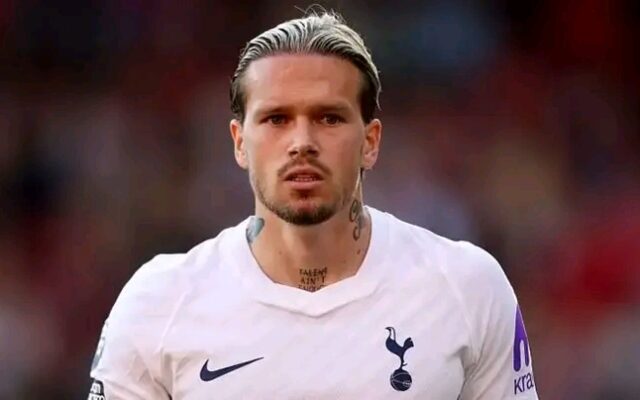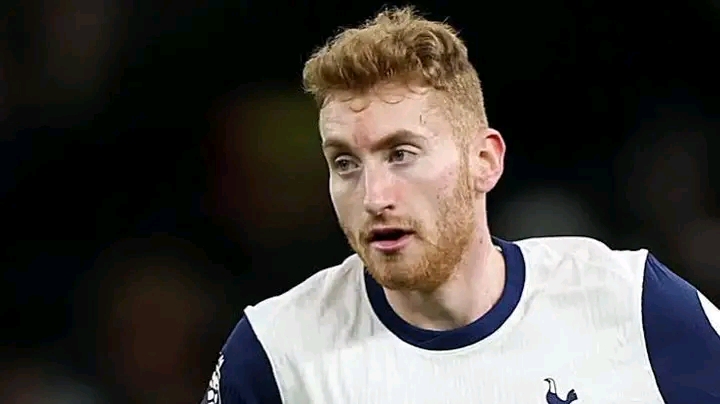
Tottenham Hotspur winger Dejan Kulusevski has opened up about the emotional and physical challenges of his lengthy injury battle, admitting that he came close to giving up football after spending 18 months away from competitive action.
The 26-year-old Sweden international revealed that the prolonged recovery from a serious knee injury left him questioning whether he would ever return to the pitch, forcing him to consider life beyond professional football.
In an emotional interview with BBC Sport, Kulusevski disclosed that he reached a point where he told his mother he no longer believed he could continue playing.
“I told my mother. I sat with her and I told her: ‘Listen, I don’t think I can play any more,’” he recalled.
The former Juventus midfielder suffered the injury on May 11, 2025, during Tottenham’s Premier League encounter against Crystal Palace. What initially appeared to be an injury that would keep him out for only a few months eventually developed into a complicated 18-month ordeal.
His recovery involved multiple operations and repeated setbacks, keeping him out for the entire 2025/26 campaign and ruling him out of the 2026 FIFA World Cup with Sweden.
Beyond the physical pain, Kulusevski admitted that watching his teammates enjoy some of the biggest moments in the club’s recent history while he remained sidelined was among the most difficult experiences of his career.
One particularly painful moment came when Tottenham defeated Manchester United to win the Europa League in Bilbao in May 2025.
While his teammates celebrated the European triumph, Kulusevski could only watch from the sidelines, making the journey to witness the final on crutches.
“That was one of the hardest days of my life,” he said.
“It was so beautiful to see all the people happy, but for me I was going there with crutches. I couldn’t work.”
The Swedish international revealed that his injury was so restrictive that he could not even climb the platform to collect his winner’s medal because of the slippery surface.
He also described the loneliness of watching his teammates celebrate together while he struggled with his rehabilitation.
“Seeing the team celebrating on the bus outside Tottenham Hotspur Stadium was probably one of the most difficult parts of this journey because you feel so alone,” he explained.
“You feel like the whole world has forgotten about you and what you put in.”
Kulusevski’s recovery became increasingly complicated as conventional treatment options failed to produce the expected progress. The midfielder disclosed that he was even offered a knee transplant as a possible solution, an option he ultimately rejected.
The uncertainty surrounding his fitness also affected his international ambitions. Having hoped to recover in time for the 2026 World Cup, he was left devastated when Sweden manager Graham Potter informed him that he would not be available for the tournament.
Recalling his reaction to the news, Kulusevski said he was so disappointed that he stared at the wall for three hours.
“I just stared at the wall for three hours because I really believed I would do it,” he said.
His wife, Eldina Ahmic, also spoke about the difficulties of watching him endure such a challenging period, particularly as he missed Tottenham’s European success and every Premier League match during the following season.
However, after months of uncertainty, setbacks and intensive rehabilitation, the winger finally made his long-awaited return.
Kulusevski made his first competitive appearance in 526 days on October 19, 2026, coming off the bench in Tottenham’s 3-1 victory over Coventry City.
His return was an emotional moment for both the player and supporters, who had waited more than a year to see him back in action.
He has also returned to the Sweden national team, offering further encouragement that his difficult chapter may finally be behind him.
The comeback has not yet marked a complete return to his previous level, as Tottenham continue to manage his workload while he rebuilds match fitness.
For a player who once feared his career was over at just 26, however, simply being back on the pitch represents a significant personal victory.
Kulusevski’s experience also highlights the often-overlooked psychological consequences of serious injuries in professional football. While attention is usually focused on surgery, rehabilitation and physical recovery, the isolation, uncertainty and emotional pressure can be equally difficult for players.
After 18 months of uncertainty, the Tottenham winger now has an opportunity to rebuild his career and rediscover the form that made him one of the club’s most important attacking players.