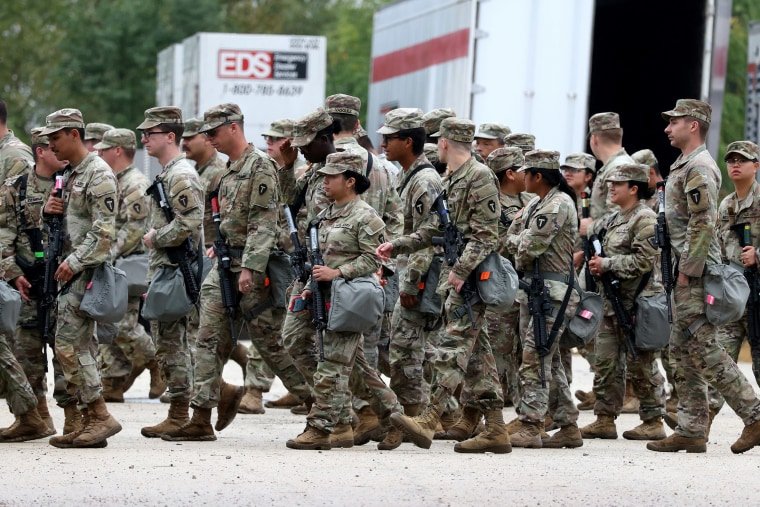
The US Supreme Court has halted the deployment of the National Guard by President Donald Trump in Chicago in order to shield Immigration and Customs Enforcement (ICE) agents, handing the Trump administration its most significant defeat so far this year.
In an unsigned order that was released on Tuesday, the Court stated that “the federal government has not presented any constitutional basis to justify the use of the military to enforce federal laws in Illinois.” However, this ruling happened despite the opposition of judges Samuel Alito, Clarence Thomas, and Neil Gorsuch.
“But at the present stage, the government has failed to point to a source of authority sufficient to empower the military to carry out the laws within the state of Illinois,” the court explained.
Legal experts explain the impact of the ruling may have in other United States cities. Steve Vladeck, a CNN Supreme Court Analyst, calls the ruling “by far the most significant defeat the Supreme Court has handed Trump all year.”

The Trump administration had based its action on a 1908 federal law that permits the activation of the National Guard by the president when the “regular forces” are not sufficient to carry out the execution of the law.
Nonetheless, the court clarified that “regular forces” may refer to the standing army but not the civilian agencies, such as ICE, responsible for the execution of the law.
Justice Brett Kavanaugh, although aligning with the majority ruling, expressed concern that the ruling could end up creating unforeseen consequences during future emergencies because of how much leeway the Supreme Court has decided to give to the presidency in matters of emergency response.
The Illinois Attorney General Kwame Raoul expressed his appreciation for the decision, stating that it established that the legal standard required in order for the deployment of the Guard to override the state’s objection is not met.
The dissenting judge, Alito, had argued that the president had the constitutional power to safeguard his officers and property, as this case could endanger the lives of federal officials.
The judge felt that the Supreme Court was questioning the judgment of the president in assessing how threatened the employees of ICE are.
This comes after months of legal disputes after Trump mobilized a large number of National Guard personnel from the states of Illinois and Texas as a measure to quell protests near ICE facilities within the city of Chicago.
This was after lower courts blocked them from operational deployment, fearing the use of peaceful protests as riots.
Even though tensions in Chicago have now been alleviated, the government insisted that the deployment of guards was justified because of attacks carried out against members of federal law enforcement.
The Supreme Court ruling does give President Trump very limited alternatives, although he still has recourse to using Insurrection Act.
The case is a significant trial of the power of the president in matters of the use of the military inside the country and upholds the long established prohibition of the use of the military in civilian law enforcement efforts.
CNN.