
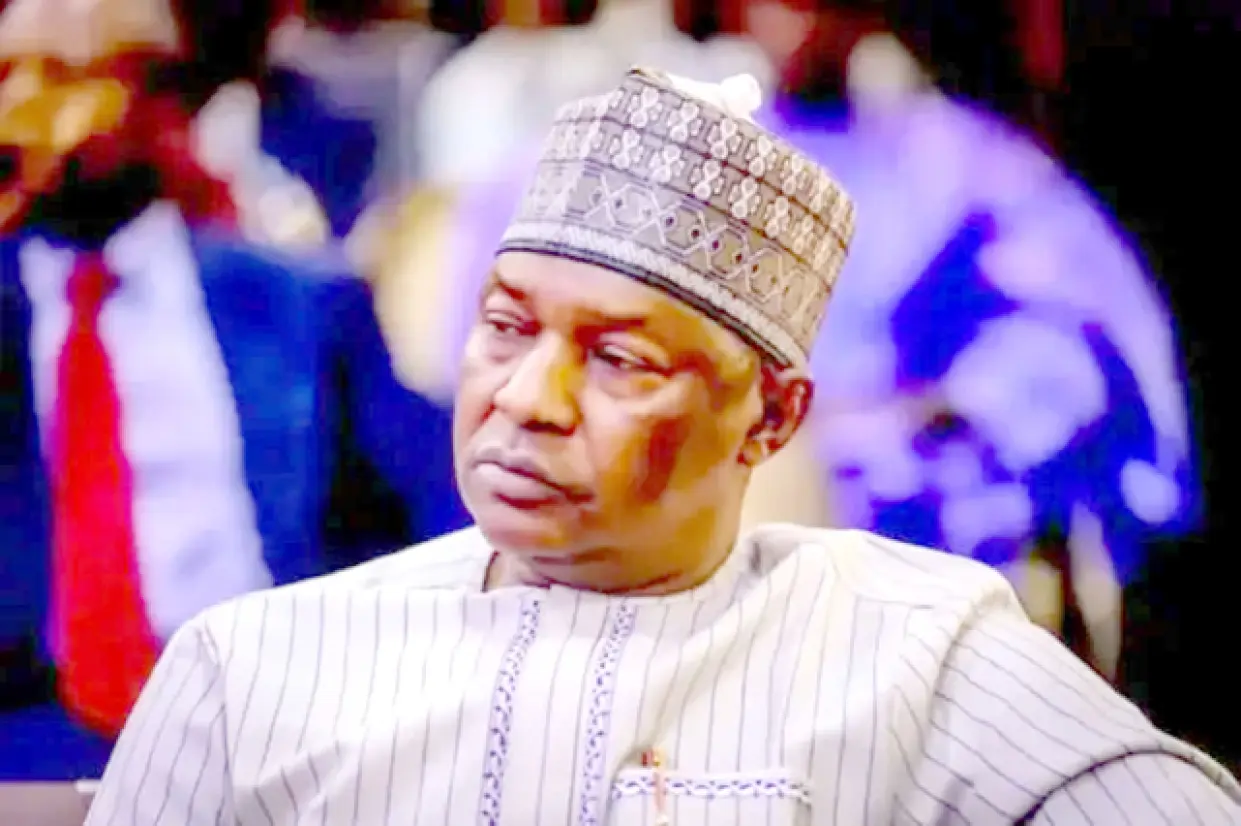
Former Attorney-General of the Federation and Minister of Justice, Abubakar Malami (SAN), has pushed back strongly against the interim forfeiture of dozens of properties linked to him and members of his family, insisting before a Federal High Court in Abuja that his wealth was acquired through legitimate means, including salaries, allowances, business income and gifts from personal associates. The unfolding legal battle, now drawing intense public scrutiny, has reignited debate over the legality and ethics of public officers receiving large monetary gifts while in service.
DDM NEWS reports that Malami, through his legal team led by senior advocate Joseph Daudu, filed a motion challenging the interim forfeiture order granted in favour of the Economic and Financial Crimes Commission (EFCC). The order, issued on January 6 by Justice Emeka Nwite, directed the temporary forfeiture of 57 properties allegedly suspected to be proceeds of unlawful activities. The assets were said to be linked to Malami and two of his sons, Abdulaziz Malami and Abiru Rahman Malami.
In granting the ex parte application filed by the EFCC, the court held that the properties were reasonably suspected to have been acquired with proceeds of unlawful activities and therefore ordered their interim forfeiture to the Federal Government. Justice Nwite also directed the anti-graft agency to publish the forfeiture order in a national newspaper, inviting interested parties to appear within 14 days to show cause why the assets should not be permanently forfeited.
However, in a swift response, Malami approached the court with a motion on notice, alleging that the EFCC secured the interim order through suppression of material facts and misrepresentation. According to DDM NEWS, the former AGF argued that the action violated his constitutional rights to property, presumption of innocence, and family life, and warned that allowing the forfeiture proceedings to continue could result in duplicative litigation and conflicting judicial outcomes.
The application, marked FHC/ABJ/CS/20/2026 and filed on January 27, specifically targets the forfeiture of three properties listed as numbers 9, 18 and 48 in the EFCC’s application. These include Plot 157 on Lamido Crescent, Nasarawa GRA, Kano, purchased on July 31, 2019; a five-bedroom duplex with boys’ quarters at No. 12 Yalinga Street, off Adetokunbo Ademola Crescent, Wuse II, Abuja, acquired in October 2018 for ₦150 million; and the ADC Kadi Malami Foundation Building, reportedly purchased for ₦56 million.

Malami is asking the court to set aside the interim forfeiture order as it affects the three properties and to restrain the EFCC from interfering with his ownership, possession and control of them. He further contends that one of the properties is held in trust for the estate of his late father, the late Kadi Malami, and therefore cannot be linked to any alleged unlawful activity.
In a detailed 14-ground argument, Daudu told the court that the EFCC failed to place any prima facie evidence before it to establish that the properties were proceeds of crime or connected to any specific offence. He noted that Malami had duly declared the assets listed as numbers 9 and 18 in his asset declaration forms submitted to the Code of Conduct Bureau (CCB) in both 2019 and 2023, while property number 48 was clearly indicated as a trust asset.
“These assets, their value and their root of title have been clearly stated and specifically demonstrated in the various asset declaration forms spanning from 2019 to 2023,” Daudu stated, according to documents sighted by DDM NEWS.
The senior lawyer went further to outline Malami’s declared sources of income, insisting that they were substantial enough to justify the acquisition of the properties in question. According to him, the former AGF disclosed earnings amounting to ₦374,630,900 from salaries, estacodes, severance allowances and related entitlements. He also listed sitting allowances received from Malami’s participation in various statutory bodies, including the Federal Judicial Service Commission, the Federal Capital Territory Judicial Service Commission, the Legal Practitioners Privileges Committee, and a high-powered presidential committee.
Other declared income streams include ₦574,073,000 from the disposal of assets, ₦10.017 billion as turnover from business ventures, ₦2.522 billion as loans extended to businesses, and ₦958 million described as traditional gifts from personal friends. Daudu further disclosed that Malami realised ₦509,880,000 from the public launch and presentation of his book titled “Contemporary Issues on Nigerian Law and Practice, Thorny Terrains in Traversing the Nigerian Justice Sector: My Travails and Triumphs.”
“These streams of income, and the continuing profits generated from the businesses over the years, sufficiently show that the properties sought to be forfeited were acquired through legitimate and lawful means,” Daudu argued, adding that the interim forfeiture order was obtained through misrepresentation.
Despite the heavy legal submissions, DDM NEWS observed that the matter could not proceed on the scheduled date, as it was not listed on the court’s cause list. The case had been handled during the court’s vacation, and the presiding judge, having concluded vacation matters, returned the file to the Chief Judge for reassignment. Several lawyers were also present in court, having filed processes on behalf of different clients seeking to halt the final forfeiture proceedings.
Beyond the courtroom, the controversy has sparked widespread legal and civil society reactions, particularly over Malami’s claim of receiving nearly ₦1 billion as gifts while serving as a public officer. Legal practitioners have pointed out that Nigerian law places strict limits on gifts received by public officials.
A former Chairman of the Nigerian Bar Association (NBA), Garki Branch, Obioma Ezenwobodo Esq, told DDM NEWS that there are clear laws prohibiting public officers from accepting gifts that could influence their official duties or create conflicts of interest. He warned that if prosecutors establish such links, Malami could face significant legal challenges.
Similarly, lawyer Nnamdi Ahaaiwe Esq cited the Fifth Schedule of the 1999 Constitution, which prohibits public officers from accepting benefits on account of actions taken in the course of duty, except within narrow and clearly defined exceptions. He also referenced provisions of the Corrupt Practices and Other Related Offences Act, which criminalise the corrupt acceptance of gifts or gratification, with penalties ranging from five to seven years imprisonment.
Civil society groups have also weighed in. The Executive Director of the Civil Society Legislative Advocacy Centre (CISLAC), Auwal Rafsanjani, described gifts received by public servants in the course of duty as a form of corruption and called for a clear cap on allowable gifts. In Kano, activist Comrade Akibu Hamisu described Malami’s claims as an attempt to legitimise alleged illicit enrichment, questioning how such figures could align with Nigeria’s official remuneration structure.
DDM NEWS notes that according to the Revenue Mobilisation Allocation and Fiscal Commission (RMAFC), ministers earn about ₦7.8 million annually, including allowances, a figure that stands in stark contrast to the sums now being debated in court. As the legal battle unfolds, observers say the case could set an important precedent for asset forfeiture, public accountability, and the interpretation of Nigeria’s anti-corruption laws.